Winterthur Institute of Health Economics, Zurich University of Applied Sciences, Gertrudstrasse 15, CH-8401 Winterthur, Switzerland.
BMC Public Health. 2013 Dec 11;13:1167. doi: 10.1186/1471-2458-13-1167.
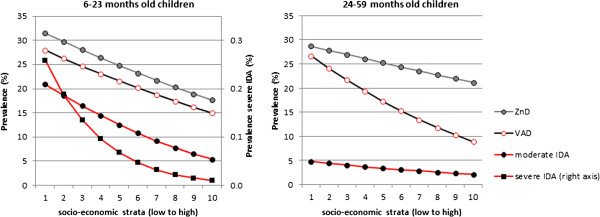
Micronutrient deficiencies (MNDs) are a chronic lack of vitamins and minerals and constitute a huge public health problem. MNDs have severe health consequences and are particularly harmful during early childhood due to their impact on the physical and cognitive development. We estimate the costs of illness due to iron deficiency (IDA), vitamin A deficiency (VAD) and zinc deficiency (ZnD) in 2 age groups (6-23 and 24-59 months) of Filipino children by socio-economic strata in 2008.
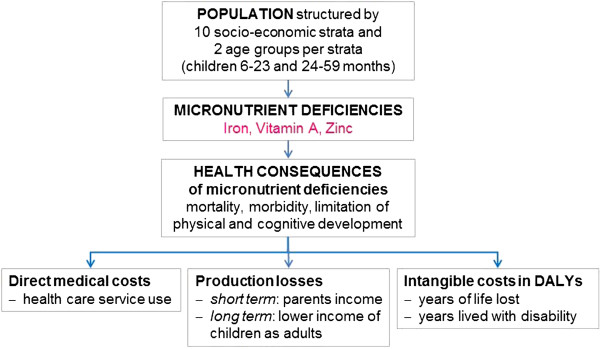
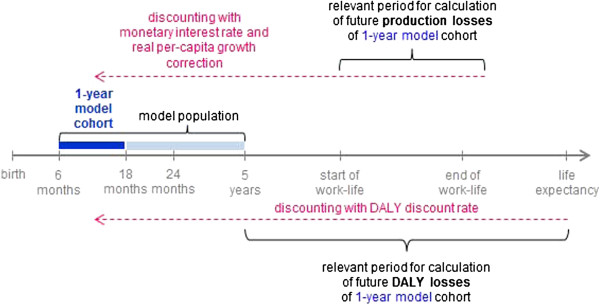
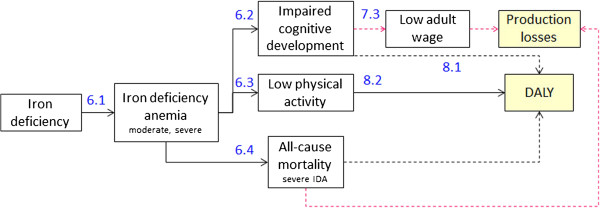
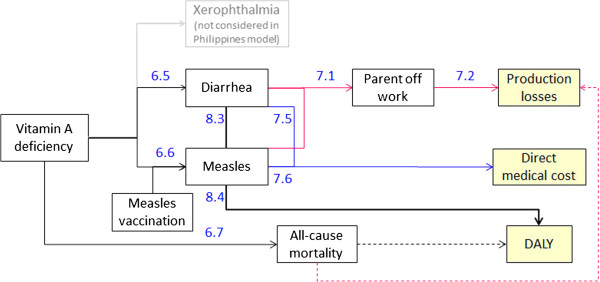
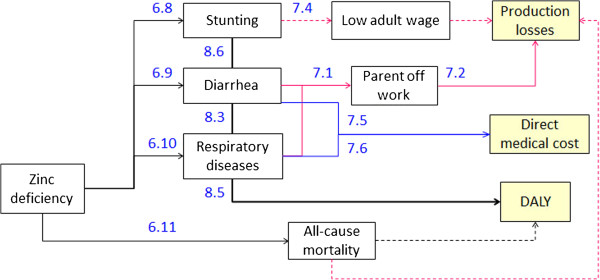
We build a health economic model simulating the consequences of MNDs in childhood over the entire lifetime. The model is based on a health survey and a nutrition survey carried out in 2008. The sample populations are first structured into 10 socio-economic strata (SES) and 2 age groups. Health consequences of MNDs are modelled based on information extracted from literature. Direct medical costs, production losses and intangible costs are computed and long term costs are discounted to present value.
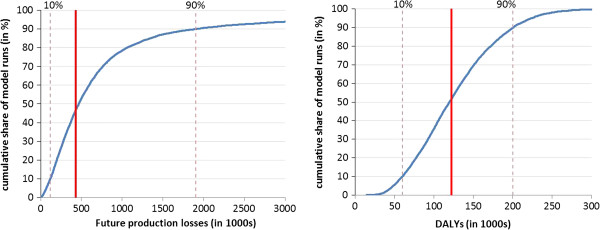
Total lifetime costs of IDA, VAD and ZnD amounted to direct medical costs of 30 million dollars, production losses of 618 million dollars and intangible costs of 122,138 disability adjusted life years (DALYs). These costs can be interpreted as the lifetime costs of a 1-year cohort affected by MNDs between the age of 6-59 months. Direct medical costs are dominated by costs due to ZnD (89% of total), production losses by losses in future lifetime (90% of total) and intangible costs by premature death (47% of total DALY losses) and losses in future lifetime (43%). Costs of MNDs differ considerably between SES as costs in the poorest third of the households are 5 times higher than in the wealthiest third.
MNDs lead to substantial costs in 6-59-month-old children in the Philippines. Costs are highly concentrated in the lower SES and in children 6-23 months old. These results may have important implications for the design, evaluation and choice of the most effective and cost-effective policies aimed at the reduction of MNDs.
微量营养素缺乏症(MND)是指维生素和矿物质的慢性缺乏,构成了一个巨大的公共卫生问题。MND 会对健康造成严重影响,尤其是在儿童早期,因为它们会对身体和认知发育产生影响。我们估计了 2008 年菲律宾儿童两个年龄组(6-23 个月和 24-59 个月)因铁缺乏症(IDA)、维生素 A 缺乏症(VAD)和锌缺乏症(ZnD)导致的疾病经济成本,按社会经济阶层进行划分。
我们构建了一个健康经济模型,模拟儿童时期 MND 对整个生命周期的影响。该模型基于 2008 年进行的一项健康调查和一项营养调查。首先将样本人群分为 10 个社会经济阶层(SES)和 2 个年龄组。MND 的健康后果是根据文献中的信息建模的。计算直接医疗成本、生产损失和无形成本,并将长期成本贴现至现值。
IDA、VAD 和 ZnD 的终身总成本为直接医疗成本 3000 万美元、生产损失 6.18 亿美元和 122138 残疾调整生命年(DALY)的无形成本。这些成本可以解释为 6-59 个月大的受 MND 影响的 1 年队列的终身成本。直接医疗成本主要由 ZnD 引起的成本(占总成本的 89%),生产损失主要由未来生命的损失(占总成本的 90%)和无形成本主要由过早死亡(占总 DALY 损失的 47%)和未来生命的损失(占总 DALY 损失的 43%)引起。MND 成本在 SES 之间存在很大差异,最贫困三分之一家庭的成本是最富裕三分之一家庭的 5 倍。
MND 给菲律宾 6-59 个月大的儿童造成了巨大的成本。成本高度集中在较低的 SES 和 6-23 个月大的儿童中。这些结果可能对旨在减少 MND 的政策的设计、评估和选择具有重要意义,这些政策应是最有效和最具成本效益的。