1 Sunovion Pharmaceuticals Inc., Marlborough, Massachusetts, USA.
2 Data Power (DP) Inc., Flemington, New Jersey, USA.
CNS Spectr. 2014 Apr;19(2):197-205. doi: 10.1017/S1092852913000904. Epub 2013 Dec 13.
The aim of this analysis was to compare the effects of 2 atypical antipsychotic agents, lurasidone (80 mg/d or 160 mg/d) and quetiapine XR (600 mg/d), on daytime alertness, and to evaluate the effects of daytime sleepiness on treatment outcomes in patients with an acute exacerbation of schizophrenia.
Patients who met Diagnostic and Statistical Manual of Mental Disorders, 4th edition, text revision (DSM-IV-TR) criteria for schizophrenia were randomized to 6 weeks of double-blind treatment with fixed doses of lurasidone 80 mg/d (n = 125), lurasidone 160 mg/d (n = 121), quetiapine XR 600 mg/d (n = 119), or placebo (n = 121), all dosed once daily in the evening, with food. Daytime sleepiness was assessed using the Epworth Sleepiness Scale (ESS).
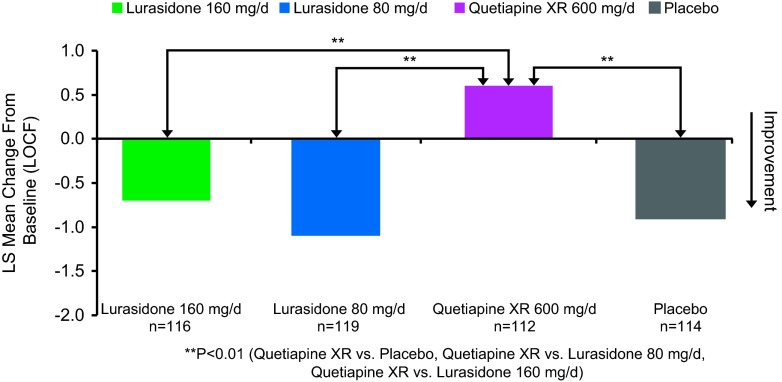
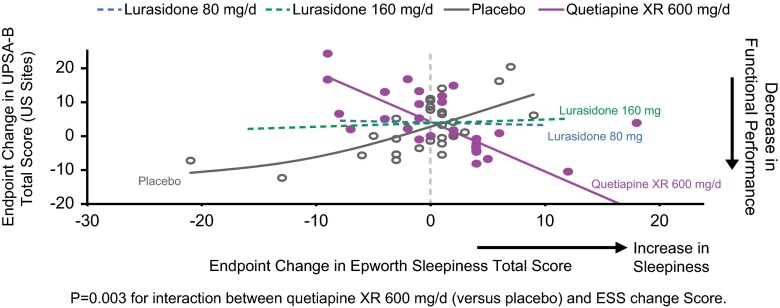
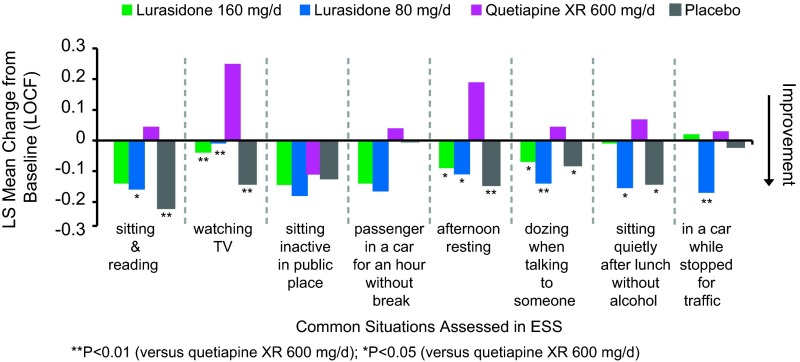
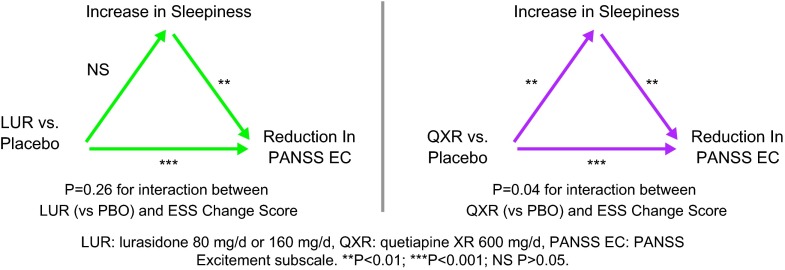
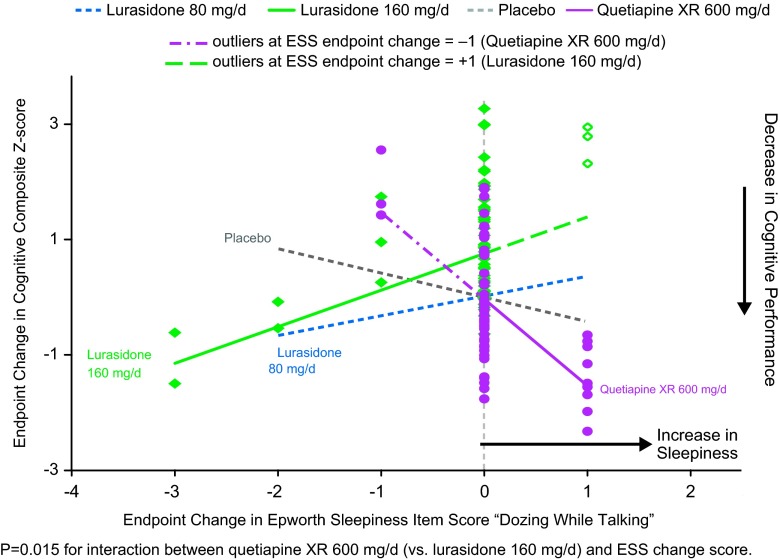
Daytime sleepiness improved in the lurasidone and placebo-treated groups but worsened in the quetiapine XR treatment group when compared to placebo (p = 0.001) and to either dose of lurasidone (both p < 0.01). Sedation associated with quetiapine XR treatment mediated an improvement in agitation [assessed by the Positive and Negative Syndrome Scale-Excitement (PANSS-EC) subscale] and a worsening in functional capacity [assessed by the University of California-San Diego (UCSD) Performance-Based Skills Assessment-Brief Version (UPSA-B) total score]; these mediating relationships were not observed for the lurasidone or placebo treatment groups.
In this 6-week double-blind study, treatment with lurasidone 80 mg or 160 mg, administered once daily in the evening, was associated with a reduction in daytime sleepiness similar in magnitude to placebo, while quetiapine XR 600 mg/d was associated with a significant increase in daytime sleepiness, compared to both lurasidone dose groups and placebo. Daytime sleepiness was associated with improvement in agitation and worsening in functional capacity for quetiapine XR, but not lurasidone or placebo-treated patients.
本分析旨在比较两种非典型抗精神病药物,鲁拉西酮(80mg/d 或 160mg/d)和喹硫平 XR(600mg/d),对白天警觉度的影响,并评估急性精神分裂症恶化患者白天嗜睡对治疗结果的影响。
符合精神障碍诊断与统计手册,第四版,文本修订版(DSM-IV-TR)精神分裂症标准的患者被随机分配接受 6 周的双盲治疗,固定剂量的鲁拉西酮 80mg/d(n=125)、鲁拉西酮 160mg/d(n=121)、喹硫平 XR 600mg/d(n=119)或安慰剂(n=121),均在晚上随餐一次给药。白天嗜睡通过 Epworth 嗜睡量表(ESS)进行评估。
与安慰剂相比,鲁拉西酮和安慰剂治疗组的白天嗜睡症状改善,但喹硫平 XR 治疗组的白天嗜睡症状恶化(p=0.001),且与鲁拉西酮的任何剂量组相比(均 p<0.01)均恶化。喹硫平 XR 治疗相关的镇静作用介导了激动症状的改善[通过阳性和阴性综合征量表-兴奋(PANSS-EC)子量表评估],以及功能能力的恶化[通过加利福尼亚大学圣地亚哥分校(UCSD)基于表现的技能评估-简短版(UPSA-B)总分评估];这些中介关系在鲁拉西酮或安慰剂治疗组中未观察到。
在这项为期 6 周的双盲研究中,每晚一次给予鲁拉西酮 80mg 或 160mg,与安慰剂相比,白天嗜睡症状减轻,程度相似,而喹硫平 XR 600mg/d 与白天嗜睡症状显著增加相关,与鲁拉西酮的两个剂量组和安慰剂相比。喹硫平 XR 引起的白天嗜睡与激越症状的改善有关,与功能能力的恶化有关,但与鲁拉西酮或安慰剂治疗的患者无关。