Gillings School of Global Public Health, University of North Carolina, Chapel Hill, NC, USA.
Lineberger Comprehensive Cancer Center, University of North Carolina, Chapel Hill, NC, USA.
Gynecol Oncol. 2014 Mar;132 Suppl 1(0 1):S33-40. doi: 10.1016/j.ygyno.2013.12.004. Epub 2013 Dec 10.
The Carolina Framework for Cervical Cancer Prevention describes 4 main causes of cervical cancer incidence: human papillomavirus (HPV) infection, lack of screening, screening errors, and not receiving follow-up care. We present 2 applications of the Carolina Framework in which we identify high-need counties in North Carolina and generate recommendations for improving prevention efforts.
We created a cervical cancer prevention need index (CCPNI) that ranked counties on cervical cancer mortality, HPV vaccine initiation and completion, Pap smear screening, and provision of Pap tests to rarely- or never-screened women. In addition, we conducted in-depth interviews with 19 key informants from programs and agencies involved in cervical cancer prevention in North Carolina.
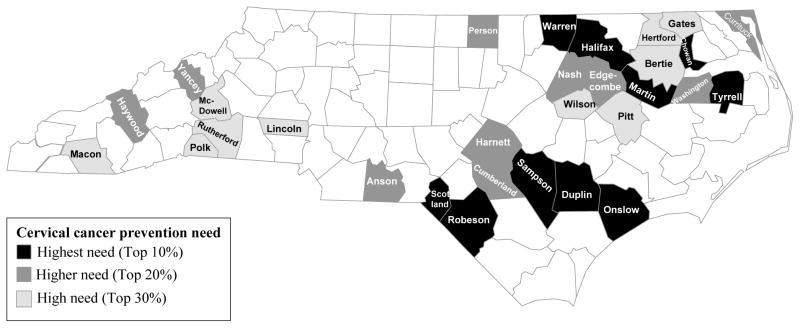
North Carolina's 100 counties varied widely on individual CCPNI components, including annual cervical cancer mortality (median 2.7/100,000 women; range 0.0-8.0), adolescent girls' HPV vaccine initiation (median 42%; range 15%-62%), and Pap testing in the previous 3 years among Medicaid-insured adult women (median 59%; range 40%-83%). Counties with the greatest prevention needs formed 2 distinct clusters in the northeast and south-central regions of the state. Interviews generated 9 recommendations to improve cervical cancer prevention in North Carolina, identifying applications to specific programs and policies in the state.
This study found striking geographic disparities in cervical cancer prevention need in North Carolina. Future prevention efforts in the state should prioritize high-need regions as well as recommended strategies and applications in existing programs. Other states can use the Carolina Framework to increase the impact of their cervical cancer prevention efforts.
《卡罗莱纳宫颈癌预防框架》描述了宫颈癌发病率的 4 个主要原因:人乳头瘤病毒(HPV)感染、缺乏筛查、筛查错误以及未接受随访护理。我们介绍了《卡罗莱纳框架》的 2 个应用案例,通过这些案例,我们确定了北卡罗来纳州高需求县,并提出了改善预防工作的建议。
我们创建了一个宫颈癌预防需求指数(CCPNI),根据宫颈癌死亡率、HPV 疫苗接种起始率和完成率、巴氏涂片筛查率以及向很少或从未接受过筛查的女性提供巴氏涂片检查的情况对各县进行排名。此外,我们还对北卡罗来纳州参与宫颈癌预防的 19 名关键信息提供者进行了深入访谈。
北卡罗来纳州的 100 个县在个别 CCPNI 组成部分上差异很大,包括宫颈癌年死亡率(中位数为 2.7/100,000 名女性;范围为 0.0-8.0)、青少年女孩 HPV 疫苗接种起始率(中位数为 42%;范围为 15%-62%)以及过去 3 年 Medicaid 保险成年女性的巴氏涂片检查率(中位数为 59%;范围为 40%-83%)。预防需求最大的县在该州东北部和中南部形成了 2 个不同的集群。访谈提出了 9 项改善北卡罗来纳州宫颈癌预防的建议,确定了州内特定项目和政策的应用。
本研究发现北卡罗来纳州宫颈癌预防需求存在显著的地域差异。该州未来的预防工作应优先考虑高需求地区以及州内现有项目的推荐策略和应用。其他州可以使用《卡罗莱纳框架》来提高其宫颈癌预防工作的效果。