Jiang Jing, Jin Mei-Shan, Kong Fei, Cao Donghui, Ma Hong-Xi, Jia Zhifang, Wang Yin-Ping, Suo Jian, Cao Xueyuan
Division of Clinical Epidemiology, First Hospital of Jilin University, Changchun, China.
PLoS One. 2013 Dec 10;8(12):e81799. doi: 10.1371/journal.pone.0081799. eCollection 2013.
Galectin-9 (Gal-9) induces adhesion and aggregation of certain cell types and inhibits the metastasis of tumor cells. T-cell immunoglobulin-and mucin domain-3-containing molecule 3 (TIM-3) plays a pivotal role in immune regulation. The aim of this study is to investigate Gal-9 and TIM-3 alterations in gastric cancer and their prognostic values.
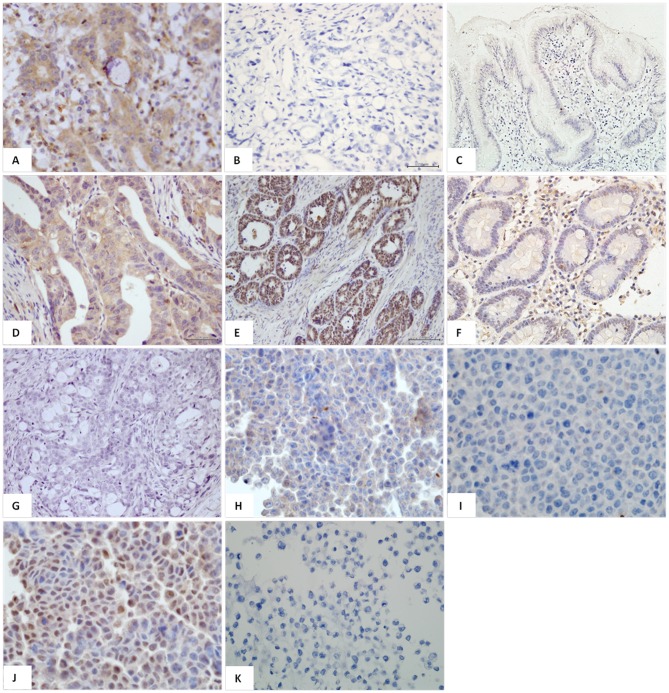
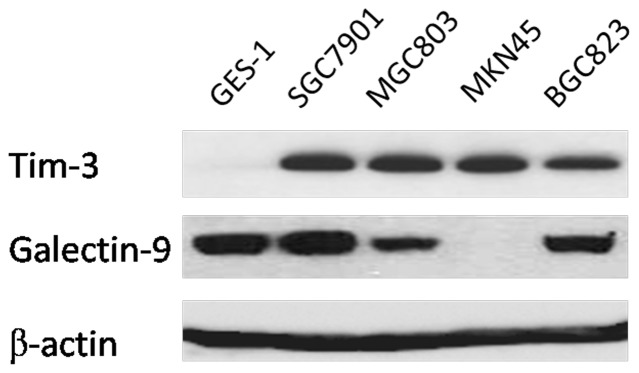
Gal-9 and Tim-3 expression was evaluated using a tissue microarray immunohistochemistry method in 305 gastric cancers, of which 84 had paired adjacent normal samples. Cell lines SGC-7901, BGC-823, MGC-803, MKN45 and GES-1 were also stained. Correlations were analyzed between expression levels of Gal-9 and Tim-3 protein and tumor parameters or clinical outcomes.
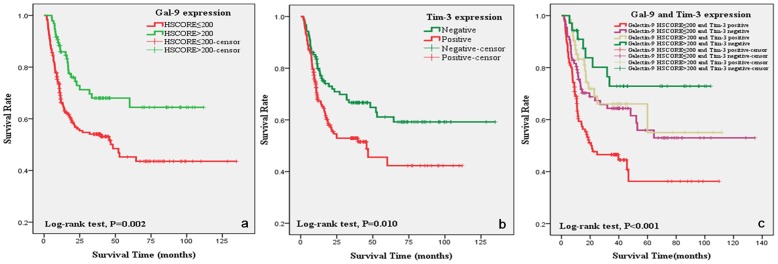
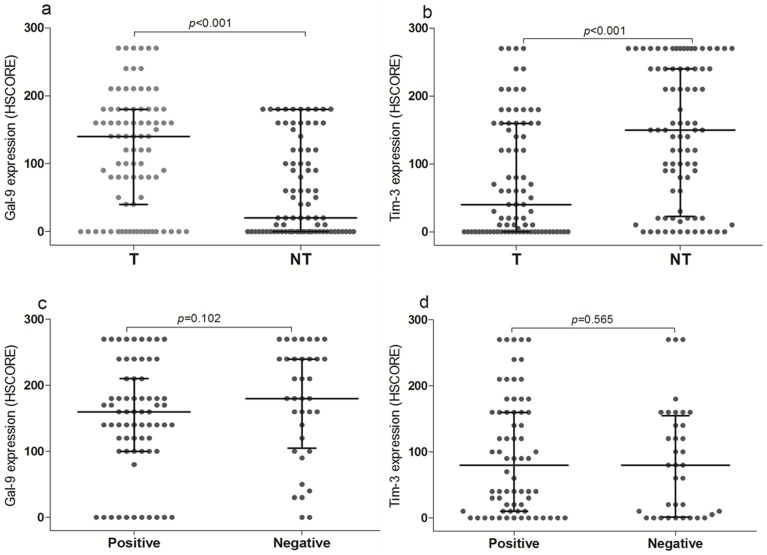
Gal-9 and Tim-3 stained positive on tumor cells in 86.2% (263/305), and 60.0% (183/305) patients with gastric cancer, respectively. Gal-9 expression was significantly higher in cancer than in normal mucosa (P<0.001). Reduced Gal-9 expression was associated with lymph-vascular invasion, lymph node metastasis, distant metastasis and worse TNM staging (P = 0.034, P = 0.009, P = 0.002 and P = 0.043, respectively). In contrast, Tim-3 expression was significantly lower in cancer than in control mucosa (P<0.001). Patients with lymph-vascular invasion had higher expression levels of Tim-3 (P<0.001). Moreover, multivariate analysis shows that both high Gal-9 expression and low Tim-3 expression were significantly associated with long overall survival (P = 0.002, P = 0.010, respectively); the combination of Gal-9 and Tim-3 expression was an independent prognostic predictor for patients with gastric cancer (RR: 0.43; 95%CI: 0.20-0.93). H.pylori infection status was not associated with Gal-9 and Tim-3 expression (P = 0.102, P = 0.565).
The results suggest that expression of Gal-9 and Tim-3 in tumor cells may be a potential, independent prognostic factor for patients with gastric cancer. Gal-9 and TIM-3 may play an important part in the gastric carcinogenesis.
半乳糖凝集素-9(Gal-9)可诱导某些细胞类型的黏附和聚集,并抑制肿瘤细胞的转移。含T细胞免疫球蛋白和黏蛋白结构域分子3(TIM-3)在免疫调节中起关键作用。本研究旨在探讨Gal-9和TIM-3在胃癌中的变化及其预后价值。
采用组织芯片免疫组化方法评估305例胃癌中Gal-9和Tim-3的表达,其中84例有配对的癌旁正常样本。对细胞系SGC-7901、BGC-823、MGC-803、MKN45和GES-1也进行了染色。分析Gal-9和Tim-3蛋白表达水平与肿瘤参数或临床结局之间的相关性。
Gal-9和Tim-3在86.2%(263/305)和60.0%(183/305)的胃癌患者肿瘤细胞中呈阳性染色。Gal-9在癌组织中的表达显著高于正常黏膜(P<0.001)。Gal-9表达降低与淋巴管侵犯、淋巴结转移、远处转移及更差的TNM分期相关(分别为P = 0.034、P = 0.009、P = 0.002和P = 0.043)。相反,Tim-3在癌组织中的表达显著低于对照黏膜(P<0.001)。有淋巴管侵犯的患者Tim-3表达水平较高(P<0.001)。此外,多因素分析显示,Gal-9高表达和Tim-3低表达均与较长的总生存期显著相关(分别为P = 0.002、P = 0.010);Gal-9和Tim-3表达的联合是胃癌患者的独立预后预测指标(RR:0.43;95%CI:0.20 - 0.93)。幽门螺杆菌感染状态与Gal-9和Tim-3表达无关(P = 0.102,P = 0.565)。
结果表明,肿瘤细胞中Gal-9和Tim-3的表达可能是胃癌患者潜在的独立预后因素。Gal-9和TIM-3可能在胃癌发生中起重要作用。