Bari Bilal A, Ollerenshaw Douglas R, Millard Daniel C, Wang Qi, Stanley Garrett B
Coulter Department of Biomedical Engineering, Georgia Institute of Technology & Emory University, Atlanta, Georgia, United States of America.
PLoS One. 2013 Dec 5;8(12):e82170. doi: 10.1371/journal.pone.0082170. eCollection 2013.
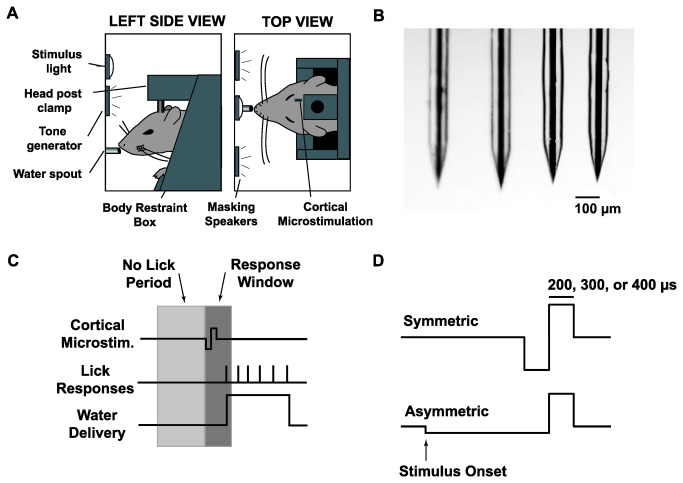
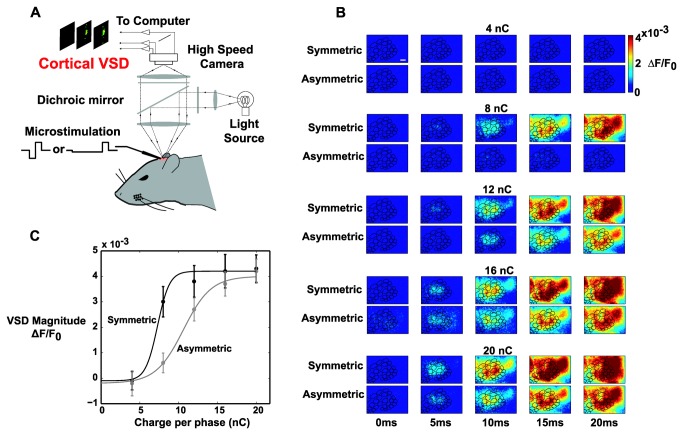
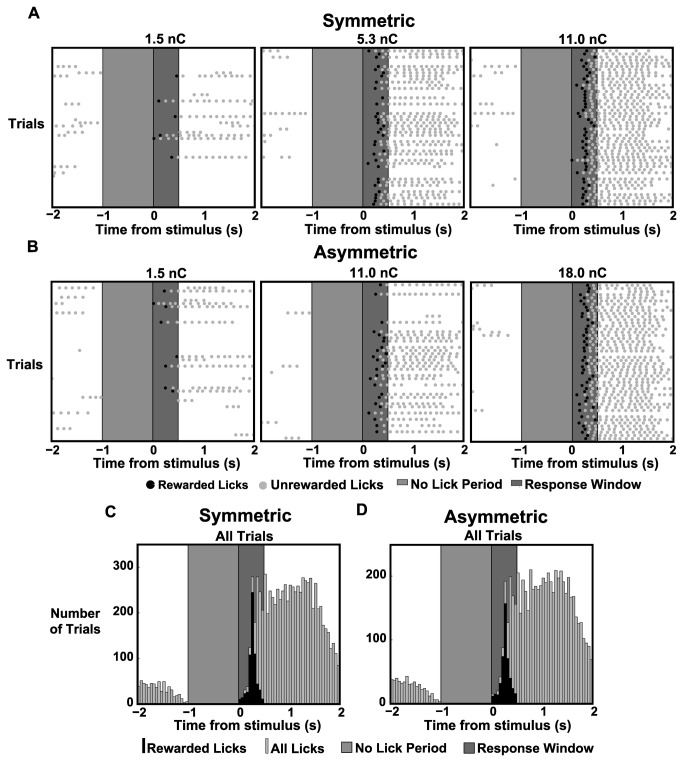
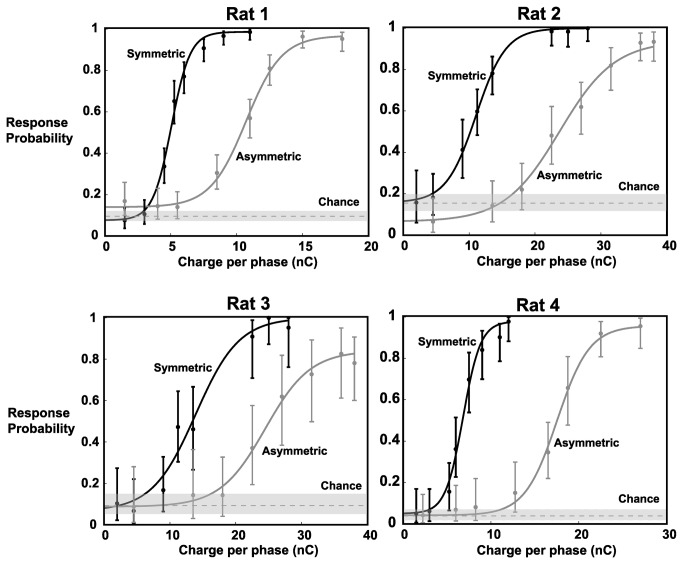
Electrical microstimulation has been widely used to artificially activate neural circuits on fast time scales. Despite the ubiquity of its use, little is known about precisely how it activates neural pathways. Current is typically delivered to neural tissue in a manner that provides a locally balanced injection of positive and negative charge, resulting in negligible net charge delivery to avoid the neurotoxic effects of charge accumulation. Modeling studies have suggested that the most common approach, using a temporally symmetric current pulse waveform as the base unit of stimulation, results in preferential activation of axons, causing diffuse activation of neurons relative to the stimulation site. Altering waveform shape and using an asymmetric current pulse waveform theoretically reverses this bias and preferentially activates cell bodies, providing increased specificity. In separate studies, measurements of downstream cortical activation from sub-cortical microstimulation are consistent with this hypothesis, as are recent measurements of behavioral detection threshold currents from cortical microstimulation. Here, we compared the behavioral and electrophysiological effects of symmetric vs. asymmetric current waveform shape in cortical microstimulation. Using a go/no-go behavioral task, we found that microstimulation waveform shape significantly shifts psychometric performance, where a larger current pulse was necessary when applying an asymmetric waveform to elicit the same behavioral response, across a large range of behaviorally relevant current amplitudes. Using voltage-sensitive dye imaging of cortex in anesthetized animals with simultaneous cortical microstimulation, we found that altering microstimulation waveform shape shifted the cortical activation in a manner that mirrored the behavioral results. Taken together, these results are consistent with the hypothesis that asymmetric stimulation preferentially activates cell bodies, albeit at a higher threshold, as compared to symmetric stimulation. These findings demonstrate the sensitivity of the pathway to varying electrical stimulation parameters and underscore the importance of designing electrical stimuli for optimal activation of neural circuits.
电微刺激已被广泛用于在快速时间尺度上人工激活神经回路。尽管其应用广泛,但对于它究竟如何激活神经通路却知之甚少。电流通常以一种能在局部实现正负电荷平衡注入的方式传递到神经组织,从而使净电荷传递可忽略不计,以避免电荷积累产生的神经毒性作用。建模研究表明,最常见的方法是使用时间对称的电流脉冲波形作为刺激的基本单元,这种方法会优先激活轴突,导致相对于刺激部位的神经元出现弥散性激活。从理论上讲,改变波形形状并使用不对称电流脉冲波形可扭转这种偏向,优先激活细胞体,从而提高特异性。在单独的研究中,皮层下微刺激引起的下游皮层激活测量结果与这一假设相符,皮层微刺激的行为检测阈值电流的最新测量结果也是如此。在此,我们比较了皮层微刺激中对称与不对称电流波形形状对行为和电生理的影响。通过使用一个“是/否”行为任务,我们发现微刺激波形形状显著改变了心理测量性能,即在应用不对称波形时,需要更大的电流脉冲才能在大范围与行为相关的电流幅度下引发相同的行为反应。在对麻醉动物进行皮层微刺激的同时,使用电压敏感染料对皮层进行成像,我们发现改变微刺激波形形状会以一种与行为结果相符的方式改变皮层激活。综上所述,这些结果与以下假设一致:与对称刺激相比,不对称刺激优先激活细胞体,尽管阈值更高。这些发现证明了该神经通路对不同电刺激参数的敏感性,并强调了设计电刺激以实现神经回路最佳激活的重要性。