Adibi Mehdi
School of Psychology, University of New South Wales, Sydney, NSW, Australia.
Tactile Perception and Learning Lab, International School for Advanced Studies (SISSA), Trieste, Italy.
Front Syst Neurosci. 2019 Aug 21;13:40. doi: 10.3389/fnsys.2019.00040. eCollection 2019.
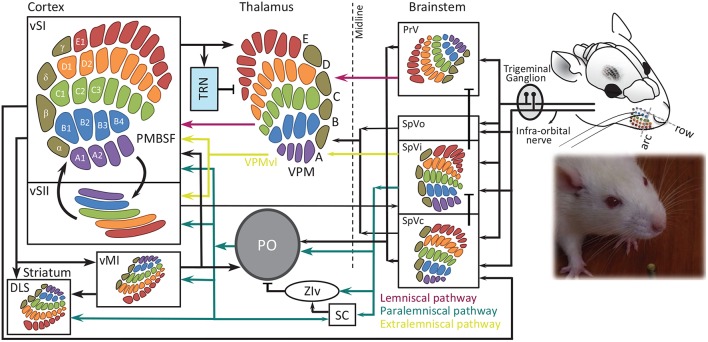
A key question in systems neuroscience is to identify how sensory stimuli are represented in neuronal activity, and how the activity of sensory neurons in turn is "read out" by downstream neurons and give rise to behavior. The choice of a proper model system to address these questions, is therefore a crucial step. Over the past decade, the increasingly powerful array of experimental approaches that has become available in non-primate models (e.g., optogenetics and two-photon imaging) has spurred a renewed interest for the use of rodent models in systems neuroscience research. Here, I introduce the rodent whisker-mediated touch system as a structurally well-established and well-organized model system which, despite its simplicity, gives rise to complex behaviors. This system serves as a behaviorally efficient model system; known as nocturnal animals, along with their olfaction, rodents rely on their whisker-mediated touch system to collect information about their surrounding environment. Moreover, this system represents a well-studied circuitry with a somatotopic organization. At every stage of processing, one can identify anatomical and functional topographic maps of whiskers; "barrelettes" in the brainstem nuclei, "barreloids" in the sensory thalamus, and "barrels" in the cortex. This article provides a brief review on the basic anatomy and function of the whisker system in rodents.
系统神经科学中的一个关键问题是确定感觉刺激如何在神经元活动中得到表征,以及感觉神经元的活动如何反过来被下游神经元“读取”并引发行为。因此,选择一个合适的模型系统来解决这些问题是至关重要的一步。在过去十年中,非灵长类模型中可用的一系列越来越强大的实验方法(如光遗传学和双光子成像)激发了人们对在系统神经科学研究中使用啮齿动物模型的新兴趣。在这里,我介绍啮齿动物的触须介导的触觉系统,它是一个结构完善且组织有序的模型系统,尽管其简单,但能产生复杂行为。这个系统是一个行为高效的模型系统;作为夜行性动物除了嗅觉外,啮齿动物依靠它们的触须介导的触觉系统来收集有关周围环境的信息。此外,这个系统代表了一个经过充分研究的具有躯体定位组织的神经回路。在处理的每个阶段,都可以识别触须的解剖学和功能地形图;脑干核中的“小桶柱”、感觉丘脑中的“桶状核”和皮层中的“桶状区”。本文对啮齿动物触须系统的基本解剖结构和功能进行简要综述。