Department of Animal Nutrition and Management, Swedish University of Agricultural Sciences, P,O, Box 7024, Uppsala SE-750 07, Sweden.
J Anim Sci Biotechnol. 2013 Dec 17;4(1):50. doi: 10.1186/2049-1891-4-50.
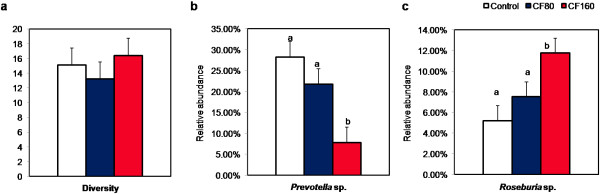
Dietary fiber, resistant to host-mediated digestion in the small intestine due to lack of endogenous enzymes, impacts many facets of animal health and is associated with gut development especially in young monogastrics. Furthermore, it can be used as in-feed antibiotic alternative. Chicory (Cichorium intybus L.) forage with high content of pectin (uronic acids as building blocks) is a novel class of dietary fiber that is chemically different from cereal grains (with high content of arabinoxylans). In the present study, we investigated effects of dietary inclusion of chicory forage on digestibility, gut morphology and microbiota in broilers and young pigs. In the chicken experiment, 160 1-d old broiler chicks were fed 3 nutritionally balanced diets for 30 d including a cereal-based diet and 2 diets with part of the cereals substituted with 60 and 120 g/kg chicory forage (CF60 and CF120), whereas in the pig experiment, 18 seven-wk old Yorkshire pigs were fed 3 diets for 18 d including a cereal-based diet and 2 diets with 80 and 160 g/kg chicory forage inclusion (CF80 and CF160). Our results showed that young pigs were capable to utilize chicory forage well with higher total tract apparent digestibility (TTAD) of all fiber fractions, particularly uronic acid, compared with the control (P < 0.01). In contrast, a decreased TTAD of all fiber fractions was observed in chickens fed on diet CF120 (P < 0.05). Moreover, diet induced changes in gut morphology were observed in the large intestine of chickens. The alteration of cecal mucosal thickness was further positively correlated with TTAD of non-starch polysaccharides (NSP) and its constituent sugars (P < 0.05). In addition, in pigs, terminal restriction fragment length polymorphism (T-RFLP) analysis of intestinal microbiota revealed substantial dietary effects (cereal control diet vs. chicory forage inclusion) on the relative abundance of 2 dominant bacterial phylotypes (Prevotella sp. vs. Roseburia sp.) respectively (P < 0.05). In conclusion, our data showed that chicory forage (Cichorium intybus L.), a novel dietary fiber source in animal nutrition, have potential beneficial properties as fiber ingredient in diets for both pigs and chickens.
膳食纤维由于缺乏内源性酶而在小肠中不受宿主介导的消化,它影响动物健康的许多方面,与肠道发育有关,尤其是在年幼的单胃动物中。此外,它可以用作饲料抗生素的替代品。菊苣(Cichorium intybus L.)饲料中果胶(作为构建块的糖醛酸)含量高,是一类新型膳食纤维,与谷物(阿拉伯木聚糖含量高)在化学上不同。在本研究中,我们研究了日粮中添加菊苣饲料对肉鸡和仔猪的消化率、肠道形态和微生物群的影响。在鸡的实验中,160 只 1 日龄的肉鸡饲喂 3 种营养平衡的日粮 30 天,包括以谷物为基础的日粮和 2 种用 60 和 120 g/kg 菊苣饲料部分替代谷物的日粮(CF60 和 CF120),而在猪的实验中,18 只 7 周龄的约克夏猪饲喂 3 种日粮 18 天,包括以谷物为基础的日粮和 2 种用 80 和 160 g/kg 菊苣饲料添加的日粮(CF80 和 CF160)。我们的结果表明,与对照组相比,仔猪能够很好地利用菊苣饲料,所有纤维成分,特别是糖醛酸的总肠道表观消化率(TTAD)更高(P<0.01)。相反,日粮 CF120 组鸡的所有纤维成分的 TTAD 均降低(P<0.05)。此外,在鸡的大肠中观察到肠道形态的饮食诱导变化。盲肠黏膜厚度的改变与非淀粉多糖(NSP)及其组成糖的 TTAD 呈正相关(P<0.05)。此外,在猪中,肠道微生物群的末端限制性片段长度多态性(T-RFLP)分析显示,日粮对 2 种主要细菌类群(普雷沃氏菌属 vs. 罗氏菌属)的相对丰度有显著影响(谷物对照日粮与菊苣饲料添加分别)(P<0.05)。总之,我们的数据表明,菊苣饲料(Cichorium intybus L.)作为动物营养中的一种新型膳食纤维来源,具有作为猪和鸡日粮纤维成分的潜在有益特性。