Aman Michael G, Bukstein Oscar G, Gadow Kenneth D, Arnold L Eugene, Molina Brooke S G, McNamara Nora K, Rundberg-Rivera E Victoria, Li Xiaobai, Kipp Heidi, Schneider Jayne, Butter Eric M, Baker Jennifer, Sprafkin Joyce, Rice Robert R, Bangalore Srihari S, Farmer Cristan A, Austin Adrienne B, Buchan-Page Kristin A, Brown Nicole V, Hurt Elizabeth A, Grondhuis Sabrina N, Findling Robert L
The Ohio State University.
University of Texas-Houston Medical School.
J Am Acad Child Adolesc Psychiatry. 2014 Jan;53(1):47-60.e1. doi: 10.1016/j.jaac.2013.09.022. Epub 2013 Nov 18.
Although combination pharmacotherapy is common in child and adolescent psychiatry, there has been little research evaluating it. The value of adding risperidone to concurrent psychostimulant and parent training (PT) in behavior management for children with severe aggression was tested.
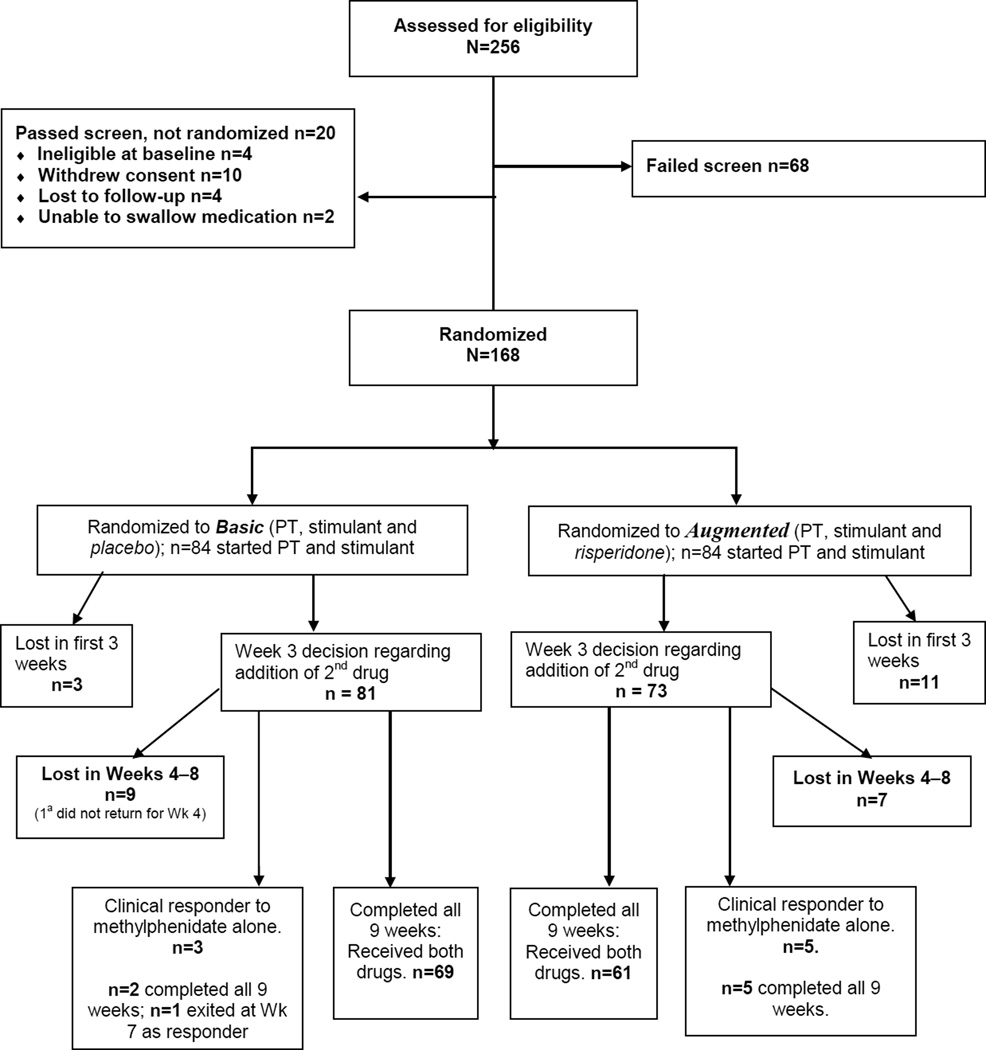
One hundred sixty-eight children 6 to 12 years old (mean age 8.89 ± 2.01 years) with severe physical aggression were randomized to a 9-week trial of PT, stimulant (STIM), and placebo (Basic treatment; n = 84) or PT, STIM, and risperidone (Augmented treatment; n = 84). All had diagnoses of attention-deficit/hyperactivity disorder and oppositional-defiant disorder (n = 124) or conduct disorder (n = 44). Children received psychostimulant (usually Osmotic Release Oral System methylphenidate) for 3 weeks, titrated for optimal effect, while parents received PT. If there was room for improvement at the end of week 3, placebo or risperidone was added. Assessments included parent ratings on the Nisonger Child Behavior Rating Form (Disruptive-Total subscale was the primary outcome) and Antisocial Behavior Scale; blinded clinicians rated change on the Clinical Global Impressions scale.
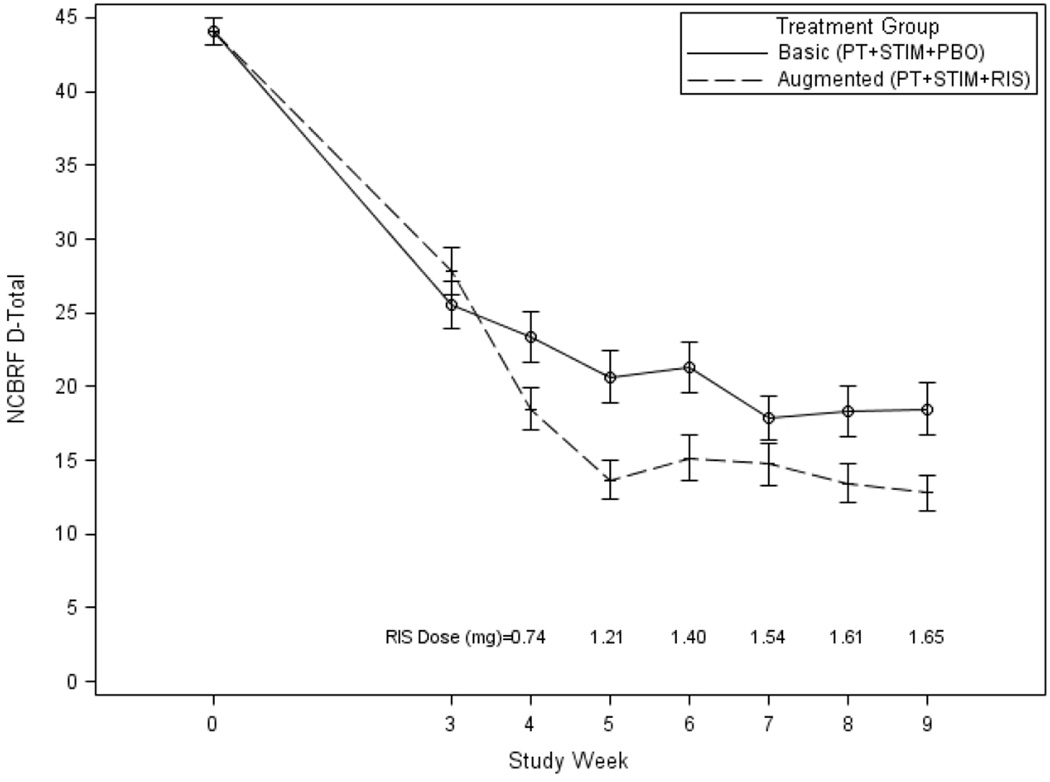
Compared with Basic treatment (PT + STIM [44.8 ± 14.6 mg/day] + placebo [1.88 mg/day ± 0.72]), Augmented treatment (PT + STIM [46.1 ± 16.8 mg/day] + risperidone [1.65 mg/day ± 0.75]) showed statistically significant improvement on the Nisonger Child Behavior Rating Form Disruptive-Total subscale (treatment-by-time interaction, p = .0016), the Nisonger Child Behavior Rating Form Social Competence subscale (p = .0049), and Antisocial Behavior Scale Reactive Aggression subscale (p = .01). Clinical Global Impressions scores were substantially improved for the 2 groups but did not discriminate between treatments (Clinical Global Impressions-Improvement score ≤2, 70% for Basic treatment versus 79% for Augmented treatment). Prolactin elevations and gastrointestinal upset occurred more with Augmented treatment; other adverse events differed modestly from Basic treatment; weight gain in the Augmented treatment group was minor.
Risperidone provided moderate but variable improvement in aggressive and other seriously disruptive child behaviors when added to PT and optimized stimulant treatment. Clinical trial registration information-Treatment of Severe Childhood Aggression (The TOSCA Study), URL: http://clinicaltrials.gov, unique identifier: NCT00796302.
尽管联合药物治疗在儿童和青少年精神病学中很常见,但对此进行评估的研究却很少。本研究测试了在对有严重攻击行为的儿童进行行为管理时,在同时使用精神兴奋剂和家长培训(PT)的基础上加用利培酮的价值。
168名6至12岁(平均年龄8.89±2.01岁)有严重身体攻击行为的儿童被随机分为两组,进行为期9周的试验。一组接受PT、兴奋剂(STIM)和安慰剂(基础治疗;n = 84),另一组接受PT、STIM和利培酮(强化治疗;n = 84)。所有儿童均被诊断为注意力缺陷/多动障碍和对立违抗障碍(n = 124)或品行障碍(n = 44)。儿童接受精神兴奋剂(通常为渗透泵控释型哌甲酯)治疗3周,根据效果进行滴定,同时家长接受PT。如果在第3周结束时仍有改善空间,则加用安慰剂或利培酮。评估包括家长对尼桑格儿童行为评定量表(破坏性行为总分量表是主要结局指标)和反社会行为量表的评分;不知情的临床医生根据临床总体印象量表对变化进行评分。
与基础治疗(PT + STIM[44.8±14.6毫克/天]+安慰剂[1.88毫克/天±0.72])相比,强化治疗(PT + STIM[46.1±16.8毫克/天]+利培酮[1.65毫克/天±0.75])在尼桑格儿童行为评定量表破坏性行为总分量表(治疗与时间交互作用,p = 0.0016)、尼桑格儿童行为评定量表社会能力分量表(p = 0.0049)和反社会行为量表反应性攻击分量表(p = 0.01)上有统计学意义的改善。两组的临床总体印象评分均有显著改善,但在不同治疗组间无差异(临床总体印象-改善评分≤2,基础治疗组为70%,强化治疗组为79%)。强化治疗组催乳素升高和胃肠道不适更为常见;其他不良事件与基础治疗组略有不同;强化治疗组体重增加较少。
在PT和优化的兴奋剂治疗基础上加用利培酮,对有攻击行为及其他严重破坏性行为的儿童有中度但不稳定的改善。临床试验注册信息-严重儿童攻击行为的治疗(TOSCA研究),网址:http://clinicaltrials.gov,唯一标识符:NCT00796302。