Department of Translational Brain Research, German Center for Neurodegenerative Diseases (DZNE), Munich, Germany.
Acta Neuropathol Commun. 2013 Dec 17;1:82. doi: 10.1186/2051-5960-1-82.
Illuminating the role of the microtubule-associated protein tau in neurodegenerative diseases is of increasing importance, supported by recent studies establishing novel functions of tau in synaptic signalling and cytoskeletal organization. In severe dementias like Alzheimer's disease (AD), synaptic failure and cognitive decline correlate best with the grade of tau-pathology. To address synaptic alterations in tauopathies, we analyzed the effects of mutant tau expression on excitatory postsynapses in vivo.
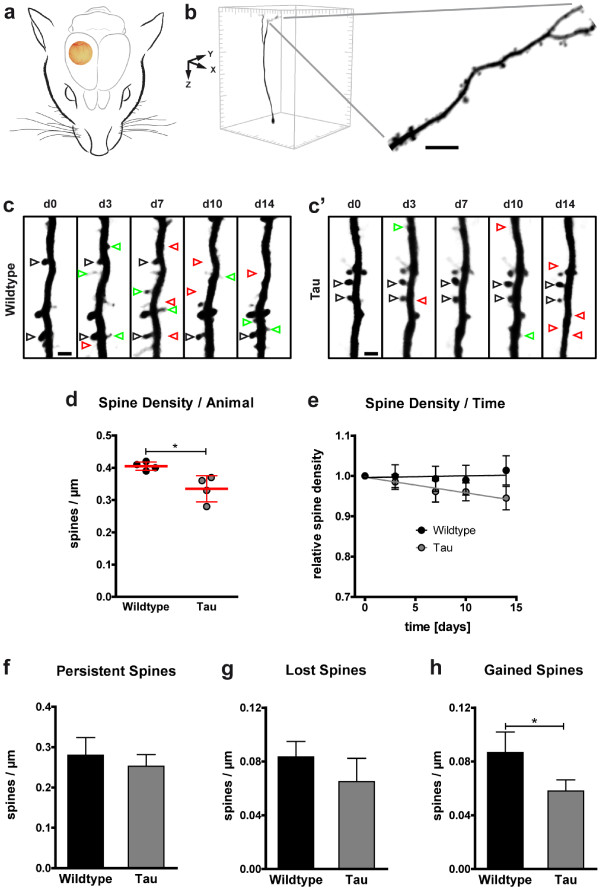
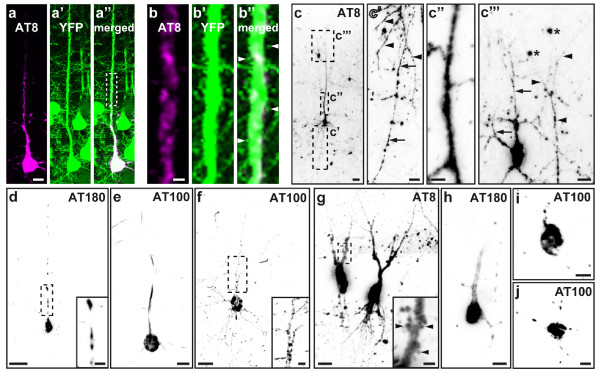
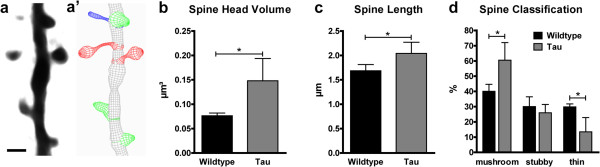
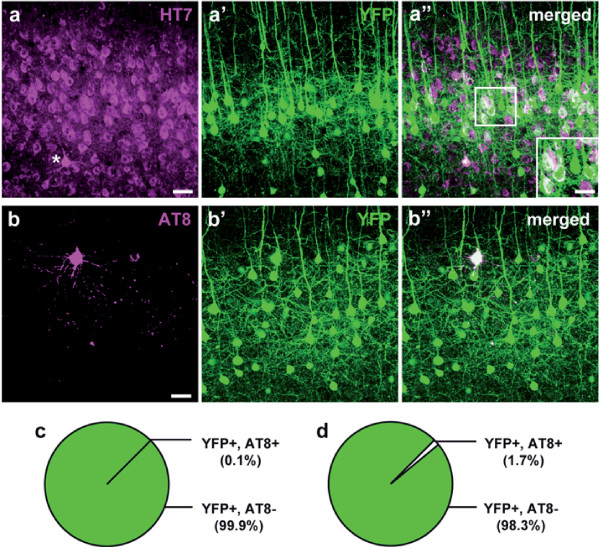
Here we followed the fate of single dendritic spines in the neocortex of a tauopathy mouse model, expressing human P301S mutated tau, for a period of two weeks. We observed a continuous decrease in spine density during disease progression, which we could ascribe to a diminished fraction of gained spines. Remaining spines were enlarged and elongated, thus providing evidence for morphological reorganization in compensation for synaptic dysfunction. Remarkably, loss of dendritic spines in cortical pyramidal neurons occurred in the absence of neurofibrillary tangles (NFTs). Therefore, we consider prefibrillar tau species as causative for the observed impairment in spine plasticity.
Dendritic spine plasticity and morphology are altered in layer V cortical neurons of P301S tau transgenic mice in vivo. This does not coincide with the detection of hyperphosphorylated tau in dendritic spines.
越来越多的研究表明微管相关蛋白 tau 在突触信号转导和细胞骨架组织中的新功能,突显了阐明 tau 在神经退行性疾病中作用的重要性。在阿尔茨海默病(AD)等严重痴呆症中,突触功能衰竭和认知能力下降与 tau 病理程度的相关性最好。为了研究 tau 病中的突触改变,我们分析了突变型 tau 表达对体内兴奋性突触后作用的影响。
在这里,我们在表达人 P301S 突变型 tau 的 tau 病小鼠模型的新皮质中,对单个树突棘的命运进行了为期两周的研究。我们观察到在疾病进展过程中棘密度持续下降,这可以归因于获得的棘的比例降低。剩余的棘增大和伸长,从而为补偿突触功能障碍的形态重组提供了证据。值得注意的是,皮质锥体神经元中的树突棘丢失发生在神经原纤维缠结(NFTs)缺失的情况下。因此,我们认为观察到的棘状可塑性损伤是由原纤维前 tau 物种引起的。
在体内 P301S tau 转基因小鼠的 V 层皮质神经元中,树突棘的可塑性和形态发生改变。这与树突棘中磷酸化 tau 的检测不相符。