Futures Group, Washington, DC, USA.
BMC Health Serv Res. 2013 Dec 17;13:521. doi: 10.1186/1472-6963-13-521.
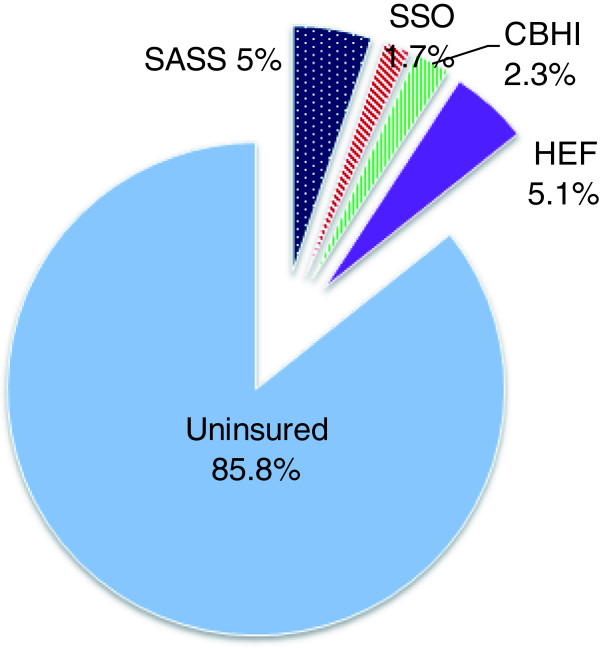
The Government of Lao Peoples' Democratic Republic (Lao PDR) has embarked on a path to achieve universal health coverage (UHC) through implementation of four risk-protection schemes. One of these schemes is community-based health insurance (CBHI) - a voluntary scheme that targets roughly half the population. However, after 12 years of implementation, coverage through CBHI remains very low. Increasing coverage of the scheme would require expansion to households in both villages where CBHI is currently operating, and new geographic areas. In this study we explore the prospects of both types of expansion by examining household and district level data.
Using a household survey based on a case-comparison design of 3000 households, we examine the determinants of enrolment at the household level in areas where the scheme is currently operating. We model the determinants of enrolment using a probit model and predicted probabilities. Findings from focus group discussions are used to explain the quantitative findings. To examine the prospects for geographic scale-up, we use secondary data to compare characteristics of districts with and without insurance, using a combination of univariate and multivariate analyses. The multivariate analysis is a probit model, which models the factors associated with roll-out of CBHI to the districts.
The household findings show that enrolment is concentrated among the better off and that adverse selection is present in the scheme. The district level findings show that to date, the scheme has been implemented in the most affluent areas, in closest proximity to the district hospitals, and in areas where quality of care is relatively good.
The household-level findings indicate that the scheme suffers from poor risk-pooling, which threatens financial sustainability. The district-level findings call into question whether or not the Government of Laos can successfully expand to more remote, less affluent districts, with lower population density. We discuss the policy implications of the findings and specifically address whether CBHI can serve as a foundation for a national scheme, while exploring alternative approaches to reaching the informal sector in Laos and other countries attempting to achieve UHC.
老挝人民民主共和国(老挝)政府已着手通过实施四项风险保护计划来实现全民健康覆盖(UHC)。其中一项计划是社区医疗保险(CBHI),这是一项针对大约一半人口的自愿计划。然而,在实施 12 年后,CBHI 的覆盖范围仍然非常低。要增加该计划的覆盖范围,需要将目前在 CBHI 运营的村庄中的家庭以及新的地理区域纳入其中。在这项研究中,我们通过检查家庭和地区一级的数据来探讨这两种扩展的前景。
我们使用基于案例对照设计的 3000 户家庭的家庭调查,在该计划目前正在运营的地区检查家庭层面参保的决定因素。我们使用概率模型和预测概率来模拟参保的决定因素。焦点小组讨论的结果被用来解释定量结果。为了研究地理规模扩展的前景,我们使用二次数据比较有保险和没有保险的地区的特征,使用单变量和多变量分析的组合。多变量分析是一个概率模型,用于对 CBHI 扩展到地区的相关因素进行建模。
家庭调查结果表明,参保主要集中在富裕人群中,且该计划中存在逆向选择。地区层面的调查结果显示,迄今为止,该计划仅在最富裕的地区、最接近地区医院的地区以及医疗质量相对较好的地区实施。
家庭层面的调查结果表明,该计划存在风险分担不佳的问题,这对财务可持续性构成威胁。地区层面的调查结果对老挝政府是否能够成功地扩展到更偏远、不那么富裕、人口密度较低的地区提出了质疑。我们讨论了这些发现的政策意义,特别是探讨了 CBHI 能否作为国家计划的基础,同时还探讨了在老挝和其他试图实现全民健康覆盖的国家中为非正规部门提供服务的替代方法。