Key Laboratory of Animal Physiology & Biochemistry, Nanjing Agricultural University, Nanjing 210095, P, R, China.
BMC Vet Res. 2013 Dec 17;9:257. doi: 10.1186/1746-6148-9-257.
The fat mass and obesity associated gene (FTO) is widely investigated in humans regarding its important roles in obesity and type 2 diabetes. Studies in mammals demonstrate that FTO is also associated with inflammation markers. However, the association of FTO with inflammation in chickens remains unclear. In this study, male chickens on day 28 posthatching were injected intraperitoneally with lipopolysaccharide (LPS) or saline to investigate whether the FTO gene is involved in LPS-induced inflammation.
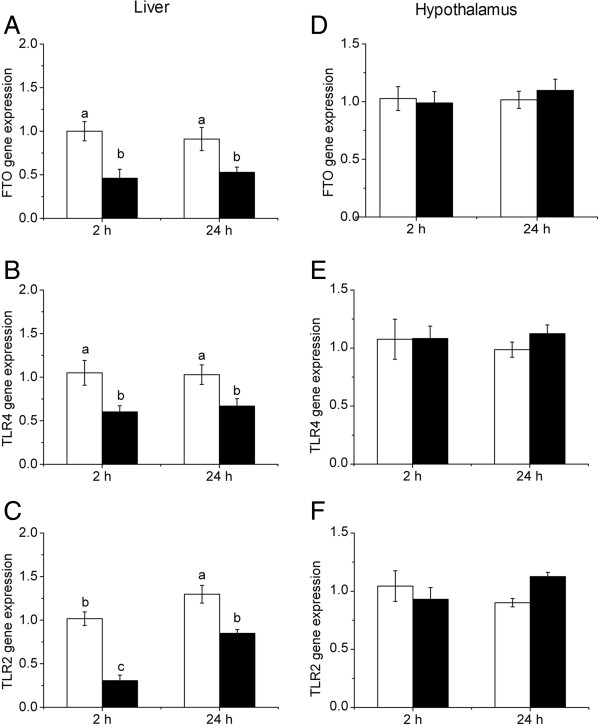
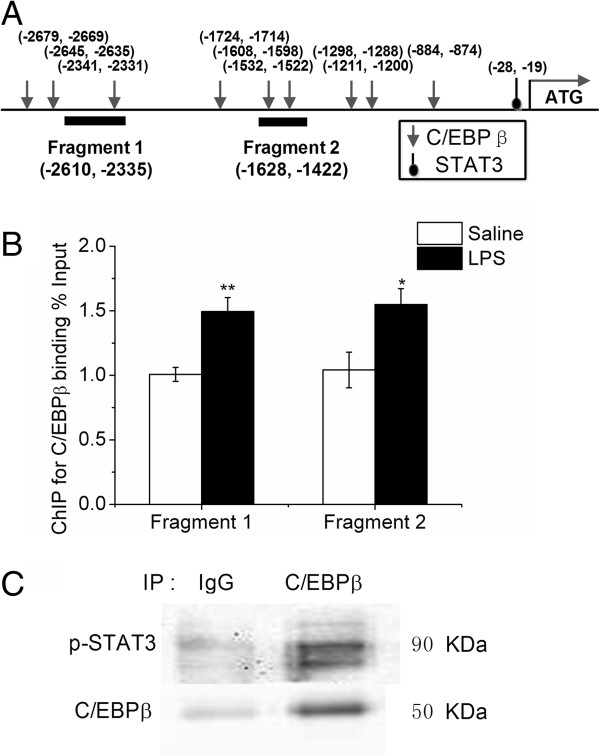
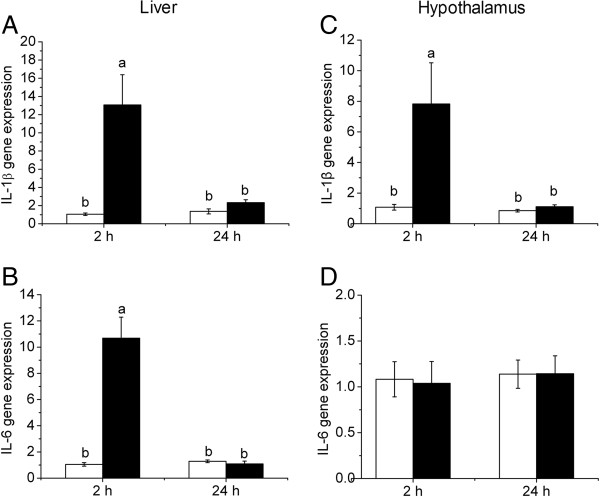
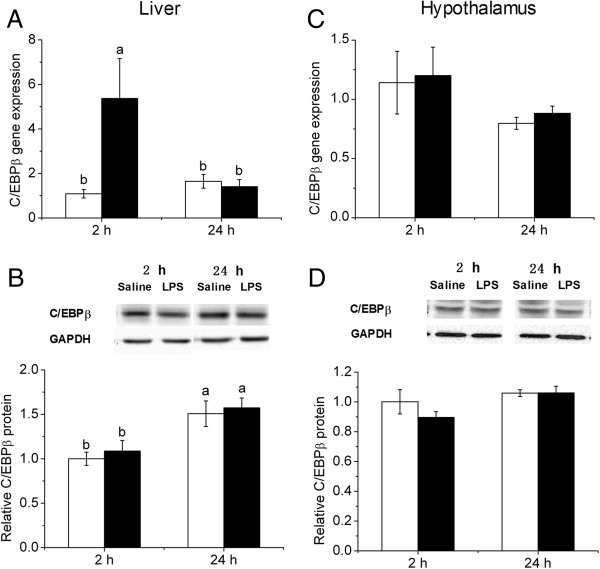
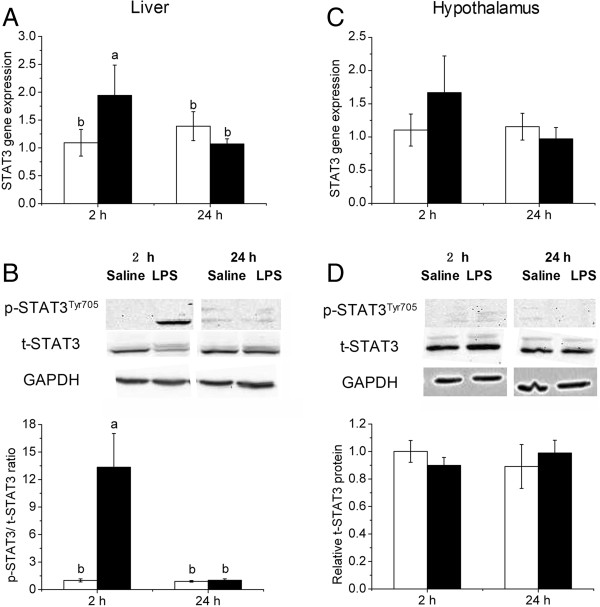
We detected significant down-regulation of FTO mRNA in the liver (P < 0.01), but not in the hypothalamus, 2 and 24 h after LPS challenge. Toll-like receptor (TLR) 2 (P < 0.01) and TLR4 (P < 0.01) followed the same pattern as FTO, being suppressed significantly in liver but not in hypothalamus. IL-1β was dramatically up-regulated (P < 0.01) in both liver and hypothalamus 2 h after LPS challenge, while activation of IL-6 was observed in the liver (P < 0.01), but not in hypothalamus. The 5'-flanking sequence of the chicken FTO gene contains nine predicted binding sites for CCAAT/enhancer binding protein beta (C/EBP beta) and one for signal transducer and activator of transcription 3 (STAT3). Significant elevation of C/EBP beta was detected in the liver (P < 0.01), but not in the hypothalamus, 2 h after LPS challenge. Lipopolysaccharide challenge increased the C/EBP beta binding to FTO promoter in the liver (P < 0.01 for fragment 1, P < 0.05 for fragment 2), although the protein content of C/EBP beta was not altered. Moreover, injection of LPS resulted in enhanced phosphorylation of liver STAT3, a downstream transcription factor in IL-6 signaling. Although phosphorylated STAT3 was not detected to directly bind to FTO promoter, it was found to interact with C/EBP beta.
Our results reveal that FTO expression in liver, but not in hypothalamus, is affected by the i.p. injection of LPS, which may be mediated through tissue-specific FTO transcriptional regulation by C/EBP beta and STAT3 interaction.
脂肪量和肥胖相关基因(FTO)在人类肥胖和 2 型糖尿病的相关研究中被广泛研究,其在肥胖和 2 型糖尿病中的重要作用也得到了证明。在哺乳动物中的研究表明,FTO 也与炎症标志物有关。然而,FTO 与鸡的炎症之间的关系尚不清楚。在这项研究中,孵化后 28 天的雄性小鸡被腹膜内注射脂多糖(LPS)或生理盐水,以研究 FTO 基因是否参与 LPS 诱导的炎症。
我们检测到 LPS 挑战后 2 小时和 24 小时,FTO mRNA 在肝脏中显著下调(P<0.01),但在下丘脑中没有。Toll 样受体(TLR)2(P<0.01)和 TLR4(P<0.01)与 FTO 的模式相同,在肝脏中显著下调,但在下丘脑中没有。LPS 挑战后 2 小时,IL-1β在肝脏和下丘脑均显著上调(P<0.01),而 IL-6 的激活仅在肝脏中观察到(P<0.01),而在下丘脑中没有。鸡 FTO 基因的 5'侧翼序列包含九个预测的 CCAAT/增强子结合蛋白β(C/EBPβ)和一个信号转导和转录激活因子 3(STAT3)结合位点。LPS 挑战后 2 小时,在肝脏中检测到 C/EBPβ显著升高(P<0.01),但在下丘脑中没有。LPS 处理增加了肝脏中 FTO 启动子与 C/EBPβ的结合(片段 1 的 P<0.01,片段 2 的 P<0.05),尽管 C/EBPβ 的蛋白含量没有改变。此外,LPS 注射导致肝脏 STAT3 磷酸化增强,这是 IL-6 信号通路中的下游转录因子。虽然未检测到磷酸化 STAT3 直接与 FTO 启动子结合,但发现它与 C/EBPβ相互作用。
我们的结果表明,LPS 腹腔注射可影响肝脏而非下丘脑的 FTO 表达,这可能是通过 C/EBPβ和 STAT3 相互作用的组织特异性 FTO 转录调节介导的。