Winhusen Theresa M, Brigham Gregory S, Kropp Frankie, Lindblad Robert, Gardin John G, Penn Pat, Hodgkins Candace, Kelly Thomas M, Douaihy Antoine, McCann Michael, Love Lee D, DeGravelles Eliot, Bachrach Ken, Sonne Susan C, Hiott Bob, Haynes Louise, Sharma Gaurav, Lewis Daniel F, VanVeldhuisen Paul, Theobald Jeff, Ghitza Udi
University of Cincinnati, 3210 Jefferson Ave, Cincinnati, OH 45220
J Clin Psychiatry. 2014 Apr;75(4):336-43. doi: 10.4088/JCP.13m08449.
To evaluate the impact of concurrent treatments for substance use disorder and nicotine-dependence for stimulant-dependent patients.
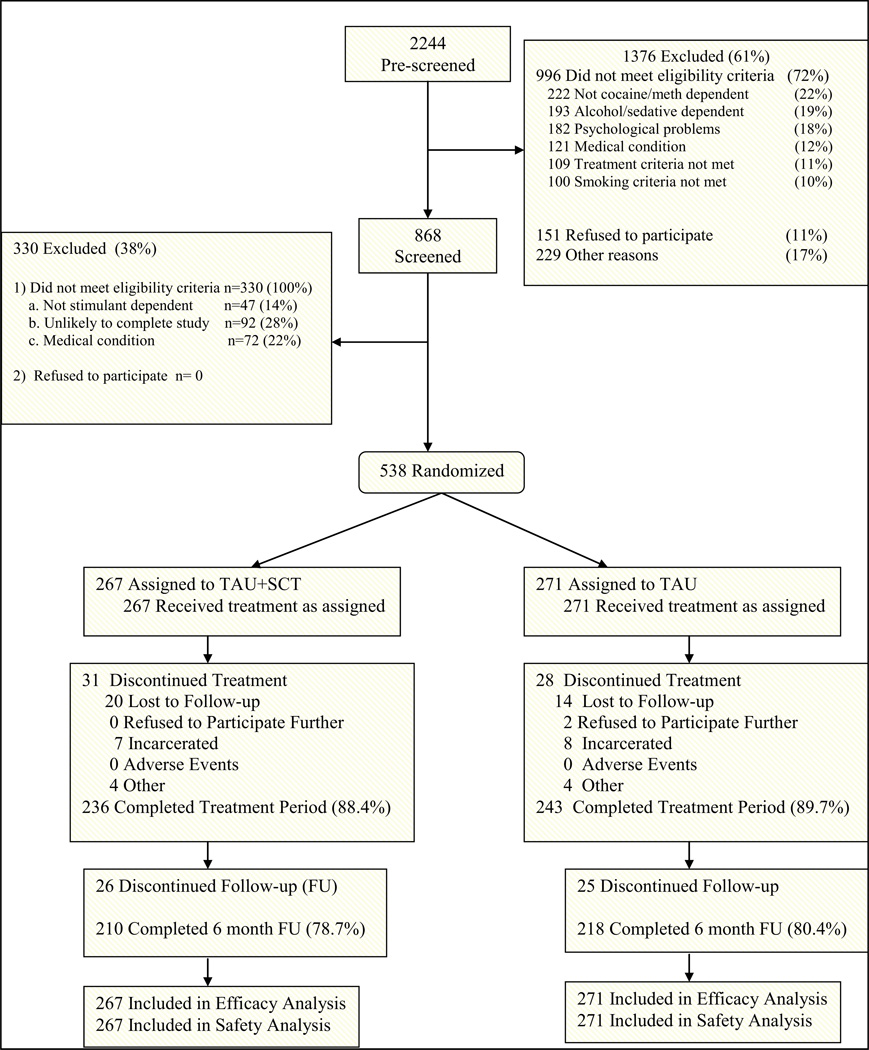
A randomized, 10-week trial with follow-up at 3 and 6 months after smoking quit date conducted at 12 substance use disorder treatment programs between February 2010 and July 2012. Adults meeting DSM-IV-TR criteria for cocaine and/or methamphetamine dependence and interested in quitting smoking were randomized to treatment as usual (n = 271) or treatment as usual with smoking-cessation treatment (n = 267). All participants received treatment as usual for substance use disorder treatment. Participants assigned to treatment as usual with concurrent smoking-cessation treatment received weekly individual smoking cessation counseling and extended-release bupropion (300 mg/d) during weeks 1-10. During post-quit treatment (weeks 4-10), participants assigned to treatment as usual with smoking-cessation treatment received a nicotine inhaler and contingency management for smoking abstinence. Weekly proportion of stimulant-abstinent participants during the treatment phase, as assessed by urine drug screens and self-report, was the primary outcome. Secondary measures included other substance/nicotine use outcomes and treatment attendance.
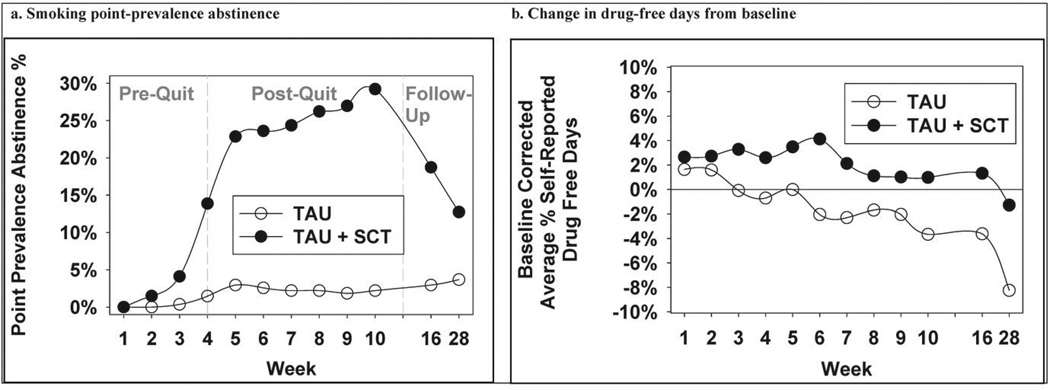
There were no significant treatment effects on stimulant-use outcomes, as measured by the primary outcome and stimulant-free days, on drug-abstinence, or on attendance. Participants assigned to treatment as usual with smoking-cessation treatment, relative to those assigned to treatment as usual, had significantly better outcomes for drug-free days at 6-month follow-up (χ(2)(1) = 4.09, P <.05), with a decrease in drug-free days from baseline of -1.3% in treatment as usual with smoking-cessation treatment and of -7.6% in treatment as usual. Participants receiving treatment as usual with smoking-cessation treatment, relative to those receiving treatment as usual, had significantly better outcomes on smoking point-prevalence abstinence (25.5% vs 2.2%; χ(2)(1) = 44.69, P < .001; OR =18.2).
These results suggest that providing smoking-cessation treatment to illicit stimulant-dependent patients in outpatient substance use disorder treatment will not worsen, and may enhance, abstinence from nonnicotine substance use.
ClinicalTrials.gov identifier: NCT01077024.
评估同时治疗物质使用障碍和尼古丁依赖对兴奋剂依赖患者的影响。
2010年2月至2012年7月期间,在12个物质使用障碍治疗项目中进行了一项为期10周的随机试验,并在戒烟日期后的3个月和6个月进行随访。符合DSM-IV-TR可卡因和/或甲基苯丙胺依赖标准且有戒烟意愿的成年人被随机分为常规治疗组(n = 271)或常规治疗加戒烟治疗组(n = 267)。所有参与者均接受物质使用障碍的常规治疗。分配到常规治疗加同时戒烟治疗组的参与者在第1 - 10周接受每周一次的个体戒烟咨询和缓释安非他酮(300 mg/天)。在戒烟后治疗期间(第4 - 10周),分配到常规治疗加戒烟治疗组的参与者接受尼古丁吸入器和戒烟应急管理。通过尿液药物筛查和自我报告评估的治疗阶段兴奋剂戒断参与者的每周比例是主要结局。次要指标包括其他物质/尼古丁使用结局和治疗出勤率。
就主要结局、无兴奋剂天数、药物戒断或出勤率衡量,对兴奋剂使用结局没有显著的治疗效果。与分配到常规治疗组的参与者相比,分配到常规治疗加戒烟治疗组的参与者在6个月随访时无药物天数的结局显著更好(χ(2)(1) = 4.09,P <.05),常规治疗加戒烟治疗组无药物天数从基线下降了 -1.3%,常规治疗组下降了 -7.6%。与接受常规治疗的参与者相比,接受常规治疗加戒烟治疗的参与者在吸烟点流行率戒断方面的结局显著更好(25.5%对2.2%;χ(2)(1) = 44.69,P <.001;OR = 18.2)。
这些结果表明,在门诊物质使用障碍治疗中为非法兴奋剂依赖患者提供戒烟治疗不会恶化,且可能增强非尼古丁物质使用的戒断。
ClinicalTrials.gov标识符:NCT01077024。