Bai Hao, Han Baohui
Department of Respiratory Medicine, Shanghai Chest Hospital, School of Medicine, Shanghai Jiaotong University, Shanghai 200030, China.
Zhongguo Fei Ai Za Zhi. 2013 Dec;16(12):646-50. doi: 10.3779/j.issn.1009-3419.2013.12.05.
Brain metastases are common in non-small cell lung cancer. Usual treatments include radiotherapy and chemotherapy. However, these methods result in poor patient prognosis. The aim of this study is to assess the effectiveness of surgical resection in the multimodality management of non-small cell lung cancer patients with synchronous solitary brain metastasis.
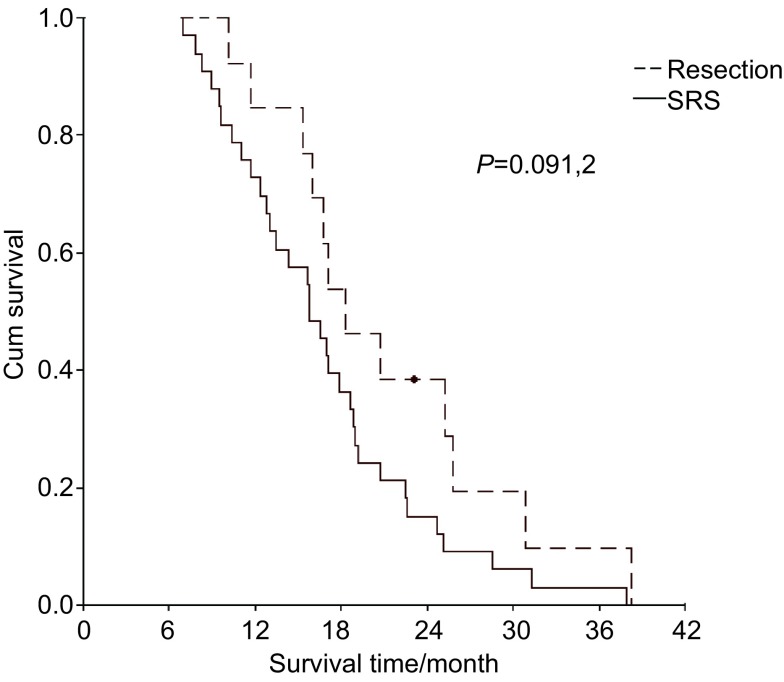
The clinical data of 46 non-small cell lung cancer patients with synchronous solitary brain metastasis were retrospectively reviewed. All patients underwent surgical resection of primary lung tumor, followed by whole brain radiotherapy and chemotherapy. In addition, 13 out of the 46 patients underwent resection of brain metastasis, whereas the remaining 33 patients received stereotactic radiosurgery.
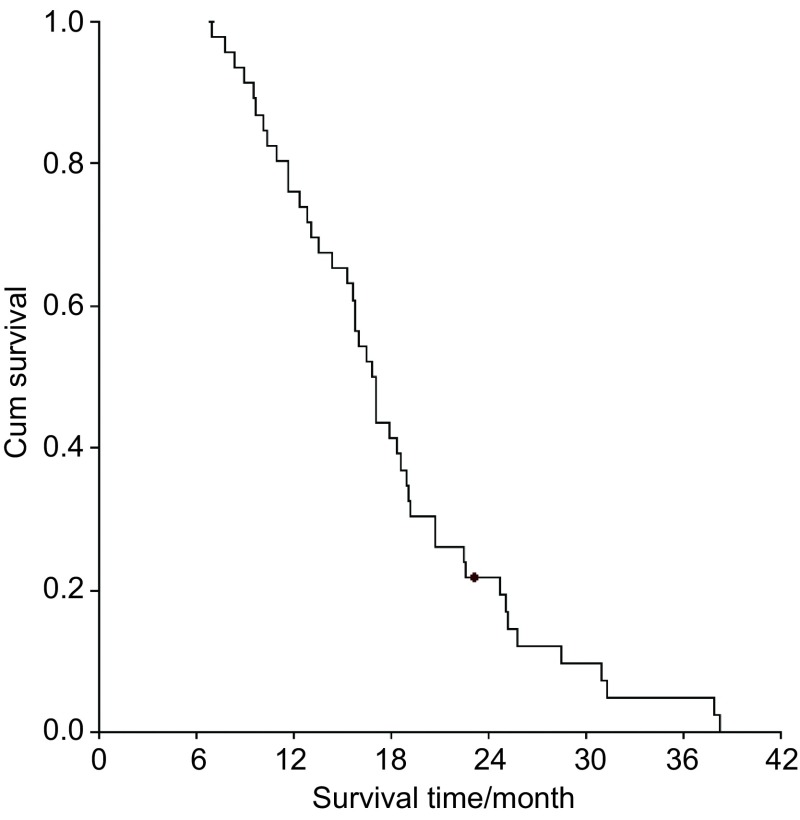
The median survival time of the enrolled patients was 16.8 months. The 1-, 2-, and 3-year survival rates were 76.1%, 20.9%, and 4.7%, respectively. The median survival times of the patients with brain metastasis resection or stereotactic radiosurgery were 18.3 and 15.8 months, respectively (P=0.091,2).
Surgical resection of primary lung tumor and brain metastasis may improve prognosis of non-small cell lung cancer patients with synchronous solitary brain metastasis. However, the survival benefit of surgical resection over brain metastasis resection or stereotactic radiosurgery is uncertain.
脑转移在非小细胞肺癌中很常见。常用治疗方法包括放疗和化疗。然而,这些方法导致患者预后较差。本研究旨在评估手术切除在同步孤立性脑转移的非小细胞肺癌患者多模式治疗中的有效性。
回顾性分析46例同步孤立性脑转移的非小细胞肺癌患者的临床资料。所有患者均接受原发性肺肿瘤手术切除,随后进行全脑放疗和化疗。此外,46例患者中有13例接受了脑转移瘤切除术,其余33例患者接受了立体定向放射外科治疗。
入组患者的中位生存时间为16.8个月。1年、2年和3年生存率分别为76.1%、20.9%和4.7%。接受脑转移瘤切除术或立体定向放射外科治疗的患者中位生存时间分别为18.3个月和15.8个月(P=0.091,2)。
手术切除原发性肺肿瘤和脑转移瘤可能改善同步孤立性脑转移的非小细胞肺癌患者的预后。然而,手术切除相对于脑转移瘤切除术或立体定向放射外科治疗的生存获益尚不确定。