Laboratory for Cognitive Neuroscience, Centre for Cognitive and Neural Systems, The University of Edinburgh, Edinburgh EH8 9JZ, United Kingdom.
Learn Mem. 2013 Dec 17;21(1):28-36. doi: 10.1101/lm.032169.113.
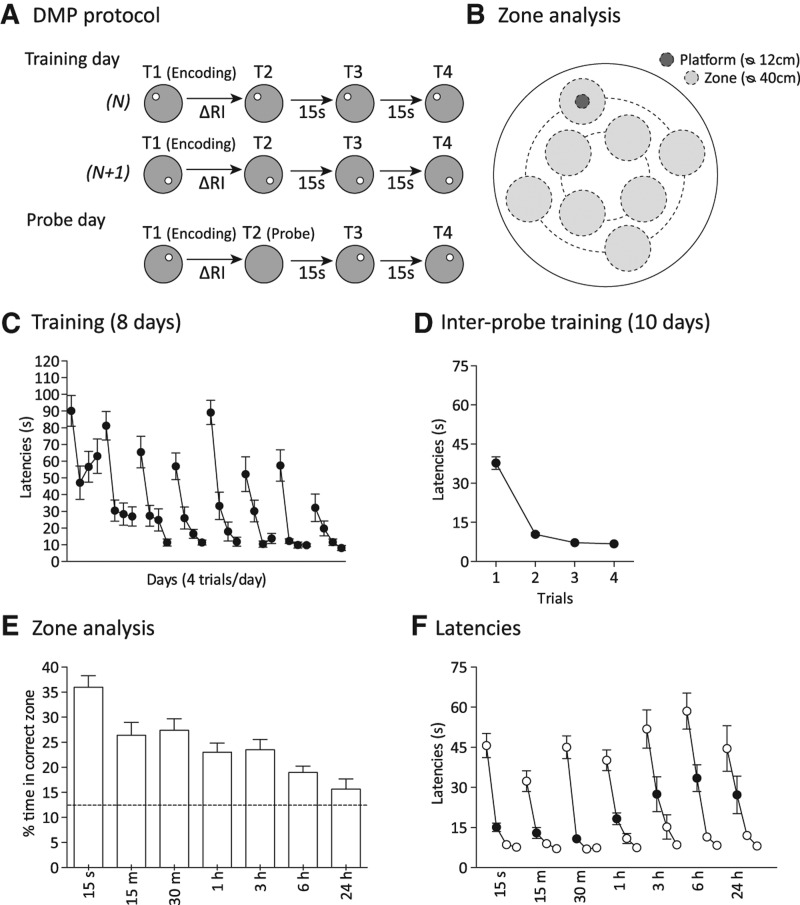
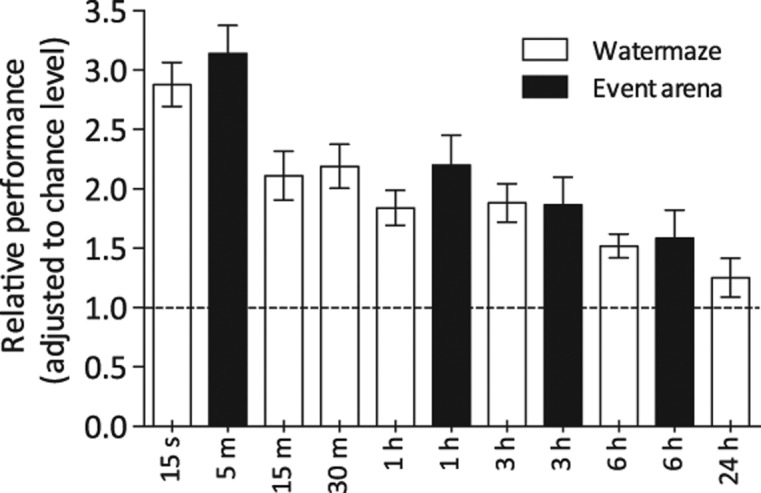
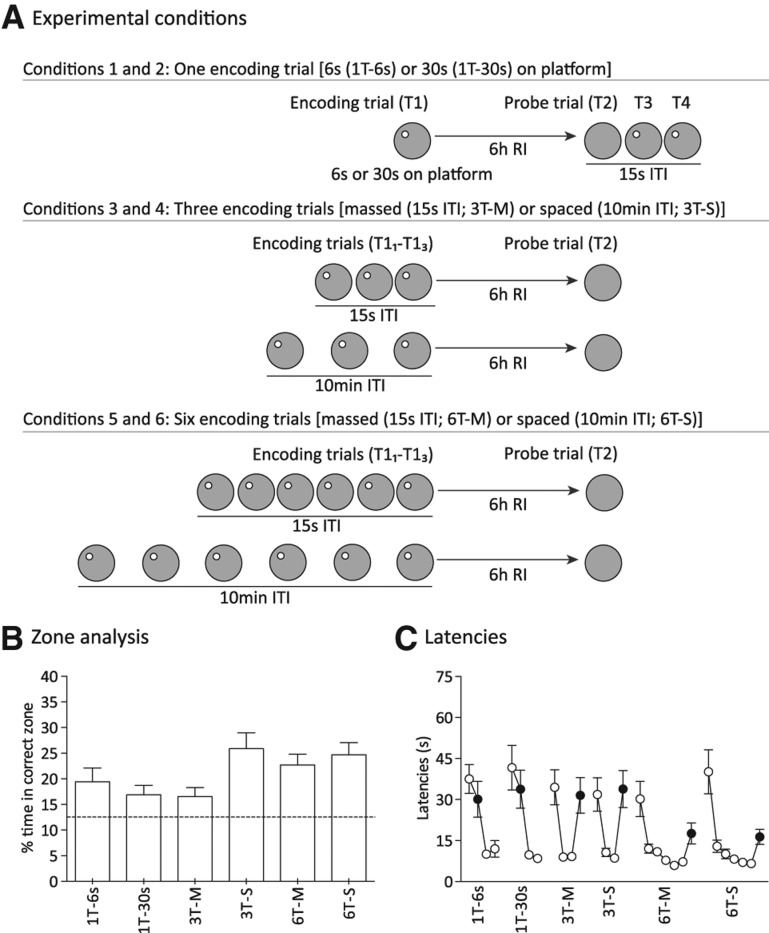
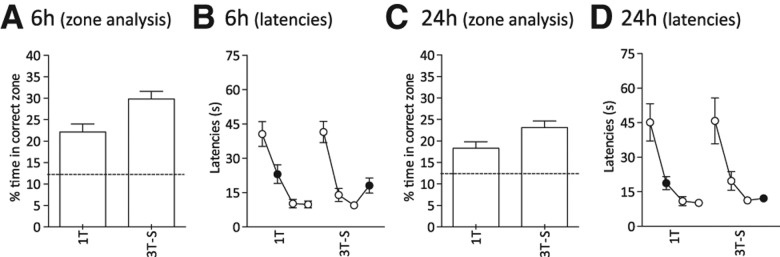
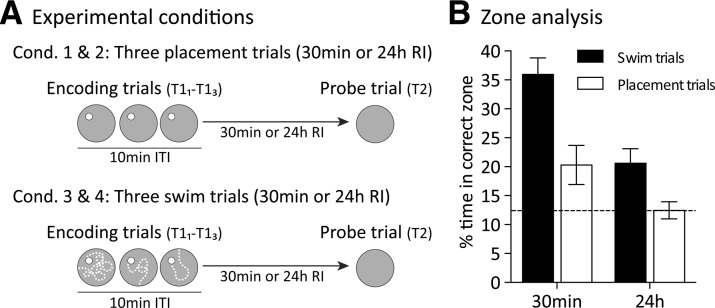
The watermaze delayed matching-to-place (DMP) task was modified to include probe trials, to quantify search preference for the correct place. Using a zone analysis of search preference, a gradual decay of one-trial memory in rats was observed over 24 h with weak memory consistently detected at a retention interval of 6 h, but unreliably at 24 h. This forgetting function in the watermaze was similar to that found using a search-preference measure in a food-reinforced dry-land DMP task in a previous study. In a search for strong and weak encoding conditions, essential for a later behavioral tagging study, three encoding trials gave strong 6-h and 24-h memory when trials were separated by 10 min (spaced training) but not 15 sec (massed training). The use of six encoding trials gave good 6-h memory with both spaced and massed training. With respect to weak encoding, placement on the escape platform, instead of the rat swimming to it, resulted in detectable memory at 30 min but this had faded to chance within 24 h. In contrast to the search-preference measure, latencies to cross the correct place revealed neither the gradual forgetting of place memory nor the benefit of spaced training.
水迷宫延迟匹配到位置(DMP)任务经过修改,增加了探针试验,以量化对正确位置的搜索偏好。使用搜索偏好的分区分析,在 24 小时内观察到大鼠的一次性记忆逐渐衰减,在 6 小时的潜伏期内始终检测到较弱的记忆,但在 24 小时内不可靠。水迷宫中的这种遗忘功能与之前在一项食物强化旱地 DMP 任务中使用搜索偏好测量发现的功能相似。在寻找强和弱编码条件的过程中,这对于后续的行为标记研究至关重要,当试验间隔为 10 分钟(间隔训练)而不是 15 秒(集中训练)时,三个编码试验分别产生了强的 6 小时和 24 小时记忆,但集中训练则不行。使用六个编码试验可以在间隔和集中训练中获得良好的 6 小时记忆。关于弱编码,将大鼠放在逃生平台上,而不是让其游向平台,会在 30 分钟时产生可检测到的记忆,但在 24 小时内记忆会消退到随机水平。与搜索偏好测量不同,穿越正确位置的潜伏期既没有揭示位置记忆的逐渐遗忘,也没有显示间隔训练的益处。