Department of Biochemistry and Cellular and Molecular Biology of Plants, Estación Experimental del Zaidín, Consejo Superior de Investigaciones Científicas Granada, Spain.
Department of Stress Biology and Plant Pathology, Centro de Edafología y Biología Aplicada del Segura, Consejo Superior de Investigaciones Científicas Murcia, Spain.
Front Plant Sci. 2013 Nov 28;4:460. doi: 10.3389/fpls.2013.00460. eCollection 2013.
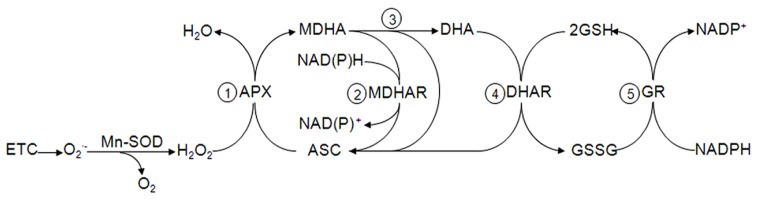
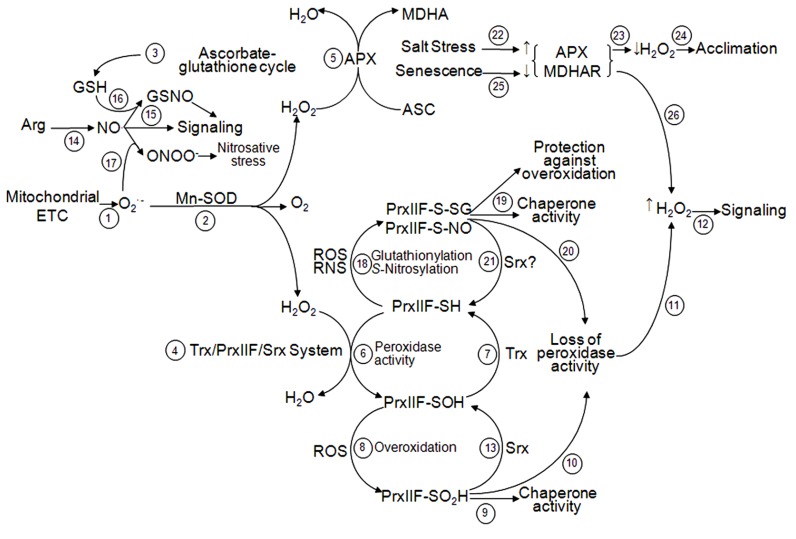
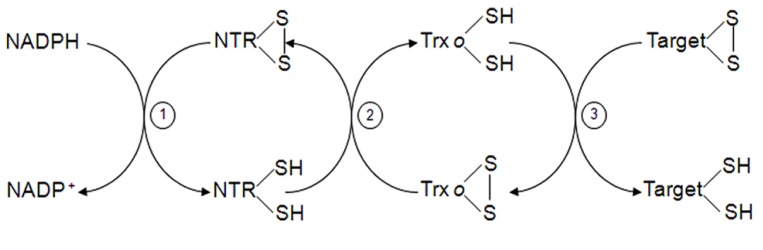
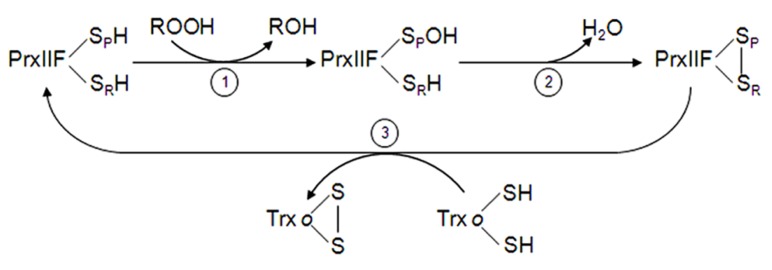
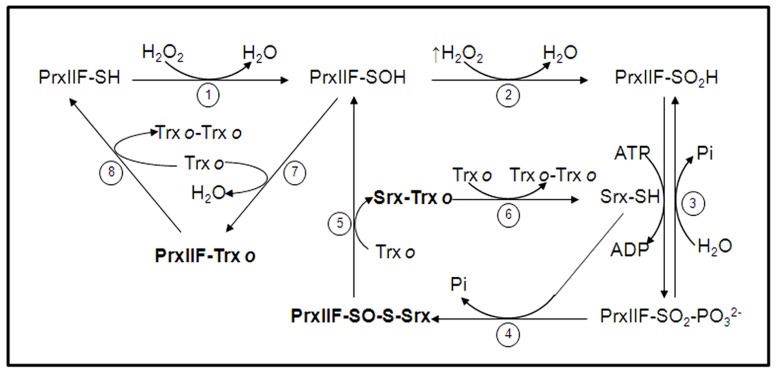
Mitochondrial respiration provides the energy needed to drive metabolic and transport processes in cells. Mitochondria are a significant site of reactive oxygen species (ROS) production in plant cells, and redox-system components obey fine regulation mechanisms that are essential in protecting the mitochondrial integrity. In addition to ROS, there are compelling indications that nitric oxide can be generated in this organelle by both reductive and oxidative pathways. ROS and reactive nitrogen species play a key role in signaling but they can also be deleterious via oxidation of macromolecules. The high production of ROS obligates mitochondria to be provided with a set of ROS scavenging mechanisms. The first line of mitochondrial antioxidants is composed of superoxide dismutase and the enzymes of the ascorbate-glutathione cycle, which are not only able to scavenge ROS but also to repair cell damage and possibly serve as redox sensors. The dithiol-disulfide exchanges form independent signaling nodes and act as antioxidant defense mechanisms as well as sensor proteins modulating redox signaling during development and stress adaptation. The presence of thioredoxin (Trx), peroxiredoxin (Prx) and sulfiredoxin (Srx) in the mitochondria has been recently reported. Cumulative results obtained from studies in salt stress models have demonstrated that these redox proteins play a significant role in the establishment of salt tolerance. The Trx/Prx/Srx system may be subjected to a fine regulated mechanism involving post-translational modifications, among which S-glutathionylation and S-nitrosylation seem to exhibit a critical role that is just beginning to be understood. This review summarizes our current knowledge in antioxidative systems in plant mitochondria, their interrelationships, mechanisms of compensation and some unresolved questions, with special focus on their response to abiotic stress.
线粒体呼吸为细胞内的代谢和运输过程提供所需的能量。线粒体是植物细胞中活性氧(ROS)产生的重要场所,氧化还原系统组件遵循精细的调节机制,这对于保护线粒体完整性至关重要。除了 ROS,还有令人信服的证据表明,一氧化氮可以通过还原和氧化途径在这个细胞器中产生。ROS 和活性氮物种在信号转导中起着关键作用,但它们也可以通过大分子的氧化而产生有害作用。ROS 的大量产生使线粒体必须配备一套 ROS 清除机制。线粒体抗氧化剂的第一道防线由超氧化物歧化酶和抗坏血酸-谷胱甘肽循环的酶组成,它们不仅能够清除 ROS,还能够修复细胞损伤,并可能作为氧化还原传感器。二硫键交换形成独立的信号节点,作为抗氧化防御机制以及作为传感器蛋白,在发育和应激适应过程中调节氧化还原信号。硫氧还蛋白(Trx)、过氧化物酶(Prx)和硫化物还原酶(Srx)在线粒体中的存在最近已经被报道。从盐胁迫模型研究中获得的累积结果表明,这些氧化还原蛋白在建立盐耐受性方面起着重要作用。Trx/Prx/Srx 系统可能受到涉及翻译后修饰的精细调节机制的影响,其中 S-谷胱甘肽化和 S-亚硝基化似乎表现出关键作用,这一作用才刚刚开始被理解。本文综述了我们目前对植物线粒体抗氧化系统及其相互关系、补偿机制和一些未解决问题的认识,特别关注它们对非生物胁迫的反应。