Viñas María R, Tuduri Ezequiel, Galar Alicia, Yih Katherine, Pichel Mariana, Stelling John, Brengi Silvina P, Della Gaspera Anabella, van der Ploeg Claudia, Bruno Susana, Rogé Ariel, Caffer María I, Kulldorff Martin, Galas Marcelo
Departamento Bacteriología, Instituto Nacional de Enfermedades Infecciosas ANLIS "Dr C. G. Malbrán", Buenos Aires, Argentina.
Department of Medicine, Brigham and Women's Hospital, World Health Organization Collaborating Centre for Surveillance of Antimicrobial Resistance, Boston, Massachusetts, United States of America.
PLoS Negl Trop Dis. 2013 Dec 12;7(12):e2521. doi: 10.1371/journal.pntd.0002521. eCollection 2013.
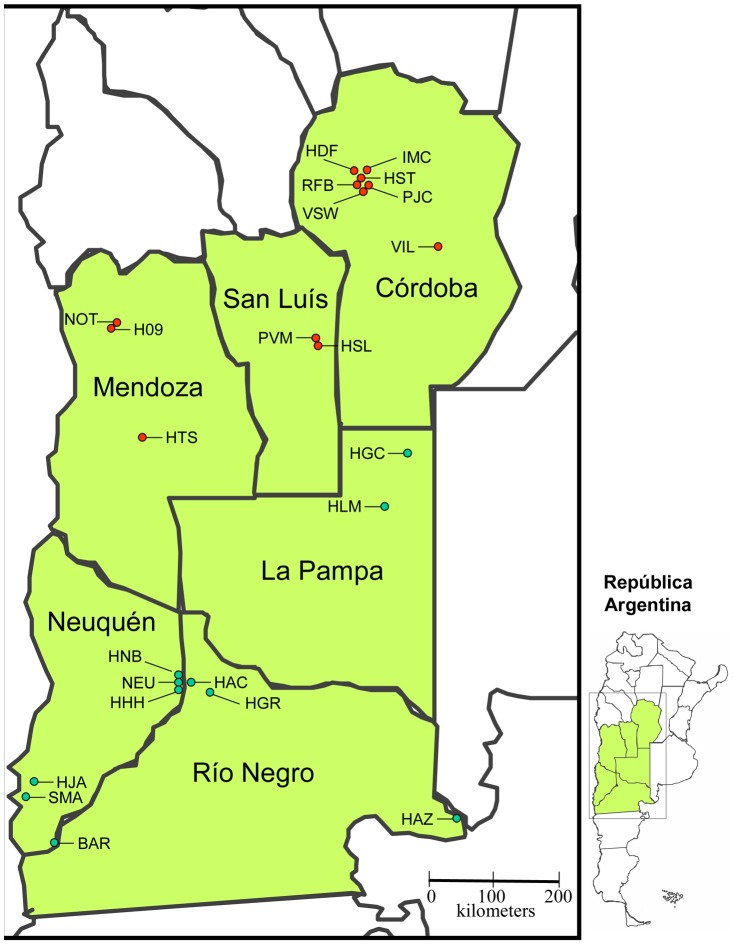
To implement effective control measures, timely outbreak detection is essential. Shigella is the most common cause of bacterial diarrhea in Argentina. Highly resistant clones of Shigella have emerged, and outbreaks have been recognized in closed settings and in whole communities. We hereby report our experience with an evolving, integrated, laboratory-based, near real-time surveillance system operating in six contiguous provinces of Argentina during April 2009 to March 2012.
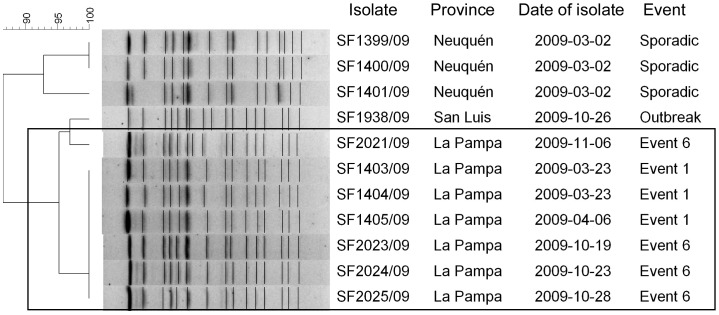
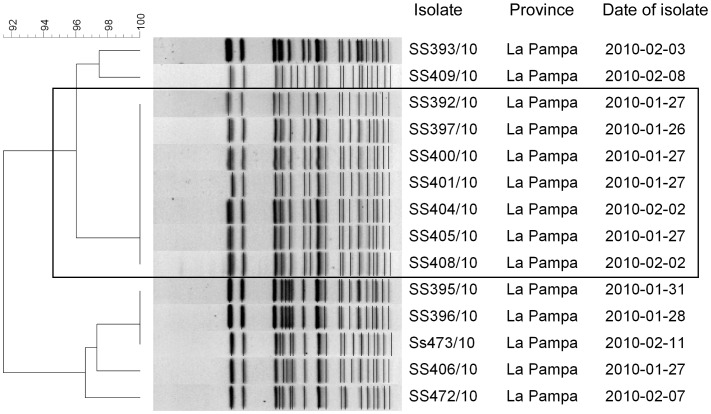
To detect localized shigellosis outbreaks timely, we used the prospective space-time permutation scan statistic algorithm of SaTScan, embedded in WHONET software. Twenty three laboratories sent updated Shigella data on a weekly basis to the National Reference Laboratory. Cluster detection analysis was performed at several taxonomic levels: for all Shigella spp., for serotypes within species and for antimicrobial resistance phenotypes within species. Shigella isolates associated with statistically significant signals (clusters in time/space with recurrence interval ≥365 days) were subtyped by pulsed field gel electrophoresis (PFGE) using PulseNet protocols.
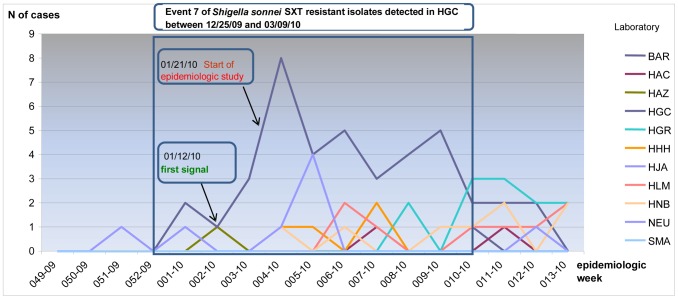
In three years of active surveillance, our system detected 32 statistically significant events, 26 of them identified before hospital staff was aware of any unexpected increase in the number of Shigella isolates. Twenty-six signals were investigated by PFGE, which confirmed a close relationship among the isolates for 22 events (84.6%). Seven events were investigated epidemiologically, which revealed links among the patients. Seventeen events were found at the resistance profile level. The system detected events of public health importance: infrequent resistance profiles, long-lasting and/or re-emergent clusters and events important for their duration or size, which were reported to local public health authorities.
CONCLUSIONS/SIGNIFICANCE: The WHONET-SaTScan system may serve as a model for surveillance and can be applied to other pathogens, implemented by other networks, and scaled up to national and international levels for early detection and control of outbreaks.
为实施有效的控制措施,及时发现疫情至关重要。志贺氏菌是阿根廷细菌性腹泻最常见的病因。高耐药性志贺氏菌克隆株不断出现,在封闭场所和整个社区均已发现疫情。我们在此报告2009年4月至2012年3月期间在阿根廷六个相邻省份运行的一个不断发展的、基于实验室的、近实时综合监测系统的经验。
为及时发现局部志贺氏菌病疫情,我们使用了嵌入WHONET软件的SaTScan前瞻性时空置换扫描统计算法。23个实验室每周向国家参考实验室发送最新的志贺氏菌数据。在几个分类水平上进行聚类检测分析:针对所有志贺氏菌属、种内血清型以及种内抗菌药物耐药表型。与具有统计学显著信号(时间/空间上的聚类,复发间隔≥365天)相关的志贺氏菌分离株通过脉冲场凝胶电泳(PFGE)使用PulseNet方案进行亚型分析。
在三年的主动监测中,我们的系统检测到32起具有统计学显著意义的事件,其中26起在医院工作人员意识到志贺氏菌分离株数量出现任何意外增加之前就已确定。通过PFGE对26个信号进行了调查,证实其中22起事件(84.6%)的分离株之间存在密切关系。对7起事件进行了流行病学调查,揭示了患者之间的联系。在耐药谱水平上发现了17起事件。该系统检测到具有公共卫生重要性的事件:罕见的耐药谱、持久和/或再次出现的聚类以及因其持续时间或规模而重要的事件,并向当地公共卫生当局进行了报告。
结论/意义:WHONET - SaTScan系统可作为监测模型,可应用于其他病原体,由其他网络实施,并扩大到国家和国际层面,以早期发现和控制疫情。