Leone Lynnette M, McCourt Mark E
Center for Visual and Cognitive Neuroscience, Department of Psychology, NDSU Department 2765, P.O. Box 6050, College of Science and Mathematics, North Dakota State University, Fargo, ND 58105-6050, USA; e-mail:
Iperception. 2013 Jun 3;4(4):213-28. doi: 10.1068/i0532. eCollection 2013.
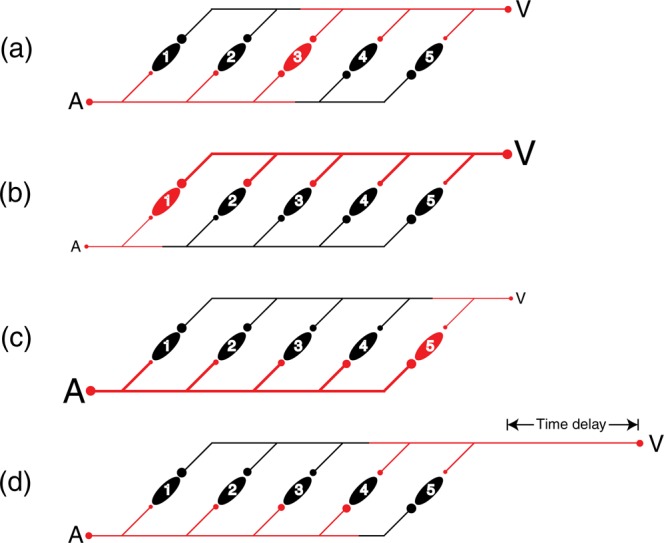
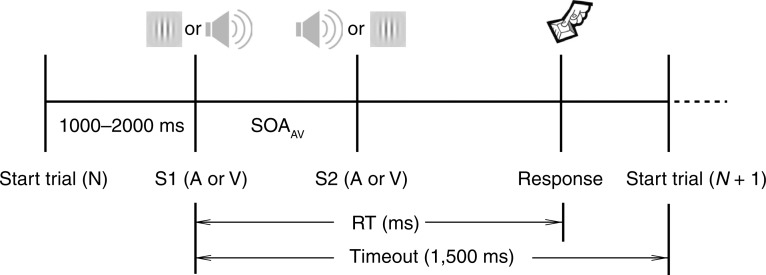
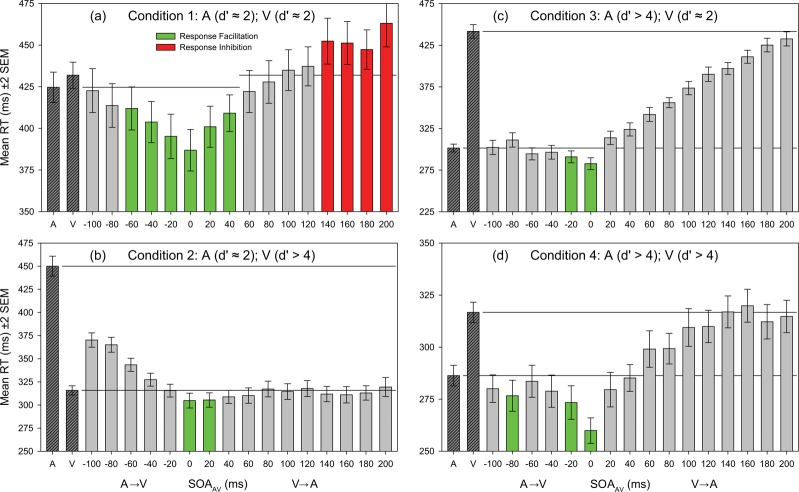
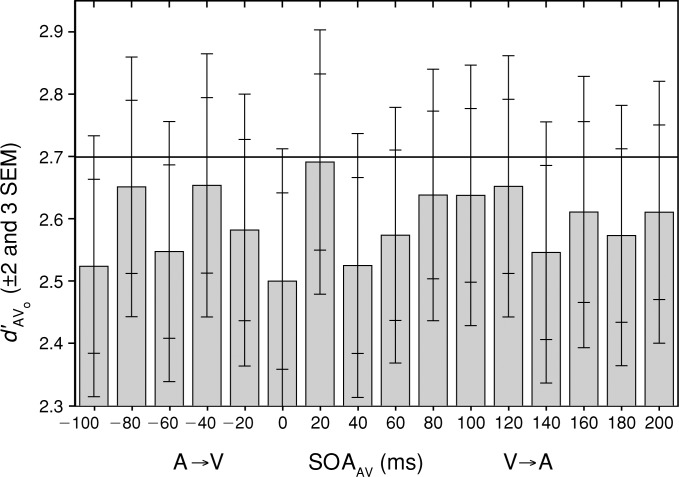
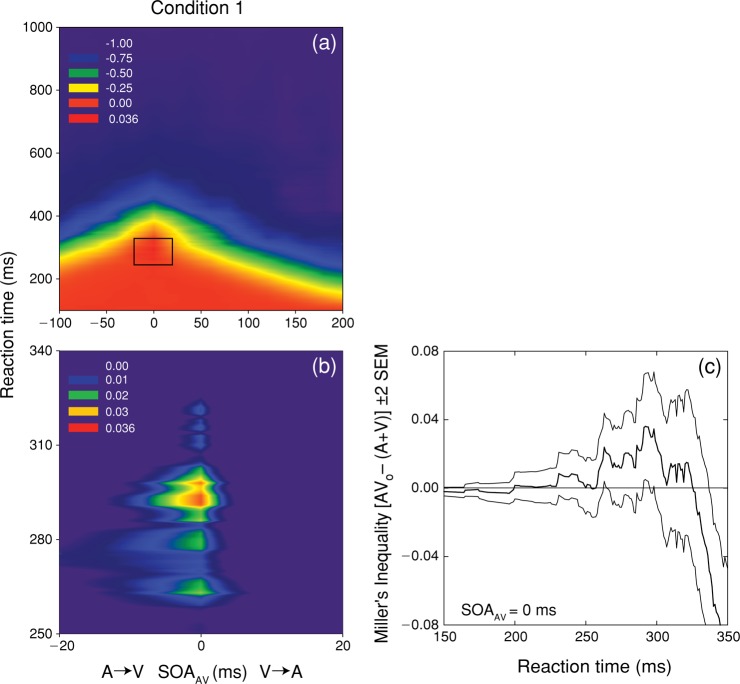
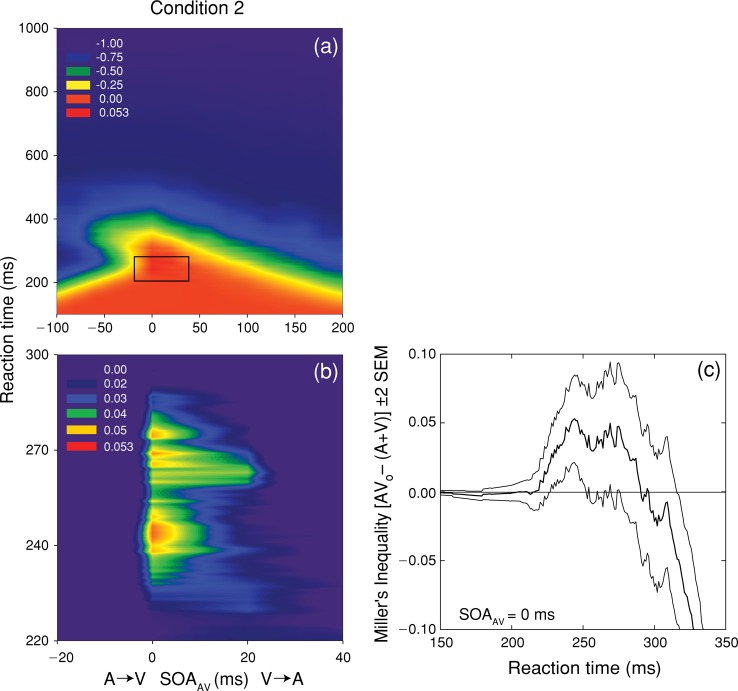
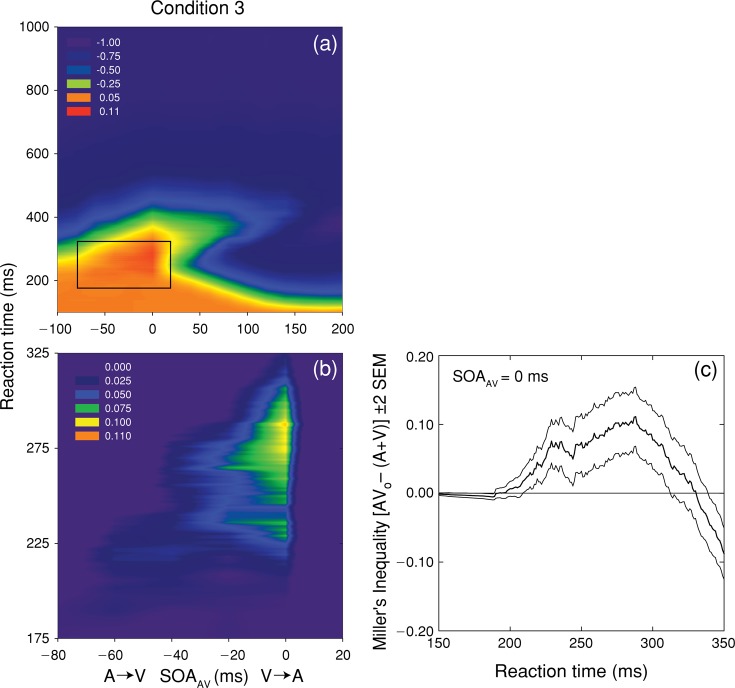
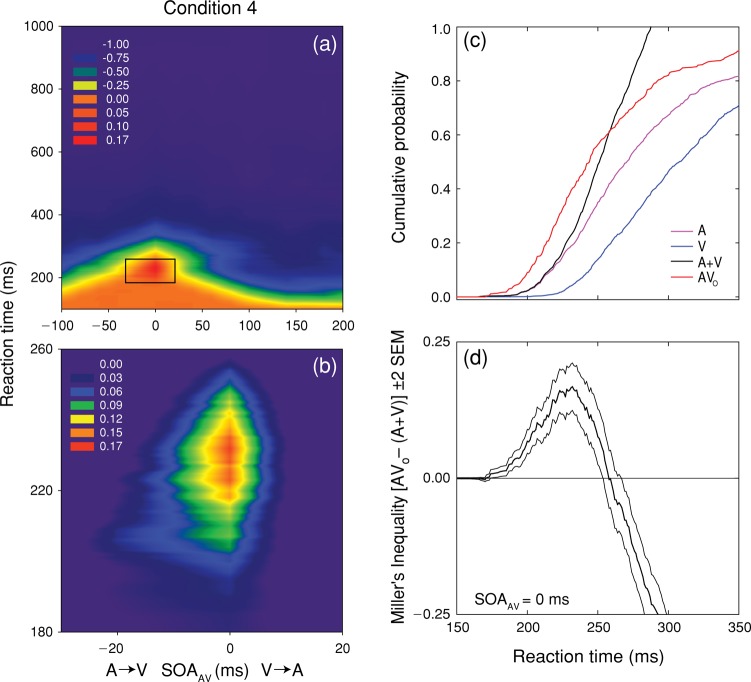
A series of experiments measured the audiovisual stimulus onset asynchrony (SOAAV), yielding facilitative multisensory integration. We evaluated (1) the range of SOAAV over which facilitation occurred when unisensory stimuli were weak; (2) whether the range of SOAAV producing facilitation supported the hypothesis that physiological simultaneity of unisensory activity governs multisensory facilitation; and (3) whether AV multisensory facilitation depended on relative stimulus intensity. We compared response-time distributions to unisensory auditory (A) and visual (V) stimuli with those to AV stimuli over a wide range (300 and 20 ms increments) of SOAAV, across four conditions of varying stimulus intensity. In condition 1, the intensity of unisensory stimuli was adjusted such that d' ≈ 2. In condition 2, V stimulus intensity was increased (d' > 4), while A stimulus intensity was as in condition 1. In condition 3, A stimulus intensity was increased (d' > 4) while V stimulus intensity was as in condition 1. In condition 4, both A and V stimulus intensities were increased to clearly suprathreshold levels (d' > 4). Across all conditions of stimulus intensity, significant multisensory facilitation occurred exclusively for simultaneously presented A and V stimuli. In addition, facilitation increased as stimulus intensity increased, in disagreement with inverse effectiveness. These results indicate that the requirements for facilitative multisensory integration include both physical and physiological simultaneity.
一系列实验测量了视听刺激起始异步性(SOAAV),产生了促进性多感官整合。我们评估了:(1)单感官刺激较弱时产生促进作用的SOAAV范围;(2)产生促进作用的SOAAV范围是否支持单感官活动的生理同步性支配多感官促进作用这一假设;以及(3)视听多感官促进作用是否取决于相对刺激强度。我们在四种不同刺激强度条件下,在较宽范围(300和20毫秒增量)的SOAAV内,比较了对单感官听觉(A)和视觉(V)刺激的反应时间分布与对AV刺激的反应时间分布。在条件1中,调整单感官刺激的强度,使d'≈2。在条件2中,V刺激强度增加(d'>4),而A刺激强度与条件1相同。在条件3中,A刺激强度增加(d'>4),而V刺激强度与条件1相同。在条件4中,A和V刺激强度均增加到明显的阈上水平(d'>4)。在所有刺激强度条件下,显著的多感官促进作用仅发生在同时呈现的A和V刺激时。此外,促进作用随着刺激强度的增加而增强,这与反向有效性不一致。这些结果表明,促进性多感官整合的要求包括物理和生理同步性。