Noel Jean-Paul, Modi Kahan, Wallace Mark T, Van der Stoep Nathan
Neuroscience Graduate Program, Vanderbilt Brain Institute, Vanderbilt University Medical Center, Vanderbilt University, Nashville, TN, 37235, USA.
Vanderbilt Brain Institute, Vanderbilt University Medical Center, Vanderbilt University, Nashville, TN, 37235, USA.
Exp Brain Res. 2018 Jul;236(7):1939-1951. doi: 10.1007/s00221-018-5274-7. Epub 2018 Apr 26.
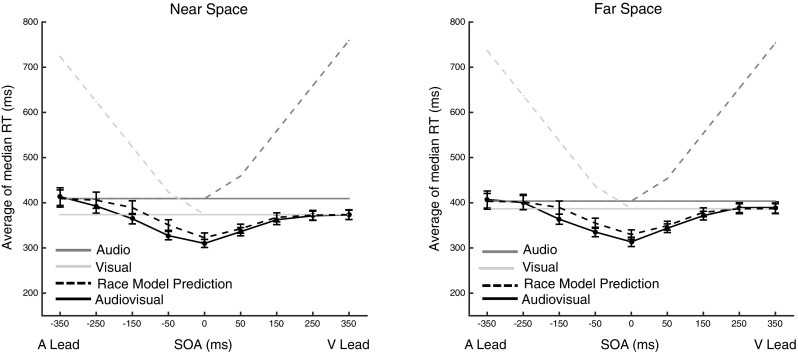
The integration of information across sensory modalities is dependent on the spatiotemporal characteristics of the stimuli that are paired. Despite large variation in the distance over which events occur in our environment, relatively little is known regarding how stimulus-observer distance affects multisensory integration. Prior work has suggested that exteroceptive stimuli are integrated over larger temporal intervals in near relative to far space, and that larger multisensory facilitations are evident in far relative to near space. Here, we sought to examine the interrelationship between these previously established distance-related features of multisensory processing. Participants performed an audiovisual simultaneity judgment and redundant target task in near and far space, while audiovisual stimuli were presented at a range of temporal delays (i.e., stimulus onset asynchronies). In line with the previous findings, temporal acuity was poorer in near relative to far space. Furthermore, reaction time to asynchronously presented audiovisual targets suggested a temporal window for fast detection-a range of stimuli asynchronies that was also larger in near as compared to far space. However, the range of reaction times over which multisensory response enhancement was observed was limited to a restricted range of relatively small (i.e., 150 ms) asynchronies, and did not differ significantly between near and far space. Furthermore, for synchronous presentations, these distance-related (i.e., near vs. far) modulations in temporal acuity and multisensory gain correlated negatively at an individual subject level. Thus, the findings support the conclusion that multisensory temporal binding and gain are asymmetrically modulated as a function of distance from the observer, and specifies that this relationship is specific for temporally synchronous audiovisual stimulus presentations.
跨感觉通道的信息整合取决于配对刺激的时空特征。尽管我们环境中事件发生的距离差异很大,但关于刺激与观察者之间的距离如何影响多感觉整合,我们所知甚少。先前的研究表明,相对于远空间,近空间中的外感受性刺激在更大的时间间隔上进行整合,并且相对于近空间,远空间中更大的多感觉促进作用更为明显。在这里,我们试图研究多感觉处理中这些先前确定的与距离相关的特征之间的相互关系。参与者在近空间和远空间中执行视听同时性判断和冗余目标任务,同时以一系列时间延迟(即刺激起始异步性)呈现视听刺激。与先前的研究结果一致,相对于远空间,近空间中的时间敏锐度较差。此外,对异步呈现的视听目标的反应时间表明存在一个快速检测的时间窗口——一系列刺激异步性,与远空间相比,近空间中的该窗口也更大。然而,观察到多感觉反应增强的反应时间范围仅限于相对较小(即150毫秒)的异步性的受限范围,并且在近空间和远空间之间没有显著差异。此外,对于同步呈现,在个体受试者水平上,时间敏锐度和多感觉增益中的这些与距离相关的(即近与远)调制呈负相关。因此,这些发现支持以下结论:多感觉时间绑定和增益作为与观察者距离的函数被不对称地调制,并明确指出这种关系对于时间同步的视听刺激呈现是特定的。