Bowden Jack, Glimm Ekkehard
MRC Biostatistics Unit, Cambridge, CB2 OSR, UK.
Biom J. 2014 Mar;56(2):332-49. doi: 10.1002/bimj.201200245. Epub 2013 Dec 18.
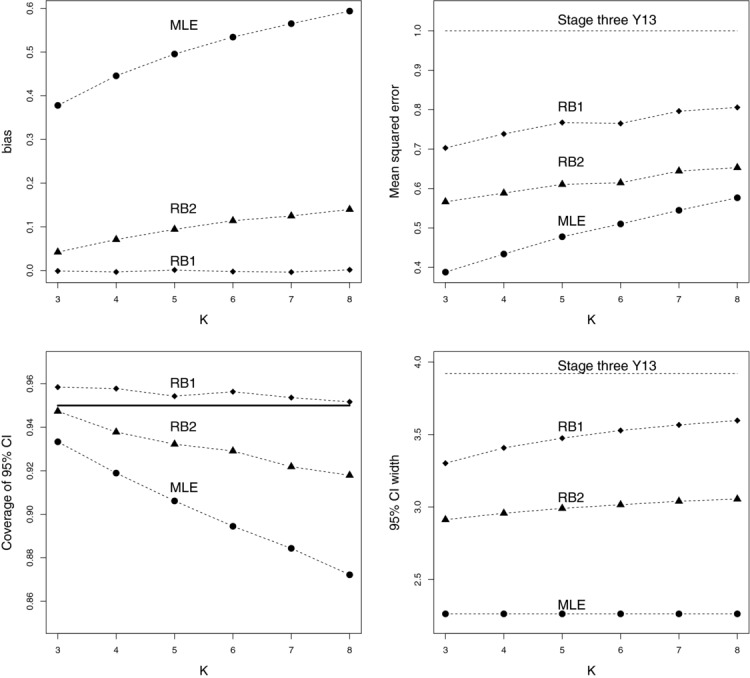
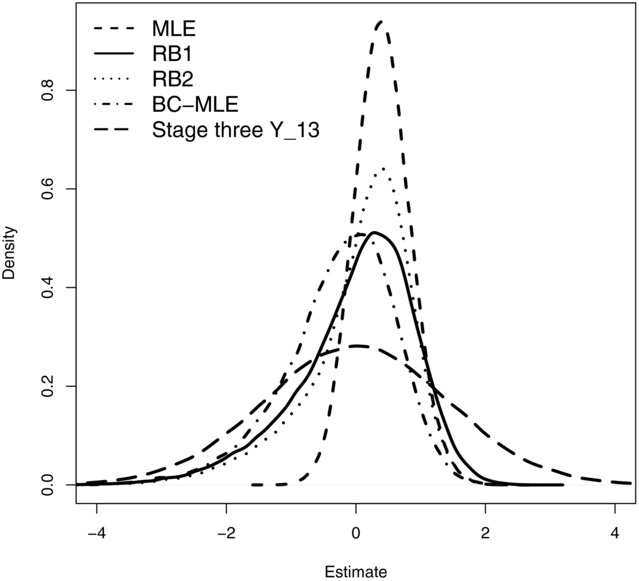
The two-stage drop-the-loser design provides a framework for selecting the most promising of K experimental treatments in stage one, in order to test it against a control in a confirmatory analysis at stage two. The multistage drop-the-losers design is both a natural extension of the original two-stage design, and a special case of the more general framework of Stallard & Friede () (Stat. Med. 27, 6209-6227). It may be a useful strategy if deselecting all but the best performing treatment after one interim analysis is thought to pose an unacceptable risk of dropping the truly best treatment. However, estimation has yet to be considered for this design. Building on the work of Cohen & Sackrowitz () (Stat. Prob. Lett. 8, 273-278), we derive unbiased and near-unbiased estimates in the multistage setting. Complications caused by the multistage selection process are shown to hinder a simple identification of the multistage uniform minimum variance conditionally unbiased estimate (UMVCUE); two separate but related estimators are therefore proposed, each containing some of the UMVCUEs theoretical characteristics. For a specific example of a three-stage drop-the-losers trial, we compare their performance against several alternative estimators in terms of bias, mean squared error, confidence interval width and coverage.
两阶段淘汰失败者设计提供了一个框架,用于在第一阶段从K种实验性治疗方法中选择最有前景的方法,以便在第二阶段的验证性分析中将其与对照进行比较。多阶段淘汰失败者设计既是原始两阶段设计的自然扩展,也是Stallard & Friede ()(《统计医学》27, 6209 - 6227)更一般框架的一个特殊情况。如果认为在一次中期分析后淘汰除表现最佳的治疗方法之外的所有方法会带来淘汰真正最佳治疗方法的不可接受风险,那么这可能是一种有用的策略。然而,尚未考虑该设计的估计问题。基于Cohen & Sackrowitz ()(《统计与概率快报》8, 273 - 278)的工作,我们在多阶段设置中推导了无偏和近似无偏估计。结果表明,多阶段选择过程引起的复杂性阻碍了对多阶段均匀最小方差条件无偏估计(UMVCUE)的简单识别;因此提出了两个单独但相关的估计量,每个都包含一些UMVCUE的理论特征。对于一个三阶段淘汰失败者试验的具体例子,我们在偏差、均方误差、置信区间宽度和覆盖率方面将它们的性能与几种替代估计量进行了比较。