Department of Mathematics & Statistics, Lancaster University, Lancaster, LA1 4YF, UK.
Roche Products Ltd, Welwyn Garden City, UK.
BMC Med. 2018 Feb 28;16(1):29. doi: 10.1186/s12916-018-1017-7.
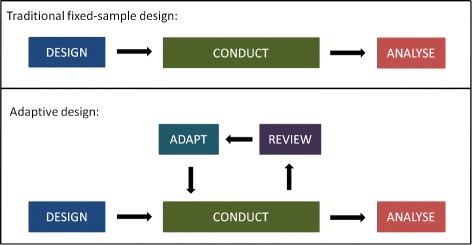
Adaptive designs can make clinical trials more flexible by utilising results accumulating in the trial to modify the trial's course in accordance with pre-specified rules. Trials with an adaptive design are often more efficient, informative and ethical than trials with a traditional fixed design since they often make better use of resources such as time and money, and might require fewer participants. Adaptive designs can be applied across all phases of clinical research, from early-phase dose escalation to confirmatory trials. The pace of the uptake of adaptive designs in clinical research, however, has remained well behind that of the statistical literature introducing new methods and highlighting their potential advantages. We speculate that one factor contributing to this is that the full range of adaptations available to trial designs, as well as their goals, advantages and limitations, remains unfamiliar to many parts of the clinical community. Additionally, the term adaptive design has been misleadingly used as an all-encompassing label to refer to certain methods that could be deemed controversial or that have been inadequately implemented.We believe that even if the planning and analysis of a trial is undertaken by an expert statistician, it is essential that the investigators understand the implications of using an adaptive design, for example, what the practical challenges are, what can (and cannot) be inferred from the results of such a trial, and how to report and communicate the results. This tutorial paper provides guidance on key aspects of adaptive designs that are relevant to clinical triallists. We explain the basic rationale behind adaptive designs, clarify ambiguous terminology and summarise the utility and pitfalls of adaptive designs. We discuss practical aspects around funding, ethical approval, treatment supply and communication with stakeholders and trial participants. Our focus, however, is on the interpretation and reporting of results from adaptive design trials, which we consider vital for anyone involved in medical research. We emphasise the general principles of transparency and reproducibility and suggest how best to put them into practice.
适应性设计可以通过利用试验中积累的结果,根据预定规则修改试验过程,从而使临床试验更加灵活。与传统的固定设计相比,具有适应性设计的试验通常更有效、信息更丰富、更符合伦理道德,因为它们通常可以更好地利用时间和金钱等资源,并且可能需要更少的参与者。适应性设计可应用于临床研究的所有阶段,从早期剂量递增到确证性试验。然而,适应性设计在临床研究中的采用速度仍然远远落后于引入新方法并强调其潜在优势的统计文献。我们推测,造成这种情况的一个因素是,许多临床界人士对试验设计可用的各种适应性以及它们的目标、优势和局限性仍然不熟悉。此外,适应性设计这个术语被误导性地用作一个包罗万象的标签,用于指代某些可能被认为有争议或实施不当的方法。我们认为,即使试验的规划和分析由专家统计学家进行,调查人员了解使用适应性设计的影响也是至关重要的,例如,实际挑战是什么,从这样的试验结果中可以(和不能)推断出什么,以及如何报告和交流结果。本教程论文提供了与临床研究人员相关的适应性设计的关键方面的指导。我们解释了适应性设计背后的基本原理,澄清了模糊的术语,并总结了适应性设计的实用性和陷阱。我们讨论了与资金、伦理批准、治疗供应以及与利益相关者和试验参与者沟通有关的实际问题。然而,我们的重点是解释和报告适应性设计试验的结果,我们认为这对参与医学研究的任何人都至关重要。我们强调透明度和可重复性的一般原则,并提出如何最好地将它们付诸实践。