Department of ORL, University Hospital, Petersgraben 4, CH - 4031 Basel, Switzerland.
J Neuroeng Rehabil. 2013 Dec 19;10:115. doi: 10.1186/1743-0003-10-115.
This study investigated changes in stance movement strategies and muscle synergies when bilateral peripheral vestibular loss (BVL) subjects are provided feedback of pelvis sway angle.
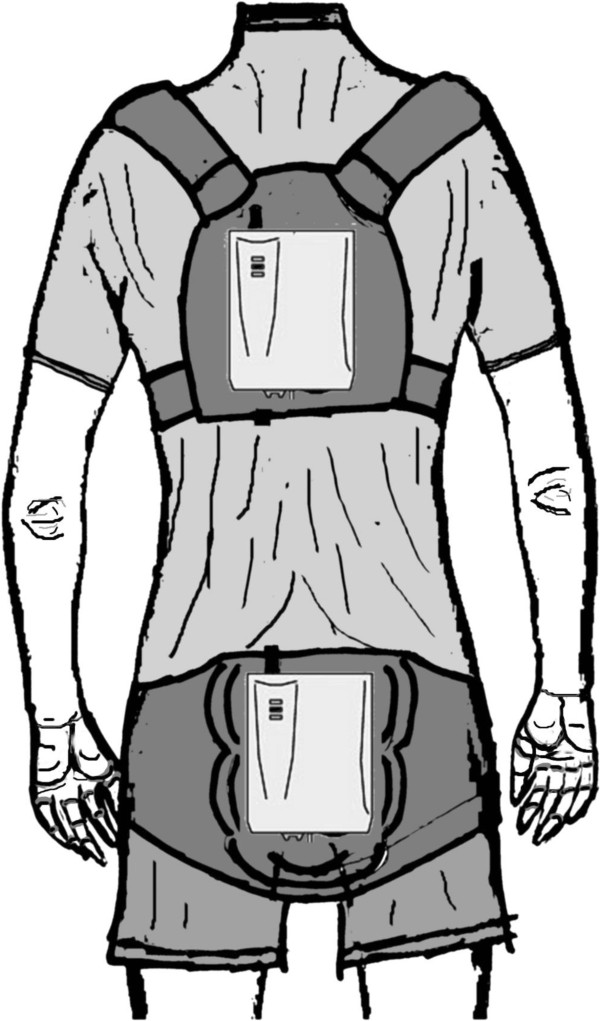
Six BVL (all male) and 7 age-matched male healthy control (HC) subjects performed 3 stance tasks: standing feet hip width apart, eyes closed, on a firm and foam surface, and eyes open on foam. Pelvis and upper trunk movements were recorded in the roll and pitch planes. Surface EMG was recorded from pairs of antagonistic muscles at the lower leg, trunk and upper arm. Subjects were first assessed without feedback. Then, they received training with vibrotactile, auditory, and fall-warning visual feedback during stance tasks before being reassessed with feedback.
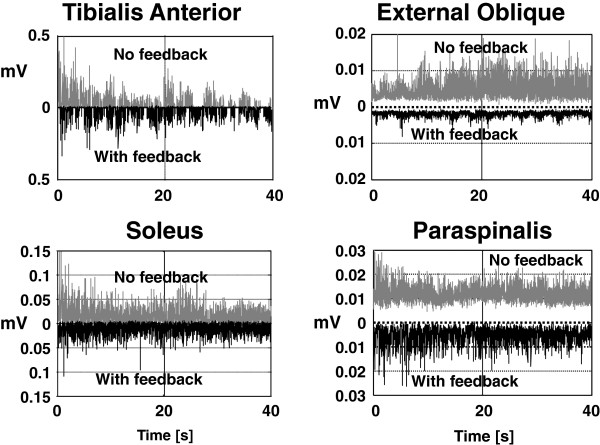
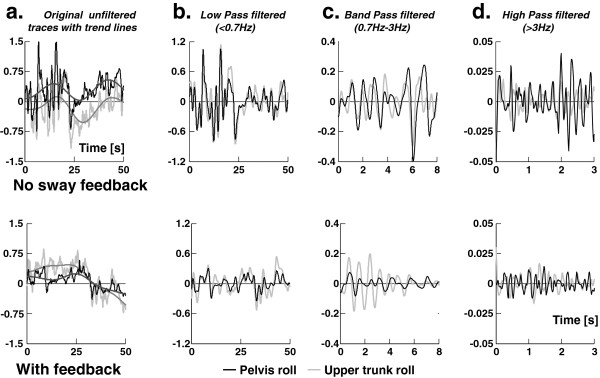
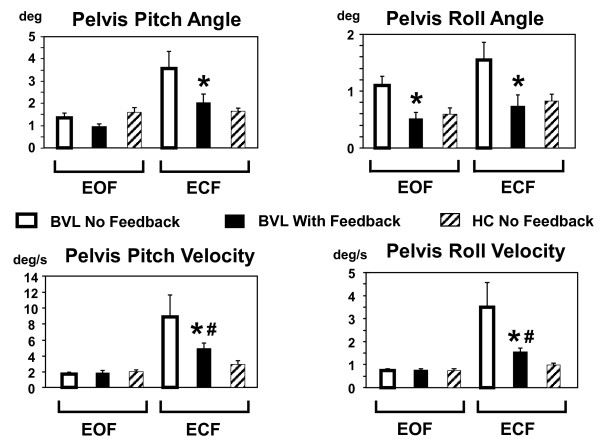
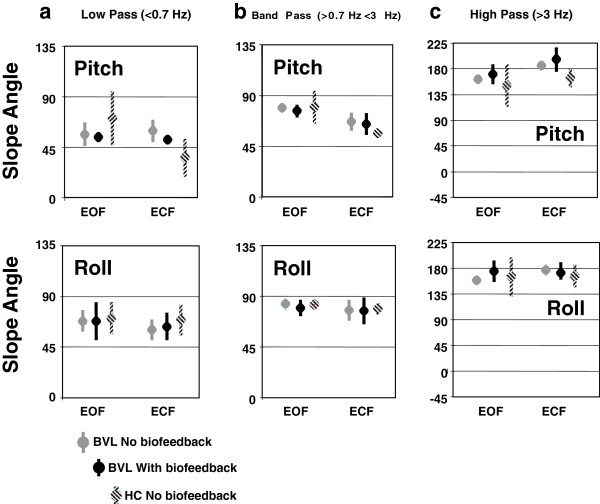
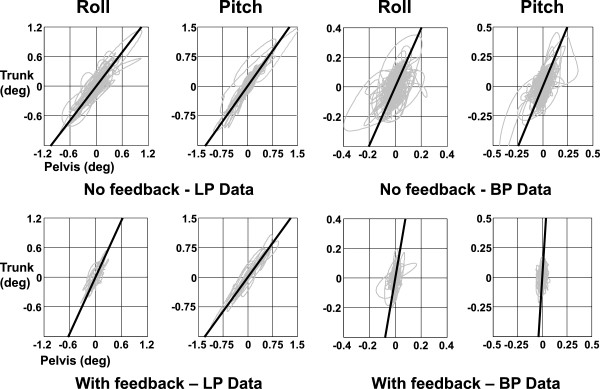
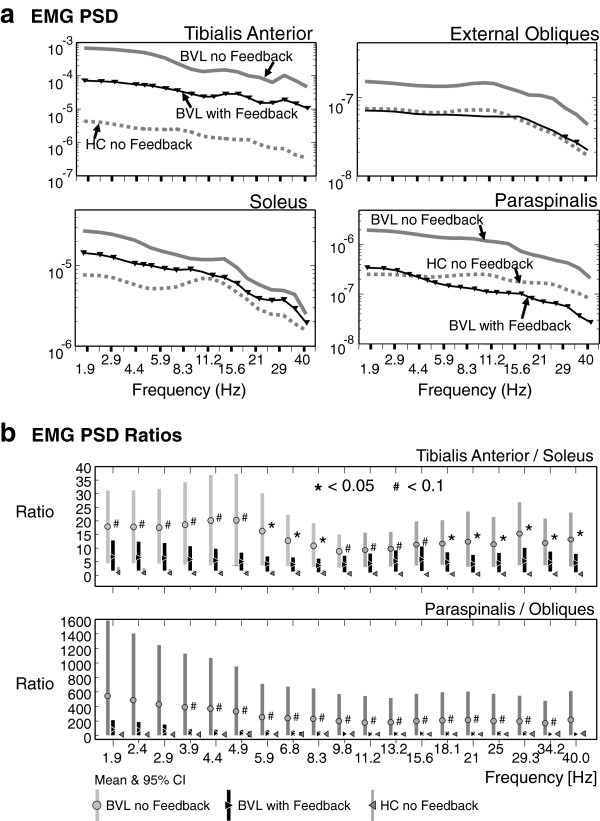
Feedback reduced pelvis sway angle displacements to values of HCs for all tasks. Movement strategies were reduced in amplitude but not otherwise changed by feedback. These strategies were not different from those of HCs before or after use of feedback. Low frequency motion was in-phase and high frequency motion anti-phasic. Feedback reduced amplitudes of EMG, activity ratios (synergies) of antagonistic muscle pairs and slightly reduced baseline muscle activity.
This is the first study demonstrating how vestibular loss subjects achieve a reduction of sway during stance with prosthetic feedback. Unchanged movement strategies with reduced amplitudes are achieved with improved antagonistic muscle synergies. This study suggests that both body movement and muscle measures could be explored when choosing feedback variables, feedback location, and patient groups for prosthetic devices which reduce sway of those with a tendency to fall.
本研究调查了双侧外周前庭功能丧失(BVL)患者在提供骨盆摆动角度反馈时,站立姿势运动策略和肌肉协同作用的变化。
6 名 BVL(均为男性)和 7 名年龄匹配的男性健康对照组(HC)受试者进行了 3 项站立任务:双脚分开与肩同宽、闭眼、在坚固的和泡沫表面上,以及在泡沫表面睁眼。在滚动和俯仰平面上记录骨盆和上躯干的运动。记录小腿、躯干和上臂对拮抗肌的表面肌电图。受试者首先在没有反馈的情况下进行评估。然后,他们在站立任务中接受振动觉、听觉和防跌倒视觉反馈的训练,然后在有反馈的情况下重新评估。
反馈将骨盆摆动角度位移减小到所有任务中 HC 的值。反馈并没有改变运动策略的幅度,但改变了运动策略。这些策略在使用反馈前后与 HC 没有不同。低频运动是同相的,高频运动是反相的。反馈降低了肌电图的幅度、拮抗肌对的活动比(协同作用),并略微降低了基线肌肉活动。
这是第一项研究,证明了前庭功能丧失患者如何通过假体反馈实现站立时摆动的减少。减少的幅度保持不变的运动策略是通过改善拮抗肌协同作用来实现的。这项研究表明,在选择反馈变量、反馈位置和假体设备的患者群体时,可以探索身体运动和肌肉测量,以减少那些有跌倒倾向的人的摆动。