
急性单侧前庭神经炎导致前庭功能改变,影响绕过障碍物的能力:一项初步研究表明前庭信号在绕过障碍物时的空间定向感知中发挥作用。
Acute unilateral vestibular neuritis contributes to alterations in vestibular function modulating circumvention around obstacles: A pilot study suggesting a role for vestibular signals in the spatial perception of orientation during circumvention.
作者信息
Allum John, Rust Heiko Mario, Honegger Flurin
机构信息
Department of ORL, University Hospital of Basel, Basel, Switzerland.
出版信息
Front Integr Neurosci. 2022 Oct 20;16:807686. doi: 10.3389/fnint.2022.807686. eCollection 2022.
BACKGROUND
Walking among crowds avoiding colliding with people is described by patients with vestibular disorders as vertigo-inducing. Accurate body motion while circumventing an impeding obstacle in the gait pathway is dependent on an integration of multimodal sensory cues. However, a direct role of vestibular signals in spatial perception of distance or orientation during obstacle circumvention has not been investigated to date.
MATERIALS AND METHODS
We examined trunk yaw motion during circumvention in patients with acute unilateral vestibular loss (aUVL) and compared their results with age-matched healthy controls (HCs). Subjects performed five gait tasks with eyes open two times: walk 6 m in total, but after 3 m, circumvent to the left or right, as closely as possible, a cylindrical obstacle representing a person, and then veer back to the original path; walk 6 m, but after left and right circumvention at 3 m, veer, respectively, to the right, and left 45 deg; and walk 6 m without circumvention. Trunk yaw angular velocities (YAVs) were measured using a gyroscope system.
RESULTS
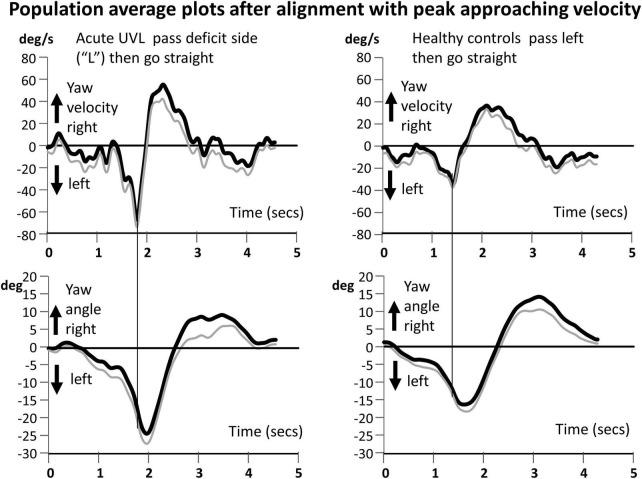
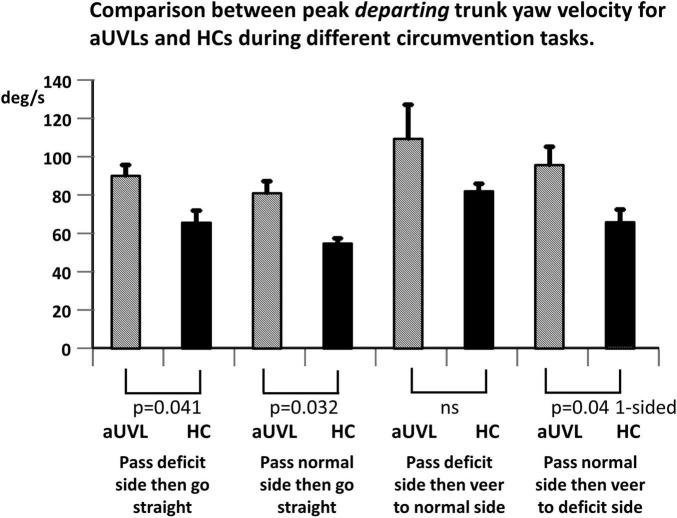
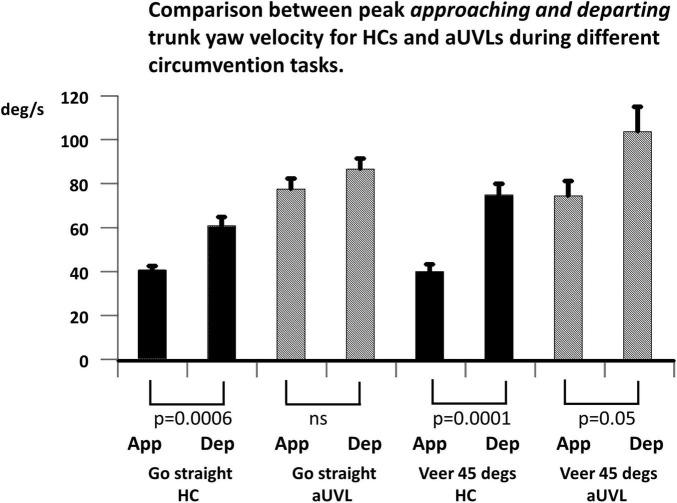
Yaw angular velocity peak amplitudes approaching to, and departing from, the circumvented object were always greater for patients with aUVL compared to HCs, regardless of whether passing was to the aUVLs' deficit or normal side. The departing peak YAV was always greater, circa 52 and 87%, than the approaching YAV for HCs when going straight and veering 45 deg ( ≤ 0.0006), respectively. For patients with aUVL, departing velocities were marginally greater (12%) than approaching YAVs when going straight ( < 0.05) and were only 40% greater when veering 45 deg ( = 0.05). The differences in departing YAVs resulted in significantly lower trajectory-end yaw angles for veering trials to the deficit side in patients with aUVL (34 vs. 43 degs in HCs).
CONCLUSION
The results demonstrate the effects of vestibular loss on yaw velocity control during the three phases of circumvention. First, approaching an obstacle, a greater YAV is found in patients with aUVL. Second, the departing YAV is found to be less than in HCs with respect to the approaching velocity, resulting in larger deficit side passing yaw angles. Third, patients with UVLs show yaw errors returning to the desired trajectory. These results could provide a basis for rehabilitation protocols helping to avoid collisions while walking in crowded spaces.
背景
前庭疾病患者称在人群中行走时避免与人碰撞会诱发眩晕。在步态路径中绕过障碍物时准确的身体运动依赖于多模态感官线索的整合。然而,迄今为止尚未研究前庭信号在绕过障碍物过程中对距离或方向空间感知的直接作用。
材料与方法
我们检查了急性单侧前庭丧失(aUVL)患者在绕过障碍物时的躯干偏航运动,并将他们的结果与年龄匹配的健康对照者(HCs)进行比较。受试者睁眼进行五次步态任务,每次两次:总共步行6米,但在3米后尽可能靠近向左或向右绕过一个代表人物的圆柱形障碍物,然后转向回到原来的路径;步行6米,但在3米处左右绕过障碍物后,分别向右和向左转向45度;以及不绕过障碍物步行6米。使用陀螺仪系统测量躯干偏航角速度(YAVs)。
结果
与HCs相比,aUVL患者接近和离开被绕过物体时的偏航角速度峰值幅度始终更大,无论通过方向是aUVL患者的患侧还是正常侧。当直线行走和转向45度时,HCs离开时的峰值YAV分别比接近时的YAV大,约为52%和87%(≤0.0006)。对于aUVL患者,直线行走时离开速度仅比接近时的YAV略大(12%)(<0.05),转向45度时仅大40%(=0.05)。aUVL患者离开时YAV的差异导致其向患侧转向试验的轨迹终点偏航角显著降低(aUVL患者为34度,HCs为43度)。
结论
结果表明前庭丧失对绕过障碍物三个阶段的偏航速度控制有影响。第一,接近障碍物时,aUVL患者的YAV更大。第二,发现离开时的YAV相对于接近速度比HCs小,导致患侧通过时的偏航角更大。第三,UVL患者在返回期望轨迹时存在偏航误差。这些结果可为康复方案提供依据,以帮助在拥挤空间行走时避免碰撞。




 Zotero 插件