Meusch Undine, Klingner Maria, Baerwald Christoph, Rossol Manuela, Wagner Ulf
Arthritis Res Ther. 2013;15(6):R219. doi: 10.1186/ar4416.
In vitro apoptosis of peripheral monocytes in rheumatoid arthritis (RA) is disturbed and influenced by cytokine production and transmembrane TNF (tmTNF) reverse signaling. The goal of the study was the analysis of the predictive value of the rate of in vitro apoptosis for the therapeutic response to anti-TNF treatment.
Spontaneous and tmTNF reverse signaling-induced apoptosis were determined in vitro in monocytes from 20 RA patients prior to initiation of therapeutic TNF inhibition with etanercept, and the subsequent clinical response was monitored.
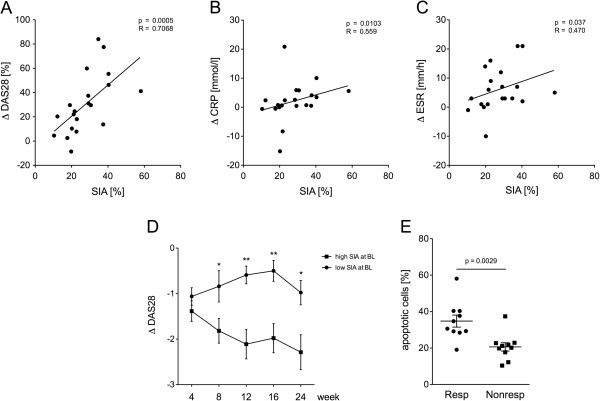
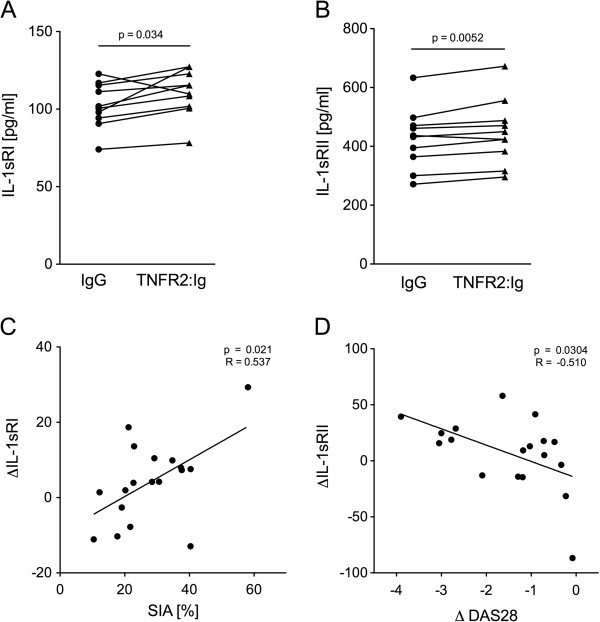
Spontaneous in vitro apoptosis was significantly reduced in RA patients compared to controls. Deficiency in spontaneous apoptosis was associated with an insufficient therapeutic response according to the European League Against Rheumatism (EULAR) response criteria and less reduction of the disease activity determined by disease activity score (DAS) 28. High susceptibility to reverse signaling-induced apoptosis was also associated with less efficient reduction in the DAS28. Of note, a strong negative correlation between the two apoptotic parameters was discernible, possibly indicative of two pathogenetically relevant processes counter-regulating each other. tmTNF reverse signaling induced in vitro production of soluble IL1-RI and IL-1RII only in monocytes not deficient in spontaneous apoptosis, and the levels of soluble IL1-RII were found to be predictive of a good clinical response to Etanercept.
Although tmTNF reverse signaling is able to induce apoptosis of RA monocytes in vitro, this process appears to occur in vitro preferentially in patients with suboptimal therapeutic response. Resistance to spontaneous in vitro apoptosis, in contrast, is a predictor of insufficient response to treatment.
类风湿关节炎(RA)患者外周血单核细胞的体外凋亡受到干扰,且受细胞因子产生和跨膜TNF(tmTNF)反向信号传导的影响。本研究的目的是分析体外凋亡率对抗TNF治疗反应的预测价值。
在20例RA患者开始使用依那西普进行TNF抑制治疗之前,体外测定单核细胞的自发凋亡和tmTNF反向信号传导诱导的凋亡,并监测随后的临床反应。
与对照组相比,RA患者的体外自发凋亡显著减少。根据欧洲抗风湿病联盟(EULAR)反应标准,自发凋亡不足与治疗反应不佳相关,且疾病活动评分(DAS)28所确定的疾病活动度降低较少。对反向信号传导诱导的凋亡高度敏感也与DAS28降低效率较低相关。值得注意的是,两个凋亡参数之间存在强烈的负相关,这可能表明两个致病相关过程相互拮抗。tmTNF反向信号传导仅在自发凋亡不缺乏的单核细胞中诱导体外可溶性IL1-RI和IL-1RII的产生,并且发现可溶性IL1-RII水平可预测对依那西普的良好临床反应。
尽管tmTNF反向信号传导能够在体外诱导RA单核细胞凋亡,但这一过程似乎在体外优先发生于治疗反应欠佳的患者中。相比之下,对体外自发凋亡的抵抗是治疗反应不足的一个预测指标。