Department of Primary Care and Public Health Sciences, King's College London, London, UK.
BMC Public Health. 2013 Dec 20;13:1203. doi: 10.1186/1471-2458-13-1203.
A diet rich in fruit, vegetables and dietary fibre and low in fat is associated with reduced risk of chronic disease. This review aimed to estimate the effectiveness of interventions to promote healthy diet for primary prevention among participants attending primary care.
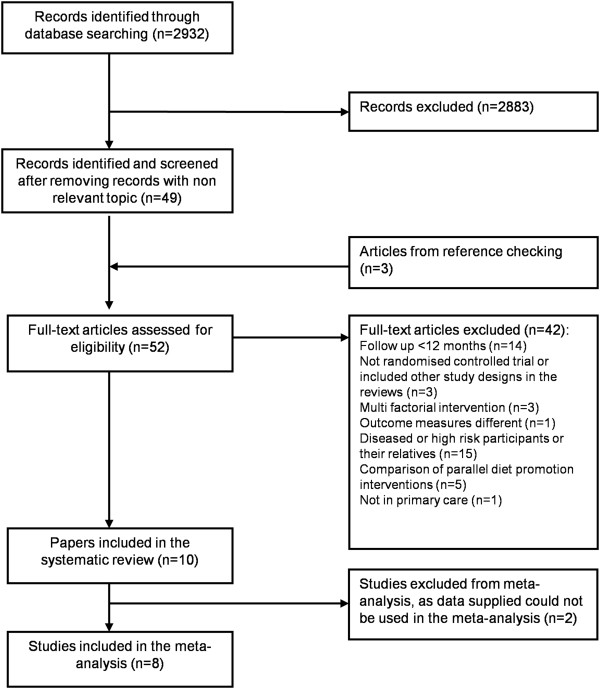
A systematic review of trials using individual or cluster randomisation of interventions delivered in primary care to promote dietary change over 12 months in healthy participants free from chronic disease or defined high risk states. Outcomes were change in fruit and vegetable intake, consumption of total fat and fibre and changes in serum cholesterol concentration.
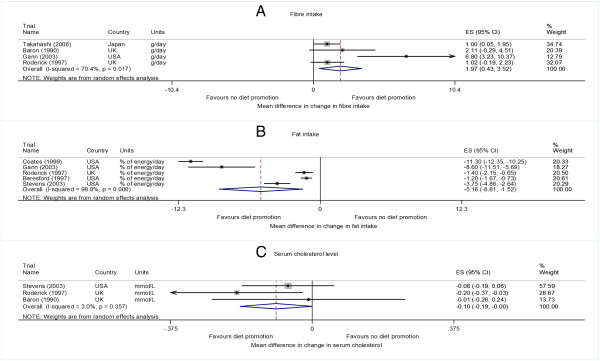
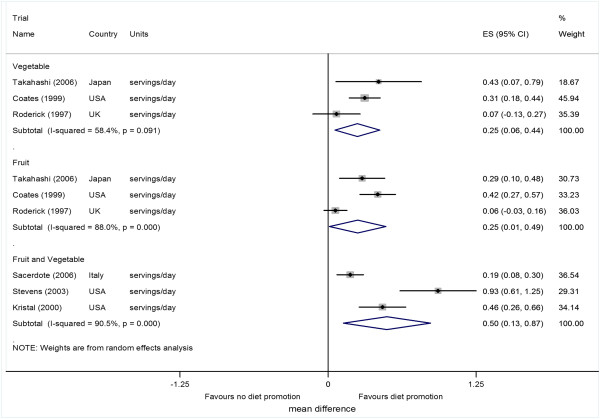
Ten studies were included with 12,414 participants. The design and delivery of interventions were diverse with respect to grounding in behavioural theory and intervention intensity. A meta-analysis of three studies showed an increase in fruit consumption of 0.25 (0.01 to 0.49) servings per day, with an increase in vegetable consumption of 0.25 (0.06 to 0.44) serving per day. A further three studies that reported on fruit and vegetable consumption together showed a pooled increment of 0.50 (0.13 to 0.87) servings per day. The pooled effect on consumption of dietary fibre, from four studies, was estimated to be 1.97 (0.43 to 3.52) gm fibre per day. Data from five studies showed a mean decrease in total fat intake of 5.2% of total energy (1.5 to 8.8%). Data from three studies showed a mean decrease in serum cholesterol of 0.10 (-0.19 to 0.00) mmol/L.
Presently-reported interventions to promote healthy diet for primary prevention in primary care, which illustrate a diverse range of intervention methods, may yield small beneficial changes in consumption of fruit, vegetables, fibre and fat over 12 months. The present results do not exclude the possibility that more effective intervention strategies might be developed.
富含水果、蔬菜和膳食纤维且低脂肪的饮食与降低慢性病风险有关。本综述旨在评估在初级保健中针对健康饮食进行的干预措施对慢性病前期健康参与者的有效性。
对在初级保健中使用个体或群体随机化干预措施来促进 12 个月内健康参与者的饮食改变的试验进行系统综述,这些参与者没有慢性病或明确的高危状态。结果是水果和蔬菜摄入量、总脂肪和纤维摄入量的变化以及血清胆固醇浓度的变化。
纳入了 10 项研究,共有 12414 名参与者。干预措施的设计和实施在行为理论基础和干预强度方面存在差异。三项研究的荟萃分析显示,每天增加水果摄入量 0.25(0.01 至 0.49)份,每天增加蔬菜摄入量 0.25(0.06 至 0.44)份。另外三项报告了水果和蔬菜消费的研究一起显示,每天的摄入量增加了 0.50(0.13 至 0.87)份。四项研究估计膳食纤维的总摄入量增加了 1.97(0.43 至 3.52)克/天。五项研究的数据显示,总脂肪摄入量平均减少了 5.2%(1.5 至 8.8%)的总能量。三项研究的数据显示,血清胆固醇平均降低了 0.10(-0.19 至 0.00)mmol/L。
目前报道的在初级保健中促进健康饮食的干预措施,说明了各种不同的干预方法,可能会在 12 个月内对水果、蔬菜、纤维和脂肪的摄入量产生微小的有益变化。目前的结果并不排除可能开发出更有效的干预策略的可能性。