Department of Obstetrics and Gynecology, Korea Cancer Center Hospital, Korea Institute of Radiological and Medical Sciences, 75 Nowon-gil, Nowon-gu, Seoul 139-706, Korea.
Biometric Research Branch, Research Institute and Hospital, National Cancer Center, 323 Ilsan-ro, Ilsandong-gu, Goyang, Gyeonggi-do 410-769, Korea.
Br J Cancer. 2014 Jan 21;110(2):278-85. doi: 10.1038/bjc.2013.716. Epub 2013 Dec 19.
In this study, we sought to identify a criterion for the intermediate-risk grouping of patients with cervical cancer who exhibit any intermediate-risk factor after radical hysterectomy.
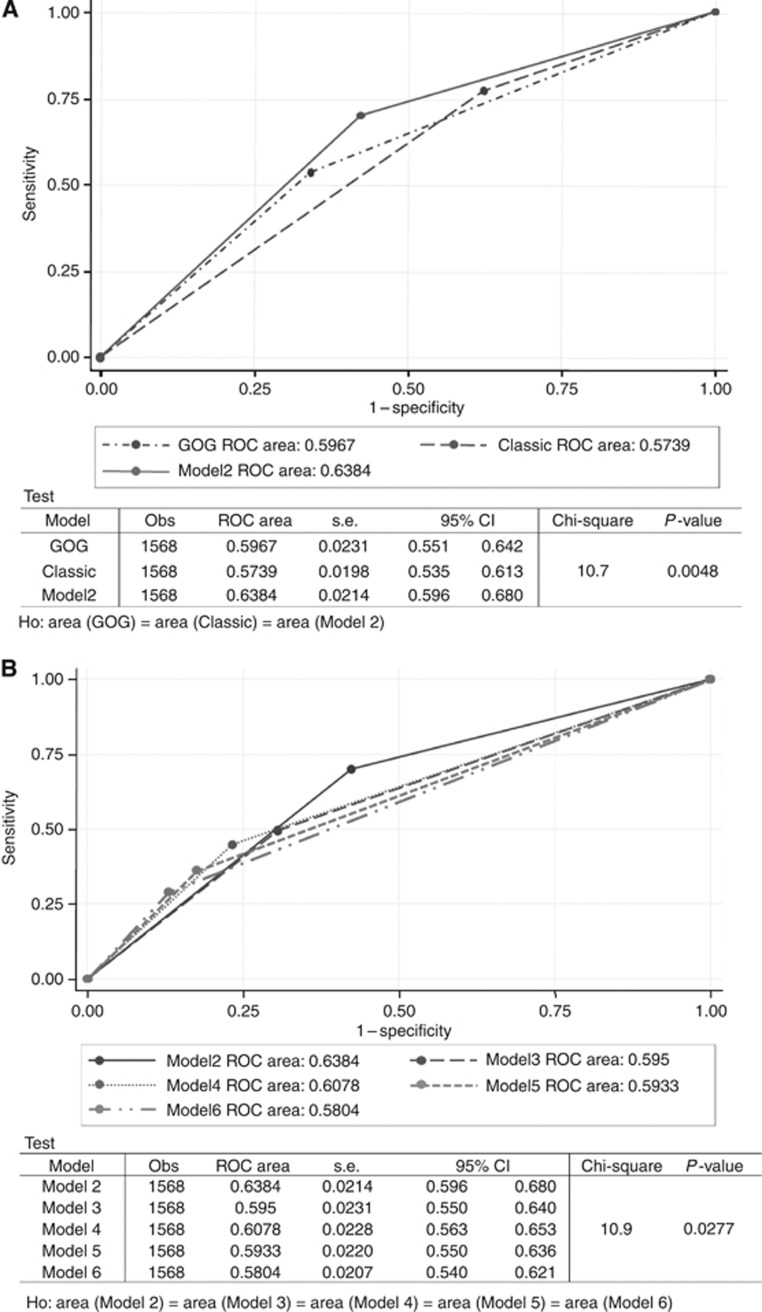
In total, 2158 patients with pathologically proven stage IB-IIA cervical cancer with any intermediate-risk factor after radical hysterectomy were randomly assigned to two groups, a development group and a validation group, at a ratio of 3 : 1 (1620 patients:538 patients). To predict recurrence, multivariate models were developed using the development group. The ability of the models to discriminate between groups was validated using the log-rank test and receiver operating characteristic (ROC) analysis.
Four factors (histology, tumour size, deep stromal invasion (DSI), and lymphovascular space involvement (LVSI)) were significantly associated with disease recurrence and included in the models. Among the nine possible combinations of the four variables, models consisting of any two of the four intermediate-risk factors (tumour size ≥3 cm, DSI of the outer third of the cervix, LVSI, and adenocarcinoma or adenosquamous carcinoma histology) demonstrated the best performance for predicting recurrence.
This study identified a 'four-factor model' in which the presence of any two factors may be useful for predicting recurrence in patients with cervical cancer treated with radical hysterectomy.
本研究旨在为根治性子宫切除术后存在任何中危因素的宫颈癌患者寻找中危分组标准。
共纳入 2158 例根治性子宫切除术后存在任何中危因素且经病理证实为 IB 期-IIA 期宫颈癌患者,按照 3:1 的比例将其随机分配至发展组和验证组(1620 例:538 例)。采用发展组建立预测复发的多因素模型,使用对数秩检验和受试者工作特征(ROC)分析验证模型的分组能力。
4 个因素(组织学、肿瘤大小、深肌层浸润(DSI)和脉管间隙浸润(LVSI))与疾病复发显著相关,并被纳入模型。在四个变量的九种可能组合中,包含四个中间风险因素(肿瘤大小≥3cm、宫颈外三分之一 DSI、LVSI 和腺癌或腺鳞癌组织学)中的任意两个的模型对预测复发的表现最佳。
本研究确定了一种“四因素模型”,该模型中存在任意两个因素可能有助于预测接受根治性子宫切除术治疗的宫颈癌患者的复发。