Llorca Pierre Michel, Abbar Mocrane, Courtet Philippe, Guillaume Sebastien, Lancrenon Sylvie, Samalin Ludovic
CHU Clermont-Ferrand, EA 7280, Clermont-Ferrand University, Clermont-Ferrand, France.
BMC Psychiatry. 2013 Dec 20;13:340. doi: 10.1186/1471-244X-13-340.
Long-acting injectable (LAI) formulations are not widely used in routine practice even though they offer advantages in terms of relapse prevention. As part of a process to improve the quality of care, the French Association for Biological Psychiatry and Neuropsychopharmacology (AFPBN) elaborated guidelines for the use and management of antipsychotic depots in clinical practice.
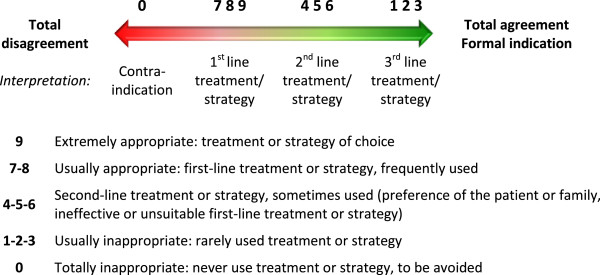
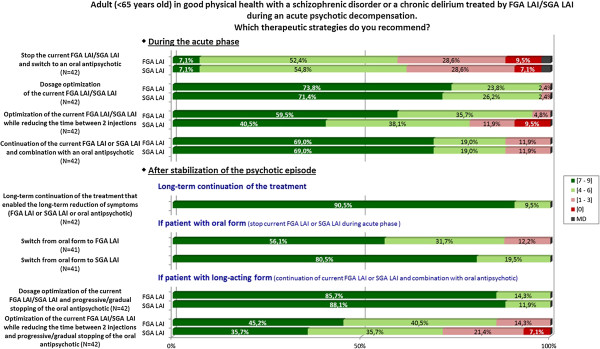
Based on a literature review, a written survey was prepared that asked about 539 options in 32 specific clinical situations concerning 3 fields: target-population, prescription and use, and specific populations. We contacted 53 national experts, 42 of whom (79%) completed the survey. The options were scored using a 9-point scale derived from the Rand Corporation and the University of California in the USA. According to the answers, a categorical rank (first-line/preferred choice, second-line/alternate choice, third-line/usually inappropriate) was assigned to each option. The first-line option was defined as a strategy rated as 7-9 (extremely appropriate) by at least 50% of the experts. The following results summarize the key recommendations from the guidelines after data analysis and interpretation of the results of the survey by the scientific committee.
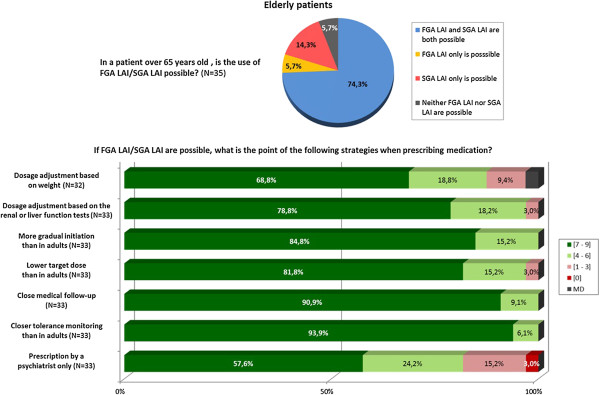
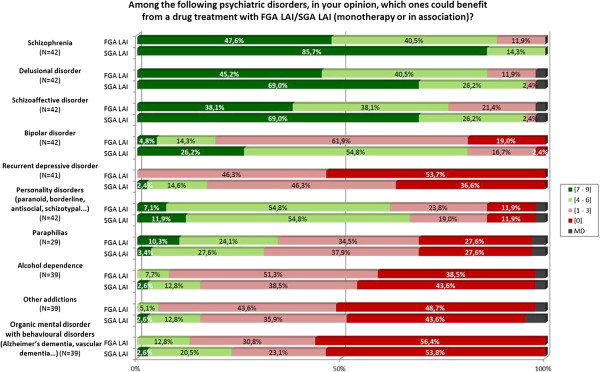
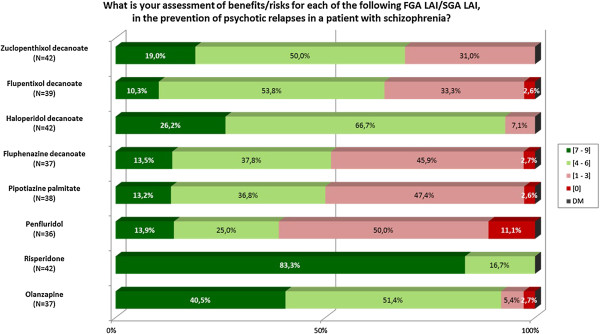
LAI antipsychotics are indicated in patients with schizophrenia, schizoaffective disorder, delusional disorder and bipolar disorder. LAI second-generation antipsychotics are recommended as maintenance treatment after the first episode of schizophrenia. LAI first-generation antipsychotics are not recommended in the early course of schizophrenia and are not usually appropriate in bipolar disorder. LAI antipsychotics have long been viewed as a treatment that should only be used for a small subgroup of patients with non-compliance, frequent relapses or who pose a risk to others. The panel considers that LAI antipsychotics should be considered and systematically proposed to any patients for whom maintenance antipsychotic treatment is indicated. Recommendations for medication management when switching oral antipsychotics to LAI antipsychotics are proposed. Recommendations are also given for the use of LAI in specific populations.
In an evidence-based clinical approach, psychiatrists, through shared decision-making, should be systematically offering to most patients that require long-term antipsychotic treatment an LAI antipsychotic as a first-line treatment.
长效注射(LAI)制剂尽管在预防复发方面具有优势,但在常规临床实践中并未得到广泛应用。作为提高医疗质量进程的一部分,法国生物精神病学和神经精神药理学协会(AFPBN)制定了临床实践中抗精神病药物长效注射剂使用和管理的指南。
基于文献综述,编写了一份书面调查问卷,涉及3个领域(目标人群、处方与使用、特定人群)中32种具体临床情况的539个选项。我们联系了53位国内专家,其中42位(79%)完成了调查。这些选项采用源自美国兰德公司和加利福尼亚大学的9分制进行评分。根据答案,为每个选项指定一个分类等级(一线/首选、二线/替代选择、三线/通常不合适)。一线选项被定义为至少50%的专家评为7 - 9分(极其合适)的策略。以下结果总结了科学委员会对调查结果进行数据分析和解读后指南中的关键建议。
LAI抗精神病药物适用于精神分裂症、分裂情感性障碍、妄想性障碍和双相情感障碍患者。推荐LAI第二代抗精神病药物作为精神分裂症首次发作后的维持治疗。不推荐在精神分裂症病程早期使用LAI第一代抗精神病药物,且其通常不适用于双相情感障碍。LAI抗精神病药物长期以来被视为仅适用于一小部分不依从、频繁复发或对他人构成风险的患者的治疗方法。专家组认为,对于任何有维持性抗精神病治疗指征的患者,都应考虑并系统地推荐使用LAI抗精神病药物。提出了从口服抗精神病药物转换为LAI抗精神病药物时的药物管理建议。还给出了LAI在特定人群中的使用建议。
在基于证据的临床方法中,精神科医生应通过共同决策,系统地为大多数需要长期抗精神病治疗的患者提供LAI抗精神病药物作为一线治疗。