Veterinary Pharmacology, Pharmacotherapy and Toxicology, Institute for Risk Assessment Sciences, Faculty of Veterinary Medicine, Utrecht University, Yalelaan 104, Utrecht 3584 CM, The Netherlands.
BMC Vet Res. 2013 Dec 20;9:259. doi: 10.1186/1746-6148-9-259.
The bile salt export pump (BSEP/ABCB11) is the primary transporter for the excretion of bile acids from hepatocytes into bile. In human, inhibition of BSEP by drugs has been related to drug-induced cholestasis and subsequent cytotoxic effects. The role of BSEP in canine and feline liver diseases has not been studied in detail, but the same mechanism of inhibition by drugs as in humans could play a role in veterinary medicine. The aim of this study was to investigate the functional characteristics of feline Bsep in comparison with canine and human Bsep/BSEP with respect to substrate affinities and inhibitory potential of model drugs. Orthologs of all three species were cloned and cell membrane vesicles overexpressing feline, canine and human Bsep/BSEP were prepared for functional analyses.
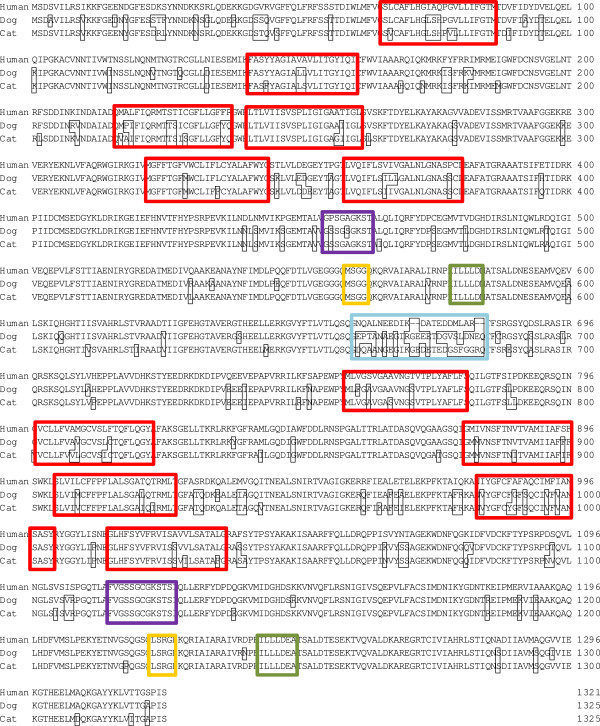
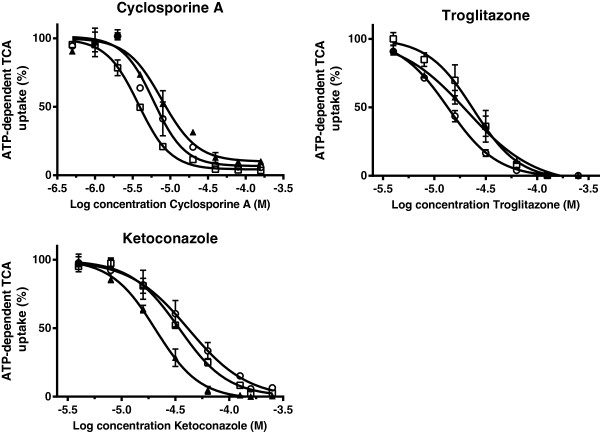
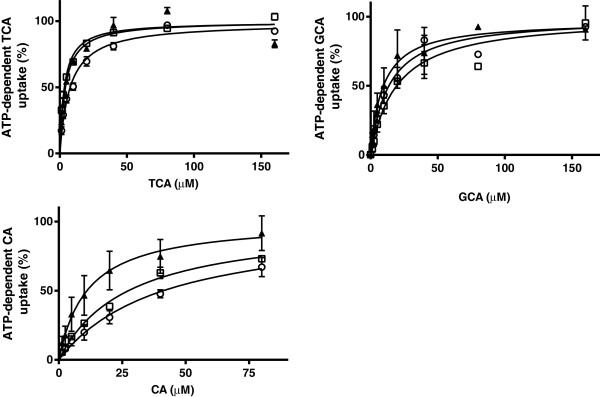
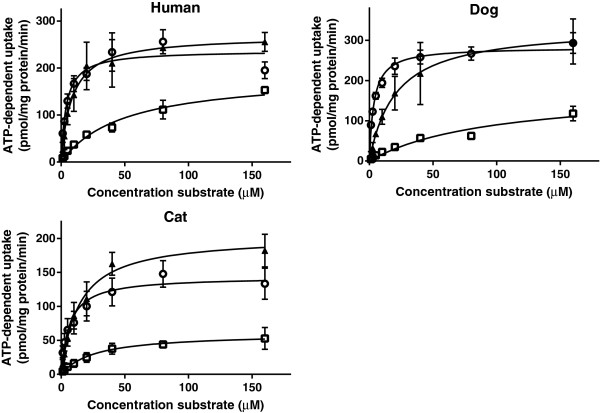
The cDNA sequences of the open reading frames of feline, canine and human Bsep/BSEP showed a high similarity between the species. Functional studies demonstrated for all species a tendency to a higher affinity of BSEP/Bsep for the conjugated bile acid taurocholic acid (TCA) than glycocholic acid (GCA), and a higher affinity for GCA than for the unconjugated cholic acid (CA). The inhibitory potency of the model inhibitors cyclosporine A, troglitazone and ketoconazole was characterized against TCA uptake into BSEP/Bsep containing membrane vesicles. All three substances potently inhibited TCA uptake without significant species differences.
Structure and functional characteristics of cat, dog and human Bsep/BSEP appeared to be very similar, indicating that the properties of this transporter have been highly preserved among the different species. Therefore, inhibition of BSEP by drugs could also be a mechanism in cholestasis and liver disease in veterinary relevant animal species. This model could be used to predict drug-induced liver injury caused by BSEP inhibition at an early stage in veterinary drug development.
胆汁盐输出泵(BSEP/ABCB11)是将胆汁酸从肝细胞分泌到胆汁中的主要转运体。在人类中,药物对 BSEP 的抑制与药物诱导的胆汁淤积和随后的细胞毒性作用有关。BSEP 在犬和猫肝病中的作用尚未详细研究,但与人类相同的药物抑制机制可能在兽医领域中发挥作用。本研究旨在比较犬和猫 BSEP 与人类 BSEP/BSEP 的功能特征,研究其对模型药物的底物亲和力和抑制潜力。克隆了所有三种物种的同源物,并制备了过表达犬、猫和人 BSEP/BSEP 的细胞膜囊泡,用于功能分析。
开放阅读框的 cDNA 序列表明,猫、犬和人 BSEP/BSEP 的物种间具有高度相似性。功能研究表明,所有物种的 BSEP/Bsep 对结合胆汁酸牛磺胆酸(TCA)的亲和力均高于甘胆酸(GCA),对 GCA 的亲和力高于非结合胆酸(CA)。模型抑制剂环孢素 A、曲格列酮和酮康唑对 BSEP/Bsep 包含的膜囊泡摄取 TCA 的抑制作用进行了特征描述。这三种物质均能强烈抑制 TCA 摄取,而无明显的物种差异。
猫、犬和人 BSEP/BSEP 的结构和功能特征似乎非常相似,表明该转运体的特性在不同物种中得到了高度保留。因此,药物对 BSEP 的抑制也可能是兽医相关动物物种胆汁淤积和肝病的一种机制。该模型可用于在兽医药物开发的早期阶段预测 BSEP 抑制引起的药物性肝损伤。