Ehlers B, Czichos J, Overath P
Mol Cell Biol. 1987 Mar;7(3):1242-9. doi: 10.1128/mcb.7.3.1242-1249.1987.
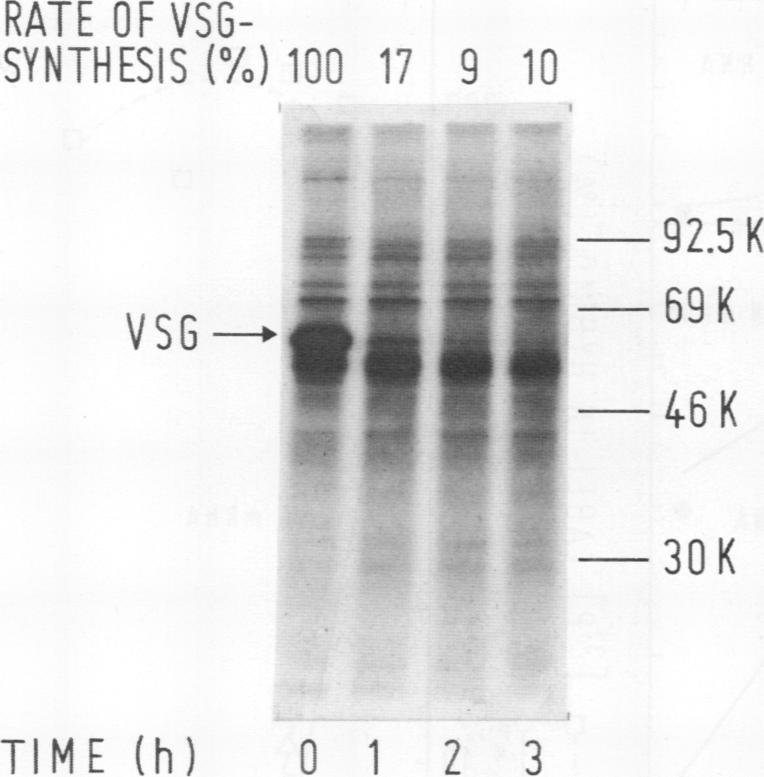
Regulation of variant surface glycoprotein (VSG) mRNA turnover in Trypanosoma brucei was studied in bloodstream forms, in procyclic cells, and during in vitro transformation of bloodstream forms to procyclic cells by approach-to-equilibrium labeling and pulse-chase experiments. Upon initiation of transformation at 27 degrees C in the presence of citrate-cis-aconitate, the half-life of VSG mRNA was reduced from 4.5 h in bloodstream forms to 1.2 h in transforming cells. Concomitantly, an approximately 25-fold decrease in the rate of transcription was observed, resulting in a 100-fold reduction in the steady-state level of de novo-synthesized VSG mRNA. This low level of expression was maintained for at least 7 h, finally decreasing to an undetectable level after 24 h. Transcription of the VSG gene in established procyclic cells was undetectable. For comparison, the turnover of polyadenylated and nonpolyadenylated RNA, beta-tubulin mRNA, and mini-exon-derived RNA (medRNA) was studied. For medRNA, no significant changes in the rate of transcription or stability were observed during differentiation. In contrast, while the rate of transcription of beta-tubulin mRNA in in vitro-cultured bloodstream forms, transforming cells, and established procyclic cells was similar, the half life was four to five times longer in procyclic cells (t1/2, 7 h) than in cultured bloodstream forms (t1/2, 1.4 h) or transforming cells (t1/2, 1.7 h). Inhibition of protein synthesis in bloodstream forms at 37 degrees Celsius caused a dramatic 20-fold decrease in the rate of VSG mRNA synthesis and a 6-fold decrease in half-life to 45 min, while beta-tubulin mRNA was stabilized 2- to 3-fold and mRNA stability remained unaffected. It is postulated that triggering transformation or inhibiting protein synthesis induces changes in the abundance of the same regulatory molecules which effect the shutoff of VSG gene transcription in addition to shortening the half-life of VSG mRNA.
通过接近平衡标记和脉冲追踪实验,研究了布氏锥虫中变异表面糖蛋白(VSG)mRNA周转在血流形式、前循环细胞以及血流形式体外转化为前循环细胞过程中的调控情况。在27℃下于柠檬酸盐-顺乌头酸盐存在的条件下开始转化时,VSG mRNA的半衰期从血流形式中的4.5小时降至转化细胞中的1.2小时。与此同时,观察到转录速率下降了约25倍,导致从头合成的VSG mRNA稳态水平降低了100倍。这种低表达水平维持了至少7小时,最终在24小时后降至不可检测水平。已建立的前循环细胞中VSG基因的转录不可检测。作为比较,研究了多聚腺苷酸化和非多聚腺苷酸化RNA、β-微管蛋白mRNA以及小外显子衍生RNA(medRNA)的周转情况。对于medRNA,在分化过程中未观察到转录速率或稳定性的显著变化。相比之下,虽然体外培养的血流形式、转化细胞和已建立的前循环细胞中β-微管蛋白mRNA的转录速率相似,但前循环细胞中的半衰期(t1/2,7小时)比培养的血流形式(t1/2,1.4小时)或转化细胞(t1/2,1.7小时)长四到五倍。在37℃下抑制血流形式中的蛋白质合成导致VSG mRNA合成速率急剧下降20倍,半衰期缩短6倍至45分钟,而β-微管蛋白mRNA稳定化2至3倍,mRNA稳定性不受影响。据推测,触发转化或抑制蛋白质合成会诱导相同调节分子丰度的变化,这些调节分子除了缩短VSG mRNA的半衰期外,还会影响VSG基因转录的关闭。