Systems Biology and Mathematical Modeling Group, Max Planck Institute of Molecular Plant Physiology, Potsdam, Germany ; System Regulation Group, Max Planck Institute of Molecular Plant Physiology, Potsdam, Germany.
Systems Biology and Mathematical Modeling Group, Max Planck Institute of Molecular Plant Physiology, Potsdam, Germany.
PLoS Comput Biol. 2013;9(12):e1003368. doi: 10.1371/journal.pcbi.1003368. Epub 2013 Dec 19.
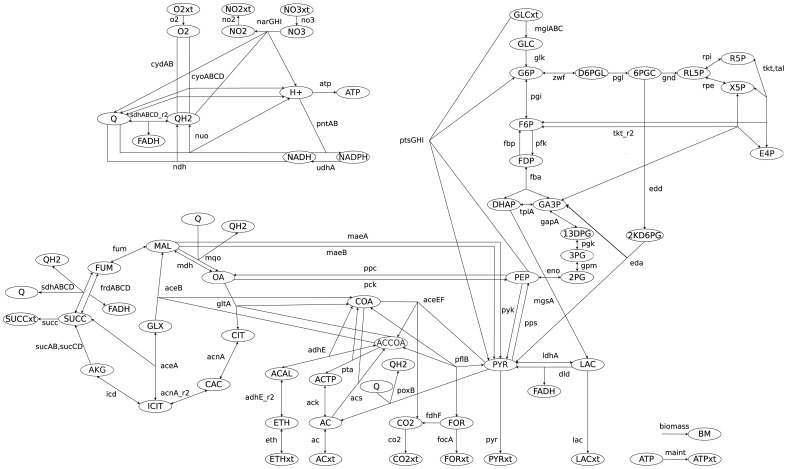
Organisms have to continuously adapt to changing environmental conditions or undergo developmental transitions. To meet the accompanying change in metabolic demands, the molecular mechanisms of adaptation involve concerted interactions which ultimately induce a modification of the metabolic state, which is characterized by reaction fluxes and metabolite concentrations. These state transitions are the effect of simultaneously manipulating fluxes through several reactions. While metabolic control analysis has provided a powerful framework for elucidating the principles governing this orchestrated action to understand metabolic control, its applications are restricted by the limited availability of kinetic information. Here, we introduce structural metabolic control as a framework to examine individual reactions' potential to control metabolic functions, such as biomass production, based on structural modeling. The capability to carry out a metabolic function is determined using flux balance analysis (FBA). We examine structural metabolic control on the example of the central carbon metabolism of Escherichia coli by the recently introduced framework of functional centrality (FC). This framework is based on the Shapley value from cooperative game theory and FBA, and we demonstrate its superior ability to assign "share of control" to individual reactions with respect to metabolic functions and environmental conditions. A comparative analysis of various scenarios illustrates the usefulness of FC and its relations to other structural approaches pertaining to metabolic control. We propose a Monte Carlo algorithm to estimate FCs for large networks, based on the enumeration of elementary flux modes. We further give detailed biological interpretation of FCs for production of lactate and ATP under various respiratory conditions.
生物必须不断适应不断变化的环境条件或经历发育转变。为了满足伴随而来的代谢需求变化,适应的分子机制涉及协同相互作用,最终导致代谢状态的改变,其特征是反应通量和代谢物浓度。这些状态转变是通过几种反应同时操纵通量的结果。虽然代谢控制分析为阐明协调这种作用以理解代谢控制的原则提供了一个强大的框架,但它的应用受到有限的动力学信息的限制。在这里,我们引入结构代谢控制作为一个框架,基于结构建模来检查单个反应控制代谢功能(如生物量生产)的潜力。使用通量平衡分析(FBA)来确定执行代谢功能的能力。我们以大肠杆菌的中心碳代谢为例,通过最近引入的功能中心性(FC)框架来检查结构代谢控制。该框架基于合作博弈论和 FBA 的 Shapley 值,我们证明了它在分配代谢功能和环境条件下单个反应的“控制份额”方面具有优越的能力。各种情况下的比较分析说明了 FC 的有用性及其与其他与代谢控制相关的结构方法的关系。我们提出了一种基于基本通量模式枚举的 Monte Carlo 算法来估计大型网络的 FC。我们进一步详细解释了在各种呼吸条件下产生乳酸和 ATP 时 FC 的生物学意义。