
记忆编码期间 fMRI 脑活动的重测信度。
Test-Retest Reliability of fMRI Brain Activity during Memory Encoding.
机构信息
Section of Brainimaging, Department of Psychiatry and Psychotherapy, Philipps-University Marburg , Marburg , Germany.
出版信息
Front Psychiatry. 2013 Dec 9;4:163. doi: 10.3389/fpsyt.2013.00163. eCollection 2013.
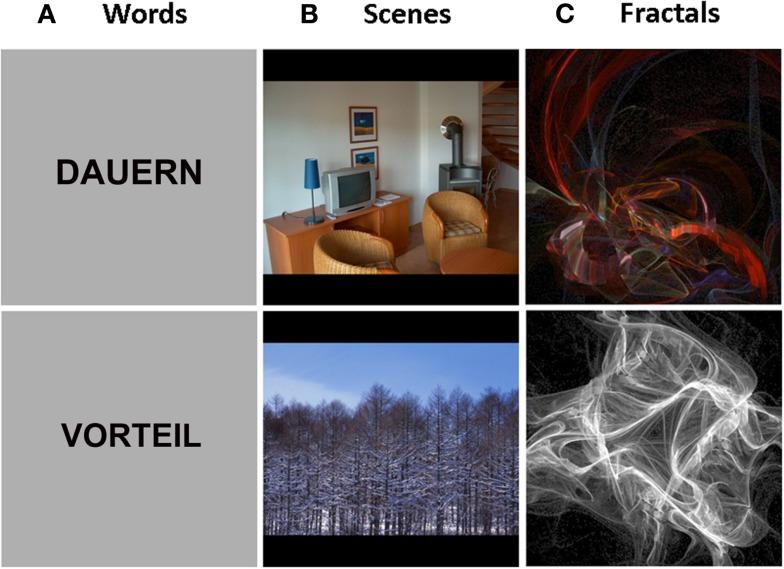
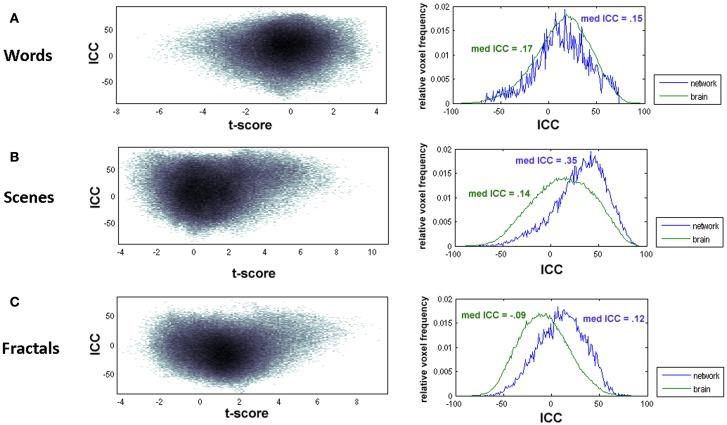
The mechanisms underlying hemispheric specialization of memory are not completely understood. Functional magnetic resonance imaging (fMRI) can be used to develop and test models of hemispheric specialization. In particular for memory tasks however, the interpretation of fMRI results is often hampered by the low reliability of the data. In the present study we therefore analyzed the test-retest reliability of fMRI brain activation related to an implicit memory encoding task, with a particular focus on brain activity of the medial temporal lobe (MTL). Fifteen healthy subjects were scanned with fMRI on two sessions (average retest interval 35 days) using a commonly applied novelty encoding paradigm contrasting known and unknown stimuli. To assess brain lateralization, we used three different stimuli classes that differed in their verbalizability (words, scenes, fractals). Test-retest reliability of fMRI brain activation was assessed by an intraclass-correlation coefficient (ICC), describing the stability of inter-individual differences in the brain activation magnitude over time. We found as expected a left-lateralized brain activation network for the words paradigm, a bilateral network for the scenes paradigm, and predominantly right-hemispheric brain activation for the fractals paradigm. Although these networks were consistently activated in both sessions on the group level, across-subject reliabilities were only poor to fair (ICCs ≤ 0.45). Overall, the highest ICC values were obtained for the scenes paradigm, but only in strongly activated brain regions. In particular the reliability of brain activity of the MTL was poor for all paradigms. In conclusion, for novelty encoding paradigms the interpretation of fMRI results on a single subject level is hampered by its low reliability. More studies are needed to optimize the retest reliability of fMRI activation for memory tasks.
大脑半球记忆专业化的机制尚未完全明了。功能磁共振成像(fMRI)可用于开发和测试大脑半球专业化模型。然而,特别是对于记忆任务,fMRI 结果的解释常常受到数据可靠性低的阻碍。在本研究中,我们分析了与内隐记忆编码任务相关的 fMRI 脑激活的测试-重测信度,特别关注内侧颞叶(MTL)的脑活动。15 名健康受试者在两次扫描(平均重测间隔 35 天)中接受 fMRI 扫描,使用常用的新颖性编码范式对比已知和未知刺激。为了评估大脑的偏侧性,我们使用了三种不同的刺激类,它们在可表达性(单词、场景、分形)上有所不同。使用组内相关系数(ICC)评估 fMRI 脑激活的测试-重测信度,该系数描述了大脑激活幅度随时间的个体间差异的稳定性。我们发现,正如预期的那样,单词范式表现出左半球激活网络,场景范式表现出双侧网络,分形范式表现出主要的右半球激活。尽管这些网络在组水平上在两次扫描中均一致激活,但跨受试者的可靠性仅为差到尚可(ICC≤0.45)。总体而言,场景范式获得的 ICC 值最高,但仅在强烈激活的脑区。特别是,所有范式的 MTL 脑活动的可靠性均较差。总之,对于新颖性编码范式,单个受试者水平的 fMRI 结果解释受到其低可靠性的阻碍。需要进一步研究来优化记忆任务的 fMRI 激活的重测可靠性。


 Zotero 插件