Center for Research and Innovation in Medical Education, University of Groningen and University Medical Center Groningen, Ant, Deusinglaan 1, FC40, 9713, AV Groningen, The Netherlands.
BMC Med Educ. 2013 Dec 27;13:172. doi: 10.1186/1472-6920-13-172.
It has been asserted that assessment can and should be used to drive students' learning. In the current study, we present a cumulative assessment program in which test planning, repeated testing and compensation are combined in order to influence study effort. The program is aimed at helping initially low-scoring students improve their performance during a module, without impairing initially high-scoring students' performance. We used performance as a proxy for study effort and investigated whether the program worked as intended.
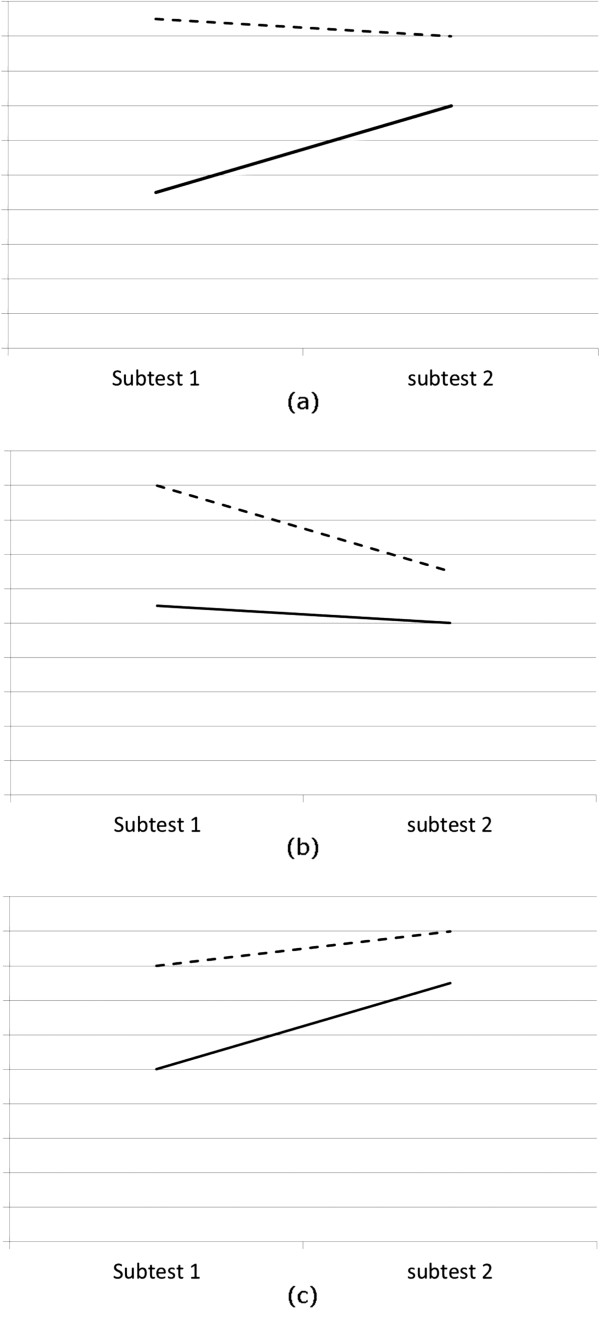
We analysed students' test scores in two second-year (n = 494 and n = 436) and two third-year modules (n = 383 and n = 345) in which cumulative assessment was applied. We used t-tests to compare the change in test scores of initially low-scoring students with that of initially high-scoring students between the first and second subtest and again between the combined first and second subtest and the third subtest. During the interpretation of the outcomes we took regression to the mean and test difficulty into account.
Between the first and the second subtest in all four modules, the scores of initially low-scoring students increased more than the scores of initially high-scoring students decreased. Between subtests two and three, we found a similar effect in one module, no significant effect in two modules and the opposite effect in another module.
The results between the first two subtests suggest that cumulative assessment may positively influence students' study effort. The inconsistent outcomes between subtests two and three may be caused by differences in perceived imminence, impact and workload between the third subtest and the first two. Cumulative assessment may serve as an example of how several evidence-based assessment principles can be integrated into a program for the benefit of student learning.
有人断言,评估可以而且应该用于促进学生的学习。在本研究中,我们提出了一个累积评估方案,该方案将测试规划、重复测试和补偿结合起来,以影响学习努力程度。该方案旨在帮助最初得分较低的学生在模块期间提高他们的表现,而不会影响最初得分较高的学生的表现。我们使用表现作为学习努力程度的替代指标,调查该方案是否按预期发挥作用。
我们分析了两个第二年(n = 494 和 n = 436)和两个第三年模块(n = 383 和 n = 345)中采用累积评估的学生的测试成绩。我们使用 t 检验比较了最初得分较低的学生和最初得分较高的学生在第一次和第二次小测试之间以及在第一次和第二次小测试与第三次小测试相结合之间的测试成绩变化。在解释结果时,我们考虑了回归均值和测试难度。
在所有四个模块中,最初得分较低的学生的分数在第一次和第二次小测试之间增加的幅度超过了最初得分较高的学生的分数减少的幅度。在第二次和第三次小测试之间,我们在一个模块中发现了类似的效果,在两个模块中没有发现显著效果,在另一个模块中则发现了相反的效果。
在前两个小测试之间的结果表明,累积评估可能会对学生的学习努力产生积极影响。在第二次和第三次小测试之间的不一致结果可能是由于第三次小测试与前两次小测试之间的感知紧迫性、影响和工作量的差异造成的。累积评估可以作为一个例子,说明如何将几个基于证据的评估原则整合到一个有利于学生学习的方案中。