School of Chemistry, ‡Astbury Centre for Structural Molecular Biology, and §School of Molecular and Cellular Biology, Faculty of Biological Sciences, University of Leeds , Woodhouse Lane, Leeds LS2 9JT, United Kingdom.
ACS Chem Biol. 2014 Mar 21;9(3):761-8. doi: 10.1021/cb400731s. Epub 2014 Jan 13.
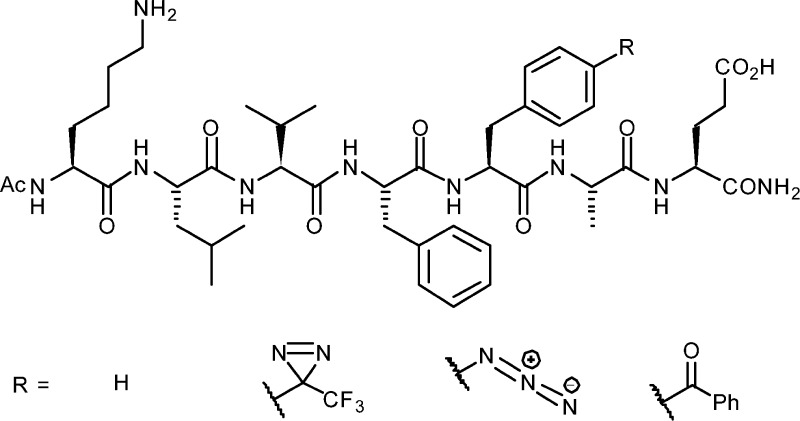
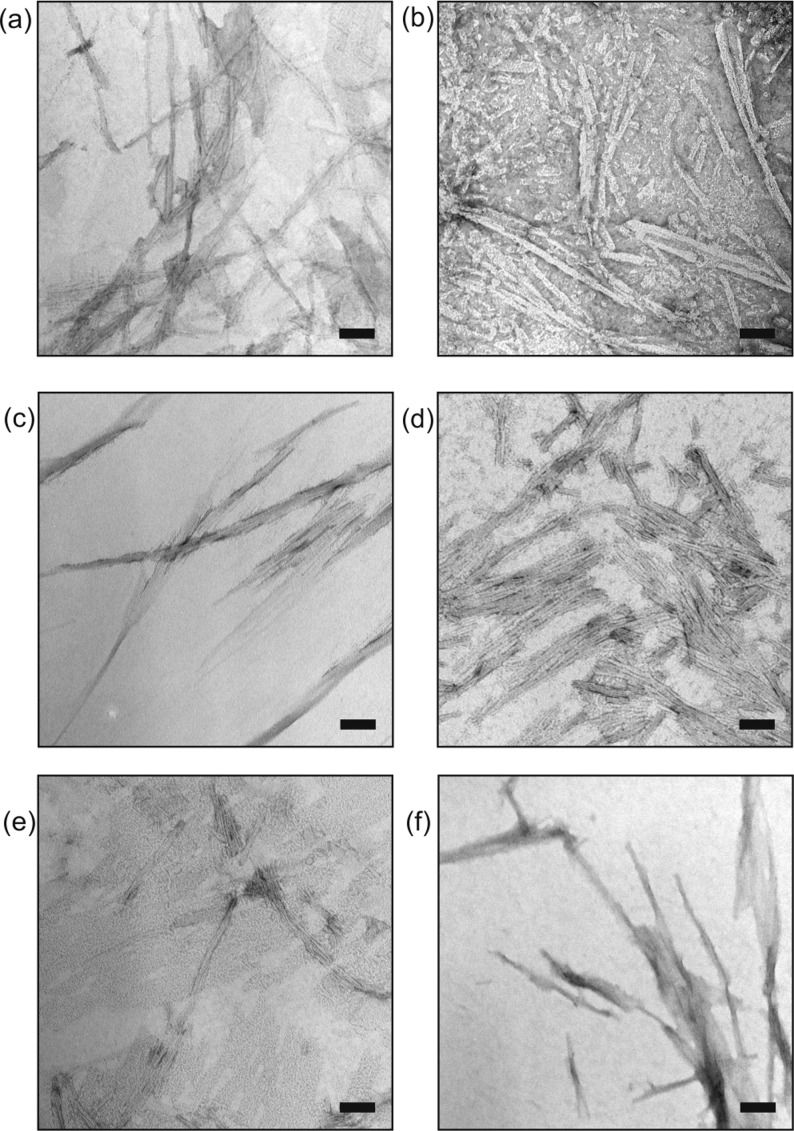
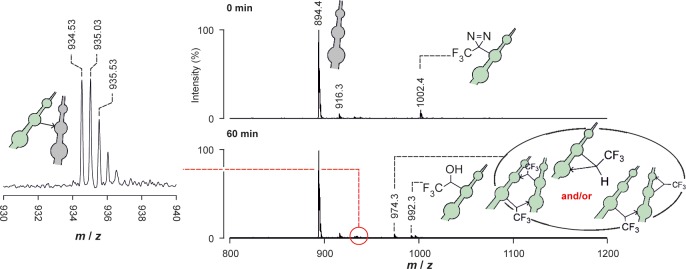
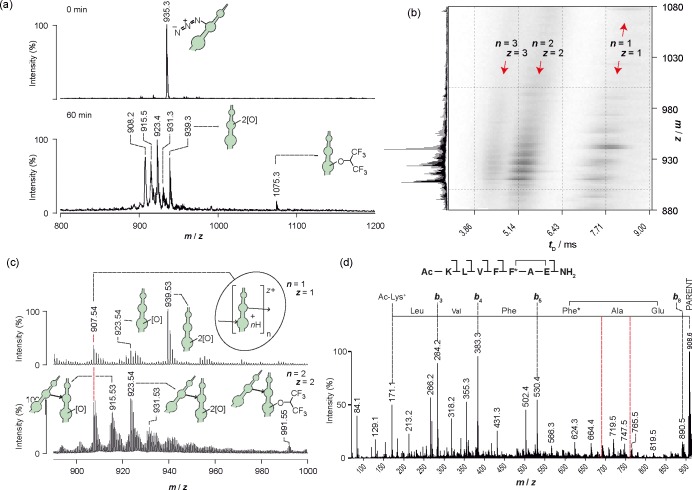
Photoinduced cross-linking (PIC) has become a powerful tool in chemical biology for the identification and mapping of stable or transient interactions between biomacromolecules and their (unknown) ligands. However, the value of PIC for in vitro and in vivo structural proteomics can be realized only if cross-linking reports accurately on biomacromolecule secondary, tertiary, and quaternary structures with residue-specific resolution. Progress in this area requires rigorous and comparative studies of PIC reagents, but despite widespread use of PIC, these have rarely been performed. The use of PIC to report reliably on noncovalent structure is therefore limited, and its potentials have yet to be fully realized. In the present study, we compared the abilities of three probes, phenyl trifluoromethyldiazirine (TFMD), benzophenone (BP), and phenylazide (PA), to record structural information within a biomolecular complex. For this purpose, we employed a self-assembled amyloid-like peptide nanostructure as a tightly and specifically packed model environment in which to photolyze the reagents. Information about PIC products was gathered using mass spectrometry and ion mobility spectrometry, and the data were interpreted using a mechanism-oriented approach. While all three PIC groups appeared to generate information within the packed peptide environment, the data highlight technical limitations of BP and PA. On the other hand, TFMD displayed accuracy and generated straightforward results. Thus TFMD, with its robust and rapid photochemistry, was shown to be an ideal probe for cross-linking of peptide nanostructures. The implications of our findings for detailed analyses of complex systems, including those that are transiently populated, are discussed.
光诱导交联(PIC)已成为化学生物学中用于鉴定和绘制生物大分子与其(未知)配体之间稳定或瞬时相互作用的有力工具。然而,只有当交联准确报告生物大分子的二级、三级和四级结构具有残基特异性分辨率时,PIC 对于体外和体内结构蛋白质组学的价值才能实现。在该领域取得进展需要对 PIC 试剂进行严格和比较研究,但尽管 PIC 广泛应用,这些研究却很少进行。因此,PIC 可靠地报告非共价结构的能力受到限制,其潜力尚未得到充分实现。在本研究中,我们比较了三种探针,苯三氟甲基重氮(TFMD)、苯甲酮(BP)和苯叠氮(PA),在记录生物分子复合物内结构信息方面的能力。为此,我们采用自组装的类淀粉样肽纳米结构作为紧密且特异性包装的模型环境,在其中光解试剂。使用质谱和离子淌度谱收集有关 PIC 产物的信息,并使用面向机制的方法解释数据。虽然所有三种 PIC 基团似乎都在包装的肽环境中生成信息,但数据突出了 BP 和 PA 的技术局限性。另一方面,TFMD 显示出准确性并产生了直接的结果。因此,TFMD 具有强大而快速的光化学性质,被证明是肽纳米结构交联的理想探针。讨论了我们的发现对包括瞬态存在的复杂系统的详细分析的影响。