Hakkarainen Katja M, Gyllensten Hanna, Jönsson Anna K, Andersson Sundell Karolina, Petzold Max, Hägg Staffan
Nordic School of Public Health NHV, Box 12133, 40242, Gothenburg, Sweden; Section of Social Medicine, Department of Public Health and Community Medicine, University of Gothenburg, Box 435, 40530, Gothenburg, Sweden.
Br J Clin Pharmacol. 2014 Jul;78(1):170-83. doi: 10.1111/bcp.12314.
To estimate the 3 month prevalence of adverse drug events (ADEs), categories of ADEs and preventable ADEs, and the preventability of ADEs among adults in Sweden. Further, to identify drug classes and organ systems associated with ADEs and estimate their seriousness.
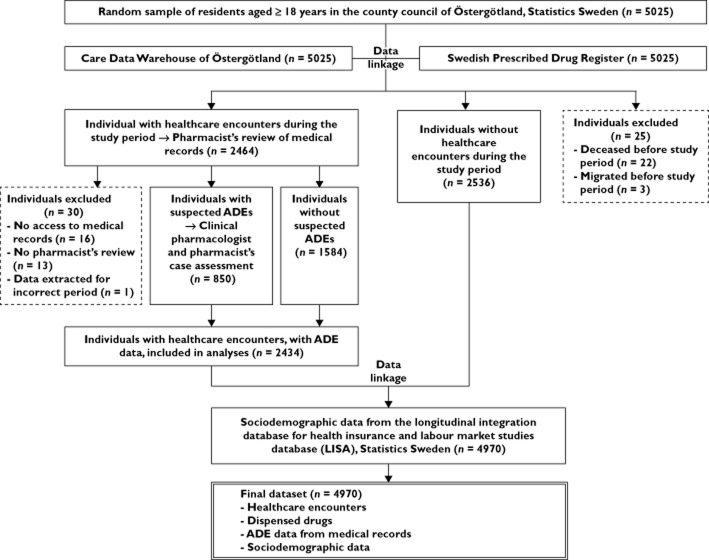
A random sample of 5025 adults in a Swedish county council in 2008 was drawn from the Total Population Register. All their medical records in 29 inpatient care departments in three hospitals, 110 specialized outpatient clinics and 51 primary care units were reviewed retrospectively in a stepwise manner, and complemented with register data on dispensed drugs. ADEs, including adverse drug reactions (ADRs), sub-therapeutic effects of drug therapy (STEs), drug dependence and abuse, drug intoxications from overdose, and morbidities due to drug-related untreated indication, were detected during a 3 month study period, and assessed for preventability.
Among 4970 included individuals, the prevalence of ADEs was 12.0% (95% confidence interval (CI) 11.1, 12.9%), and preventable ADEs 5.6% (95% CI 5.0, 6.2%). ADRs (6.9%; 95% CI 6.2, 7.6%) and STEs (6.4%; 95% CI 5.8, 7.1%) were more prevalent than the other ADEs. Of the ADEs, 38.8% (95% CI 35.8-41.9%) was preventable, varying by ADE category and seriousness. ADEs were frequently associated with nervous system and cardiovascular drugs, but the associated drugs and affected organs varied by ADE category.
The considerable burden of ADEs and preventable ADEs from commonly used drugs across care settings warrants large-scale efforts to redesign safer, higher quality healthcare systems. The heterogeneous nature of the ADE categories should be considered in research and clinical practice for preventing, detecting and mitigating ADEs.
评估瑞典成年人中药物不良事件(ADEs)的3个月患病率、ADEs的类别和可预防的ADEs,以及ADEs的可预防性。此外,确定与ADEs相关的药物类别和器官系统,并评估其严重程度。
2008年从瑞典一个郡议会的总人口登记册中随机抽取5025名成年人作为样本。逐步回顾了他们在三家医院的29个住院护理部门、110个专科门诊诊所和51个初级保健单位的所有医疗记录,并辅以已配发药物的登记数据。在3个月的研究期间检测ADEs,包括药物不良反应(ADRs)、药物治疗的亚治疗效果(STEs)、药物依赖和滥用、药物过量中毒以及与药物相关的未治疗指征导致的疾病,并评估其可预防性。
在纳入的4970名个体中,ADEs的患病率为12.0%(95%置信区间(CI)11.1,12.9%),可预防的ADEs为5.6%(95%CI 5.0,6.2%)。ADRs(6.9%;95%CI 6.2,7.6%)和STEs(6.4%;95%CI 5.8,7.1%)比其他ADEs更常见。在ADEs中,38.8%(95%CI 35.8 - 41.9%)是可预防的,因ADE类别和严重程度而异。ADEs经常与神经系统和心血管系统药物相关,但相关药物和受影响器官因ADE类别而异。
不同医疗机构中常用药物导致的ADEs和可预防的ADEs负担较重,需要大规模努力重新设计更安全、更高质量的医疗保健系统。在预防、检测和减轻ADEs的研究和临床实践中,应考虑ADE类别异质性。