Nordic School of Public Health NHV, Gothenburg, Sweden.
BMJ Open. 2013 Jun 20;3(6):e002574. doi: 10.1136/bmjopen-2013-002574.
To estimate the cost of illness (COI) of individuals with self-reported adverse drug events (ADEs) from a societal perspective and to compare these estimates with the COI for individuals without ADE. Furthermore, to estimate the direct costs resulting from two ADE categories, adverse drug reactions (ADRs) and subtherapeutic effects of medication therapy (STE).
Cross-sectional study.
The adult Swedish general population.
The survey was distributed to a random sample of 14 000 Swedish residents aged 18 years and older, of which 7099 responded, 1377 reported at least one ADE and 943 reported an ADR or STE.
Societal COI, including direct and indirect costs, for individuals with at least one self-reported ADE, and the direct costs for prescription drugs and healthcare use resulting from self-reported ADRs and STEs were estimated during 30 days using a bottom-up approach.
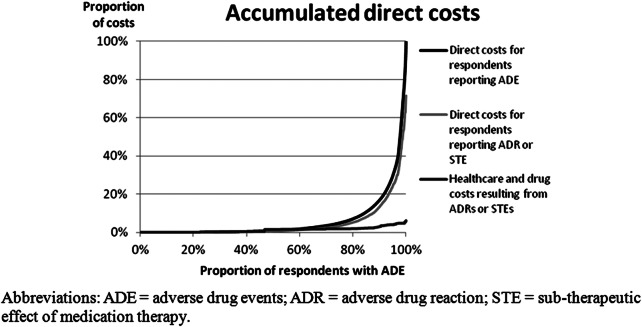
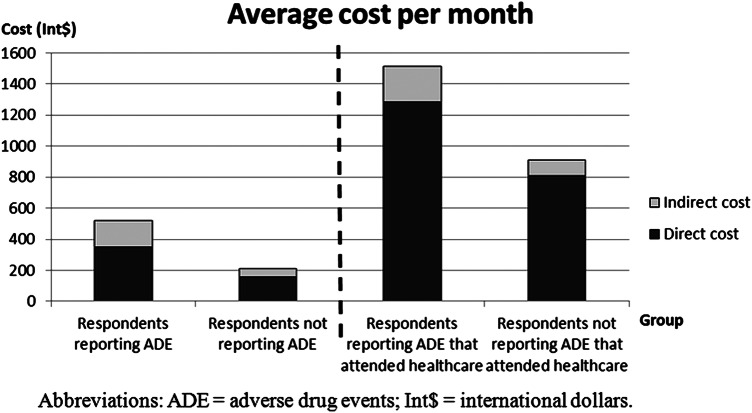
The economic burden for individuals with ADEs were (95% CI) 442.7 to 599.8 international dollars (Int$), of which direct costs were Int$ 279.6 to 420.0 (67.1%) and indirect costs were Int$ 143.0 to 199.8 (32.9%). The average COI was higher among those reporting ADEs compared with other respondents (COI: Int$ 442.7 to 599.8 versus Int$ 185.8 to 231.2). The COI of respondents reporting at least one ADR or STE was Int$ 468.9 to 652.9. Direct costs resulting from ADRs or STEs were Int$ 15.0 to 48.4. The reported resource use occurred both in hospitals and outside in primary care.
Self-reported ADRs and STEs cause resource use both in hospitals and in primary care. Moreover, ADEs seem to be associated with high overall COI from a societal perspective when comparing respondents with and without ADEs. There is a need to further examine this relationship and to study the indirect costs resulting from ADEs.
从社会角度评估报告有不良药物事件(ADE)的个体的疾病成本(COI),并将这些估计值与无 ADE 个体的 COI 进行比较。此外,估计两种 ADE 类别(药物不良反应(ADR)和药物治疗的治疗不足效应(STE))所导致的直接成本。
横断面研究。
成年瑞典一般人群。
该调查向年龄在 18 岁及以上的 14000 名瑞典居民随机抽取的样本发放问卷,其中 7099 人做出了回应,1377 人报告了至少一次 ADE,943 人报告了 ADR 或 STE。
至少报告一次 ADE 的个体的社会 COI,包括直接和间接成本,以及使用自下而上的方法在 30 天内估算因报告的 ADR 和 STE 而导致的处方药和医疗保健使用的直接成本。
ADE 个体的经济负担为(95%CI)442.7 至 599.8 国际元(Int$),其中直接成本为 Int$ 279.6 至 420.0(67.1%),间接成本为 Int$ 143.0 至 199.8(32.9%)。与其他应答者相比,报告 ADE 的个体的平均 COI 更高(COI:Int$ 442.7 至 599.8 比 Int$ 185.8 至 231.2)。报告至少有一次 ADR 或 STE 的应答者的 COI 为 Int$ 468.9 至 652.9。因 ADR 或 STE 导致的直接成本为 Int$ 15.0 至 48.4。报告的资源使用既发生在医院,也发生在初级保健机构。
报告的 ADR 和 STE 既在医院又在初级保健机构导致资源使用。此外,当比较有和无 ADE 的应答者时,ADE 似乎与从社会角度来看的总体较高的 ADE 相关成本相关。需要进一步研究这种关系,并研究 ADE 导致的间接成本。