Department of Psychiatry, Yale University, New Haven, CT, USA.
Bipolar Disord. 2014 May;16(3):262-9. doi: 10.1111/bdi.12168. Epub 2013 Dec 23.
Bipolar disorder (BP) has been associated with increased aggressive behaviors. However, all existing studies are cross-sectional and include forensic or inpatient populations and many do not take into account the effects of comorbid conditions. The goal of this study was to evaluate the longitudinal course of aggression among adult outpatients with BP compared with non-BP patients and healthy controls.
Subjects with bipolar I disorder (BP-I)/bipolar II disorder (BP-II) (n = 255), those with non-BP psychopathology (n = 85), and healthy controls (n = 84) (average 38.9 years, 78.7% female, and 84.9% Caucasian) were evaluated at intake and after two and four years of follow-up. Aggression was self-rated using the Aggression Questionnaire (AQ). Comparisons were adjusted for any significant demographic and clinical differences and for multiple comparisons. For subjects with BP, associations of AQ with subtype of BP, current versus past mood episodes, polarity and severity of the current episode, psychosis, and current pharmacological treatment were evaluated.
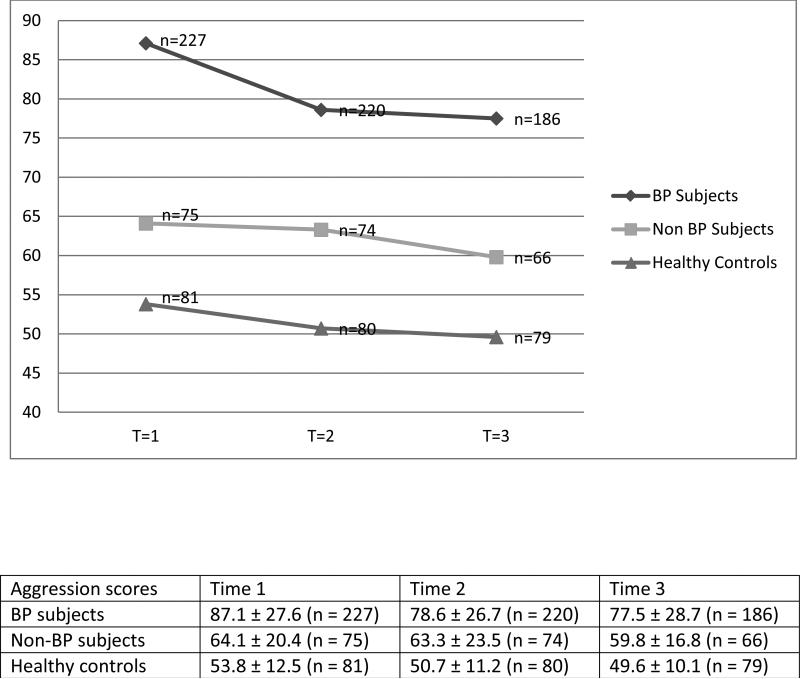
In comparison with subjects with non-BP psychiatric disorders and healthy controls, subjects with BP showed persistently higher total and subscale AQ scores (raw and T-scores) during the four-year follow-up. There were no effects of BP subtype, severity or polarity of the current episode, psychosis, and current pharmacological treatments. Subjects in an acute mood episode showed significantly higher AQ scores than euthymic subjects.
BP, particularly during acute episodes, is associated with increased self-reported verbal and physical aggression, anger, and hostility. These results provide further evidence of the need for treatments to prevent mood recurrences and prompt treatment of acute mood episodes in subjects with BP.
双相情感障碍(BP)与攻击性增强有关。然而,所有现有的研究都是横断面的,包括法医或住院患者,并且许多研究没有考虑到合并症的影响。本研究的目的是评估与非 BP 患者和健康对照相比,成人门诊 BP 患者的攻击性纵向病程。
评估了 255 名双相 I 型障碍(BP-I)/双相 II 型障碍(BP-II)患者、85 名非 BP 精神病理学患者和 84 名健康对照者(平均年龄 38.9 岁,78.7%为女性,84.9%为白种人)在入组时和两年及四年随访时的情况。使用攻击性问卷(AQ)对攻击性进行自我评估。比较结果经过了任何显著的人口统计学和临床差异以及多重比较的调整。对于 BP 患者,AQ 与 BP 亚型、当前与过去的情绪发作、当前发作的极性和严重程度、精神病和当前药物治疗的关联进行了评估。
与非 BP 精神障碍患者和健康对照者相比,BP 患者在四年随访期间的总 AQ 评分(原始和 T 评分)和子量表评分一直较高。BP 亚型、当前发作的严重程度或极性、精神病和当前药物治疗均无影响。处于急性情绪发作期的患者的 AQ 评分明显高于心境稳定期的患者。
BP 尤其是在急性发作期,与自我报告的言语和身体攻击、愤怒和敌意增加有关。这些结果进一步证明了需要治疗来预防 BP 患者的情绪复发,并及时治疗急性情绪发作。