Center for International Health, Ludwig Maximilians University, Munich, Germany.
BMC Public Health. 2013 Dec 28;13:1239. doi: 10.1186/1471-2458-13-1239.
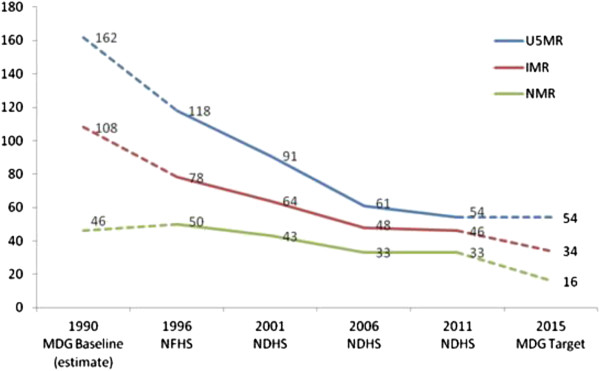
Nepal has made substantial progress in reducing under-five mortality and is on track to achieve Millennium Development Goal 4, but advances in neonatal health are less encouraging. The objectives of this study were to assess relative and absolute inequalities in neonatal mortality over time, and to review experience with major programs to promote neonatal health.
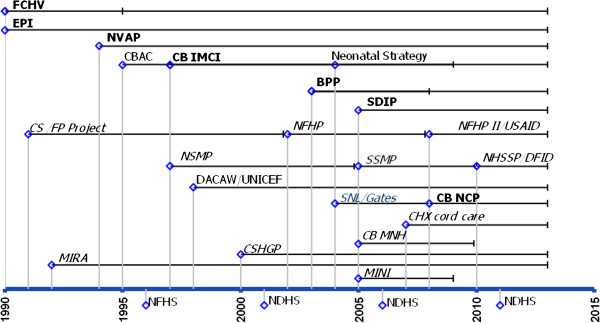
Using four nationally representative surveys conducted in 1996, 2001, 2006 and 2011, we calculated neonatal mortality rates for Nepal and for population groups based on child sex, geographical and socio-economic variables using a true cohort log probability approach. Inequalities based on different variables and years were assessed using rate differences (rd) and rate ratios (rr); time trends in neonatal mortality were measured using the annual rate of reduction. Through literature searches and expert consultation, information on Nepalese policies and programs implemented since 1990 and directly or indirectly attempting to reduce neonatal mortality was compiled. Data on timeline, coverage and effectiveness were extracted for major programs.
The annual rate of reduction for neonatal mortality between 1996 and 2011 (2.8 percent per annum) greatly lags behind the achievements in under-five and infant mortality, and varies across population groups. For the year 2011, stark absolute and relative inequalities in neonatal mortality exist in relation to wealth status (rd = 21.4, rr = 2.2); these are less pronounced for other measures of socio-economic status, child sex and urban-rural residence, ecological and development region. Among many efforts to promote child and maternal health, three established programs and two pilot programs emerged as particularly relevant to reducing neonatal mortality. While these were designed based on national and international evidence, information about coverage of different population groups and effectiveness is limited.
Neonatal mortality varies greatly by socio-demographic variables. This study clearly shows that much remains to be achieved in terms of reducing neonatal mortality across different socio-economic, ethnic and geographical population groups in Nepal. In moving forward it will be important to scale up programs of proven effectiveness, conduct in-depth evaluation of promising new approaches, target unreached and hard-to-reach populations, and maximize use of financial and personnel resources through integration across programs.
尼泊尔在降低五岁以下儿童死亡率方面取得了重大进展,已步入实现千年发展目标 4 的正轨,但新生儿健康方面的进展却不尽人意。本研究旨在评估新生儿死亡率随时间推移的相对和绝对不平等,并回顾促进新生儿健康的主要方案的经验。
本研究使用 1996 年、2001 年、2006 年和 2011 年四次全国代表性调查,使用真正队列对数概率方法,根据儿童性别、地理和社会经济变量,为尼泊尔和人口组计算新生儿死亡率。通过率差异(rd)和率比(rr)评估基于不同变量和年份的不平等情况;通过测量新生儿死亡率的年降低率来衡量新生儿死亡率的时间趋势。通过文献检索和专家咨询,收集了自 1990 年以来尼泊尔实施的直接或间接试图降低新生儿死亡率的政策和方案的信息。提取了主要方案的时间轴、覆盖范围和有效性数据。
1996 年至 2011 年期间,新生儿死亡率的年降低率(每年 2.8%)大大落后于五岁以下和婴儿死亡率的成就,且在不同人群中存在差异。在 2011 年,财富状况方面存在明显的新生儿死亡率绝对和相对不平等(rd=21.4,rr=2.2);在其他社会经济地位衡量指标、儿童性别和城乡居住、生态和发展区域方面,不平等程度则不太明显。在促进儿童和孕产妇健康的诸多努力中,有三项既定方案和两项试点方案被认为与降低新生儿死亡率特别相关。虽然这些方案是基于国家和国际证据制定的,但关于不同人群的覆盖范围和有效性的信息有限。
新生儿死亡率因社会人口变量而异。本研究清楚地表明,尼泊尔在不同社会经济、族裔和地理人口群体中降低新生儿死亡率方面仍有许多工作要做。在前进的过程中,重要的是扩大已证明有效的方案,深入评估有前途的新方法,以针对未覆盖和难以覆盖的人群,并通过方案整合最大限度地利用财政和人力资源。