Possible, New York, USA.
Icahn School of Medicine at Mount Sinai, Arnhold Institute for Global Health, New York, NY, USA.
Popul Health Metr. 2022 Jul 27;20(1):16. doi: 10.1186/s12963-022-00293-4.
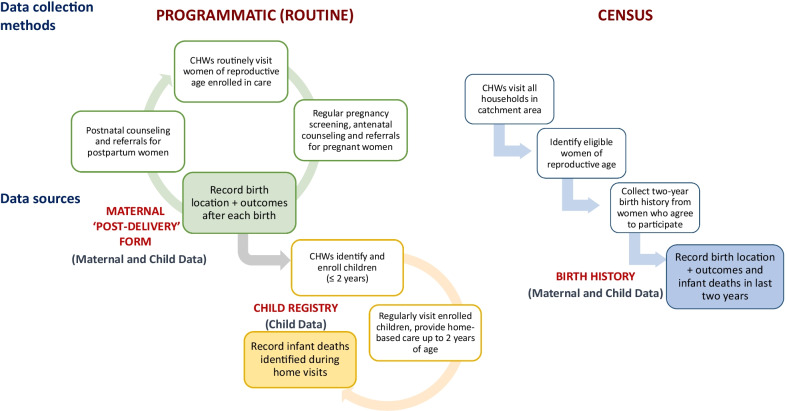
Timely tracking of health outcomes is difficult in low- and middle-income countries without comprehensive vital registration systems. Community health workers (CHWs) are increasingly collecting vital events data while delivering routine care in low-resource settings. It is necessary, however, to assess whether routine programmatic data collected by CHWs are sufficiently reliable for timely monitoring and evaluation of health interventions. To study this, we assessed the consistency of vital events data recorded by CHWs using two methodologies-routine data collected while delivering an integrated maternal and child health intervention, and data from a birth history census approach at the same site in rural Nepal.
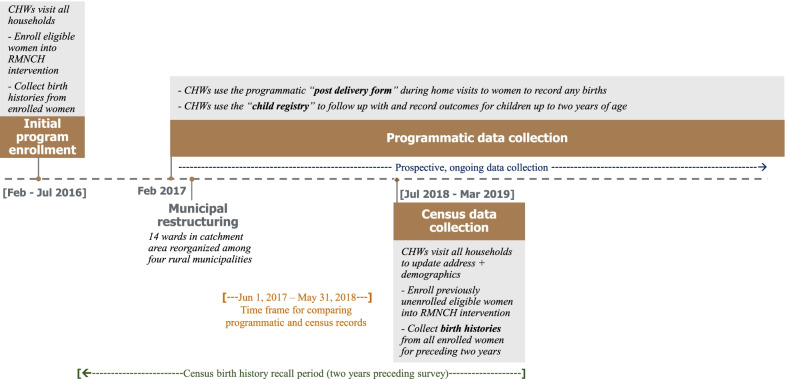
We linked individual records from routine programmatic data from June 2017 to May 2018 with those from census data, both collected by CHWs at the same site using a mobile platform. We categorized each vital event over a one-year period as 'recorded by both methods,' 'census alone,' or 'programmatic alone.' We further assessed whether vital events data recorded by both methods were classified consistently.
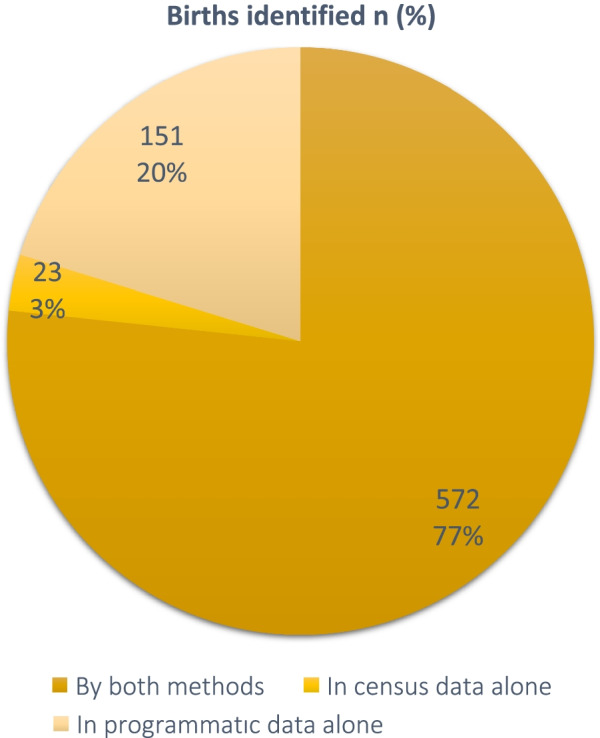
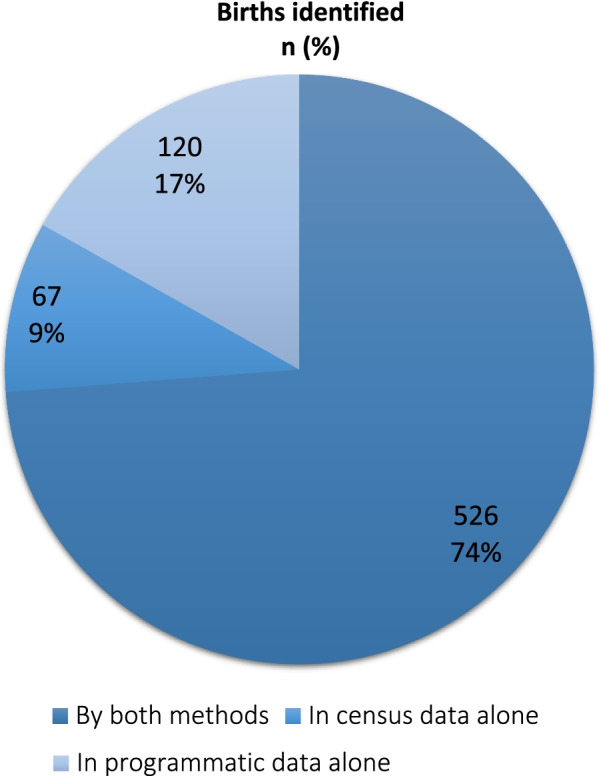
From June 2017 to May 2018, we identified a total of 713 unique births collectively from the census (birth history) and programmatic maternal 'post-delivery' data. Three-fourths of these births (n = 526) were identified by both. There was high consistency in birth location classification among the 526 births identified by both methods. Upon including additional programmatic 'child registry' data, we identified 746 total births, of which 572 births were identified by both census and programmatic methods. Programmatic data (maternal 'post-delivery' and 'child registry' combined) captured more births than census data (723 vs. 595). Both methods consistently classified most infants as 'living,' while infant deaths and stillbirths were largely classified inconsistently or recorded by only one method. Programmatic data identified five infant deaths and five stillbirths not recorded in census data.
Our findings suggest that data collected by CHWs from routinely tracking pregnancies, births, and deaths are promising for timely program monitoring and evaluation. Despite some limitations, programmatic data may be more sensitive in detecting vital events than cross-sectional census surveys asking women to recall these events.
在没有全面生命登记系统的中低收入国家,很难及时跟踪健康结果。社区卫生工作者(CHW)在资源匮乏的环境中提供常规护理的同时,越来越多地收集生命事件数据。然而,有必要评估 CHW 收集的常规方案数据是否足够可靠,以便及时监测和评估卫生干预措施。为了研究这一点,我们使用两种方法评估了 CHW 记录的生命事件数据的一致性 - 在提供综合母婴健康干预措施时收集的常规数据,以及在尼泊尔农村同一地点进行的出生史普查方法的数据。
我们将 2017 年 6 月至 2018 年 5 月期间的常规方案数据中的个人记录与普查数据联系起来,这两个数据都是由 CHW 在同一地点使用移动平台收集的。我们将一年期间的每个生命事件分为“两种方法均记录”、“仅普查记录”或“仅方案记录”。我们还进一步评估了两种方法记录的生命事件数据是否分类一致。
从 2017 年 6 月至 2018 年 5 月,我们从普查(出生史)和方案性的孕产妇“产后”数据中总共确定了 713 个独特的出生事件。其中四分之三(n=526)是通过两种方法确定的。在通过两种方法确定的 526 个出生事件中,出生地点的分类高度一致。在包括更多的方案性“儿童登记”数据后,我们总共确定了 746 个出生事件,其中 572 个出生事件是通过普查和方案性方法确定的。方案性数据(孕产妇“产后”和“儿童登记”相结合)比普查数据记录了更多的出生事件(723 比 595)。两种方法都一致地将大多数婴儿归类为“活产”,而婴儿死亡和死产则主要不一致或仅由一种方法记录。方案性数据确定了普查数据中未记录的 5 例婴儿死亡和 5 例死产。
我们的研究结果表明,CHW 从常规跟踪妊娠、分娩和死亡中收集的数据对于及时的方案监测和评估很有前景。尽管存在一些局限性,但方案性数据在检测生命事件方面可能比询问妇女回忆这些事件的横断面普查更敏感。