CECAV, Departamento de Zootecnia, Universidade de Trás-os-Montes e Alto Douro, Vila Real, Portugal; FMDUP, Laboratory for Bone Metabolism and Regeneration, Faculty of Dental Medicine, University of Porto, Porto, Portugal.
J Cell Mol Med. 2014 Jan;18(1):27-37. doi: 10.1111/jcmm.12154. Epub 2013 Oct 31.
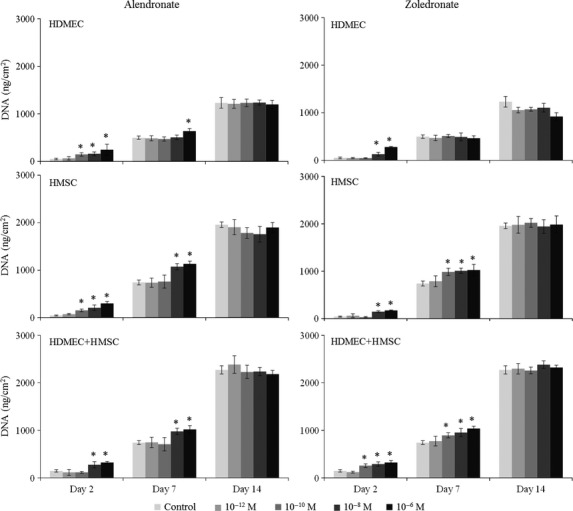
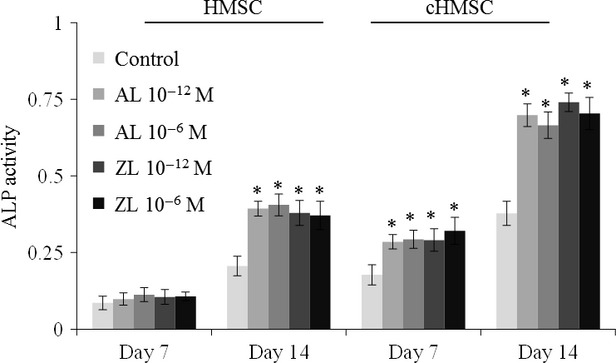
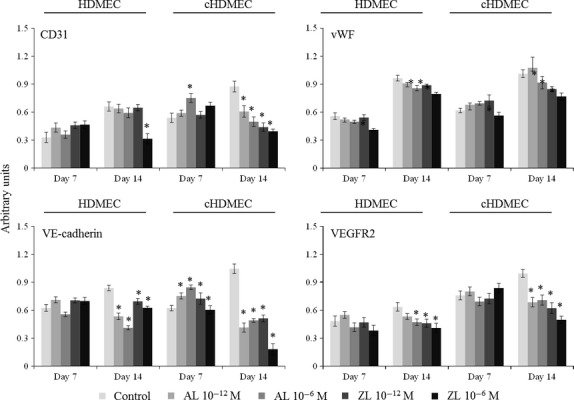
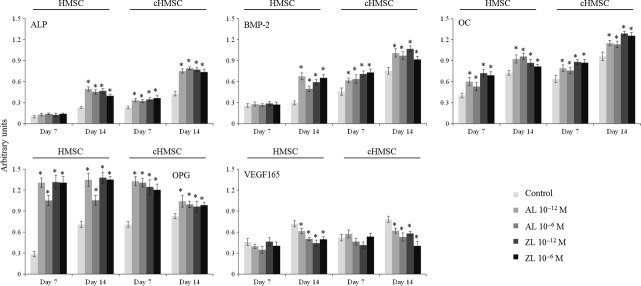
Bisphosphonates (BPs) are known to affect bone homeostasis and also to have anti-angiogenic properties. Because of the intimate relationship between angiogenesis and osteogenesis, this study analysed the effects of Alendronate (AL) and Zoledronate (ZL) in the expression of endothelial and osteogenic genes on interacting endothelial and mesenchymal stem cells, an issue that was not previously addressed. Alendronate and ZL, 10(-12) -10(-6) M, were evaluated in a direct co-culture system of human dermal microvascular endothelial cells (HDMEC) and human bone marrow mesenchymal stem cells (HMSC), over a period of 14 days. Experiments with the respective monocultures were run in parallel. Alendronate and ZL caused an initial dose-dependent stimulation in the cell proliferation in the monocultures and co-cultures, and did not interfere with their cellular organization. In HDMEC monocultures, the expression of the endothelial genes CD31, VE-cadherin and VEGFR2 was down-regulated by AL and ZL. In HMSC monocultures, the BPs inhibited VEGF expression, but up-regulated the expression of the osteogenic genes alkaline phosphatase (ALP), bone morphogenic protein-2 (BMP-2) and osteocalcin (OC) and, to a greater extent, osteoprotegerin (OPG), a negative regulator of the osteoclastic differentiation, and increased ALP activity. In co-cultured HDMEC/HMSC, AL and ZL decreased the expression of endothelial genes but elicited an earlier and sustained overexpression of ALP, BMP-2, OC and OPG, compared with the monocultured cells; they also induced ALP activity. This study showed for the first time that AL and ZL greatly induced the osteogenic gene expression on interacting endothelial and mesenchymal stem cells.
双膦酸盐(BPs)已知会影响骨内稳态,并且具有抗血管生成特性。由于血管生成和骨生成之间的密切关系,本研究分析了阿仑膦酸盐(AL)和唑来膦酸盐(ZL)在相互作用的内皮和间充质干细胞中内皮和成骨基因表达的影响,这是以前没有解决的问题。在人真皮微血管内皮细胞(HDMEC)和人骨髓间充质干细胞(HMSC)的直接共培养系统中,评估了浓度为 10(-12) -10(-6) M 的阿仑膦酸盐和唑来膦酸盐,共培养 14 天。相应的单核培养实验也平行进行。阿仑膦酸盐和唑来膦酸盐在单核培养物和共培养物中引起了初始剂量依赖性的细胞增殖刺激,并且不干扰它们的细胞组织。在 HDMEC 单核培养物中,AL 和 ZL 下调内皮基因 CD31、VE-cadherin 和 VEGFR2 的表达。在 HMSC 单核培养物中,BPs 抑制 VEGF 的表达,但上调成骨基因碱性磷酸酶(ALP)、骨形态发生蛋白-2(BMP-2)和骨钙素(OC)的表达,并且在更大程度上上调破骨细胞分化的负调节剂骨保护素(OPG)的表达,并增加 ALP 活性。在共培养的 HDMEC/HMSC 中,AL 和 ZL 降低了内皮基因的表达,但与单核培养细胞相比,更早且持续上调了 ALP、BMP-2、OC 和 OPG 的表达,并且还诱导了 ALP 活性。本研究首次表明,AL 和 ZL 极大地诱导了相互作用的内皮和间充质干细胞中成骨基因的表达。