Department of Medicine, Queen Mary Hospital, The University of Hong Kong, Hong Kong, China.
Mol Cancer. 2013 Dec 27;12:173. doi: 10.1186/1476-4598-12-173.
The miR-9 family microRNAs have been identified as a tumor suppressor miRNA in cancers. We postulated that miR-9-1, miR-9-2 and miR-9-3 might be inactivated by DNA hypermethylation in chronic lymphocytic leukemia (CLL).
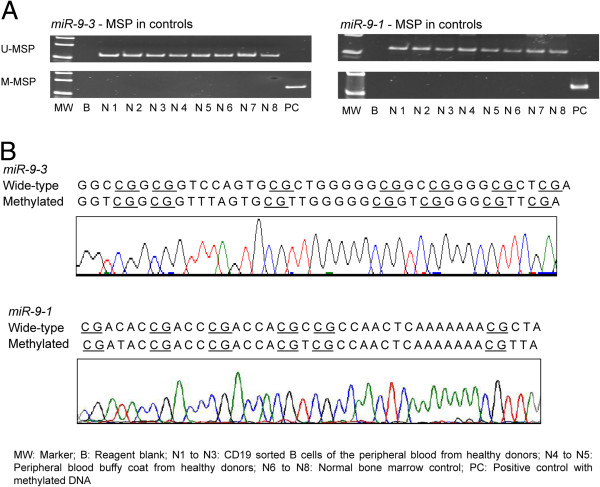
Methylation of miR-9-1, miR-9-2 and miR-9-3 was studied in eight normal controls including normal bone marrow, buffy coat, and CD19-sorted peripheral blood B-cells from healthy individuals, seven CLL cell lines, and seventy-eight diagnostic CLL samples by methylation-specific polymerase chain reaction.
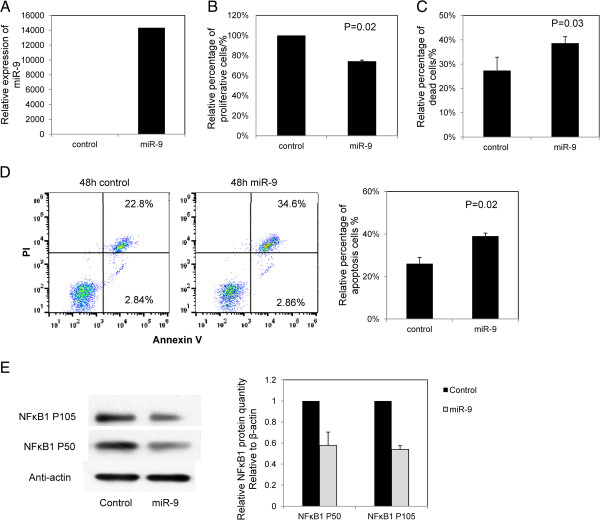
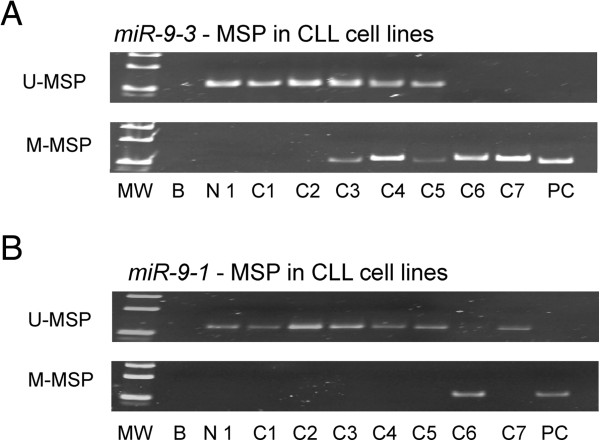
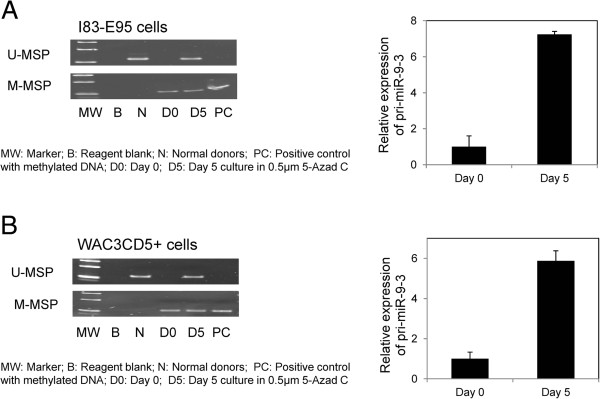
The promoters of miR-9-3 and miR-9-1 were both unmethylated in normal controls, but methylated in five (71.4%) and one of seven CLL cell lines respectively. However, miR-9-2 promoter was methylated in normal controls including CD19 + ve B-cells, hence suggestive of a tissue-specific but not tumor-specific methylation, and thus not further studied. Different MSP statuses of miR-9-3, including complete methylation, partial methylation, and complete unmethylation, were verified by quantitative bisulfite methylation analysis. 5-Aza-2'-deoxycytidine treatment resulted in miR-9-3 promoter demethylation and re-expression of pri-miR-9-3 in I83-E95 and WAC3CD5+ cells, which were homozygously methylated for miR-9-3. Moreover, overexpression of miR-9 led to suppressed cell proliferation and enhanced apoptosis together with downregulation of NFκB1 in I83-E95 cells, supporting a tumor suppressor role of miR-9-3 in CLL. In primary CLL samples, miR-9-3 was detected in 17% and miR-9-1 methylation in none of the patients at diagnosis. Moreover, miR-9-3 methylation was associated with advanced Rai stage (≥ stage 2) (P = 0.04).
Of the miR-9 family, miR-9-3 is a tumor suppressor miRNA relatively frequently methylated, and hence silenced in CLL; whereas miR-9-1 methylation is rare in CLL. The role of miR-9-3 methylation in the constitutive activation of NFκB signaling pathway in CLL warrants further study.
miR-9 家族 microRNAs 已被鉴定为癌症中的肿瘤抑制 miRNA。我们推测 miR-9-1、miR-9-2 和 miR-9-3 可能在慢性淋巴细胞白血病(CLL)中因 DNA 过度甲基化而失活。
通过甲基化特异性聚合酶链反应研究了 miR-9-1、miR-9-2 和 miR-9-3 在 8 名正常对照者(包括正常骨髓、白细胞层和健康个体的 CD19 分选外周血 B 细胞)、7 个 CLL 细胞系和 78 个诊断性 CLL 样本中的甲基化情况。
miR-9-3 和 miR-9-1 的启动子在正常对照者中均未甲基化,但在 5 个(71.4%)和 7 个 CLL 细胞系中的 1 个分别甲基化。然而,miR-9-2 启动子在包括 CD19+ve B 细胞在内的正常对照者中甲基化,提示组织特异性而非肿瘤特异性甲基化,因此不再进一步研究。通过定量亚硫酸氢盐甲基化分析验证了 miR-9-3 的不同 MSP 状态,包括完全甲基化、部分甲基化和完全非甲基化。5-氮杂-2'-脱氧胞苷处理导致 I83-E95 和 WAC3CD5+细胞中 miR-9-3 启动子去甲基化和 pri-miR-9-3 的重新表达,这些细胞系中 miR-9-3 呈纯合甲基化。此外,在 I83-E95 细胞中,过表达 miR-9 导致细胞增殖受到抑制,凋亡增强,同时 NFκB1 下调,支持 miR-9-3 在 CLL 中作为肿瘤抑制 miRNA 的作用。在原发性 CLL 样本中,在诊断时 17%的患者检测到 miR-9-3 甲基化,而无一例患者检测到 miR-9-1 甲基化。此外,miR-9-3 甲基化与晚期 Rai 分期(≥2 期)相关(P=0.04)。
在 miR-9 家族中,miR-9-3 是一种相对频繁被甲基化从而失活的肿瘤抑制 miRNA,存在于 CLL 中;而 miR-9-1 甲基化在 CLL 中罕见。miR-9-3 甲基化在 CLL 中 NFκB 信号通路的组成性激活中的作用值得进一步研究。