Laboratory of Endocrine Neurobiology, Institute of Experimental Medicine, Hungarian Academy of Sciences, Budapest, Hungary.
Department of Forensic Medicine, Faculty of Medicine of the University of Debrecen, Debrecen, Hungary.
PLoS One. 2013 Dec 20;8(12):e83029. doi: 10.1371/journal.pone.0083029. eCollection 2013.
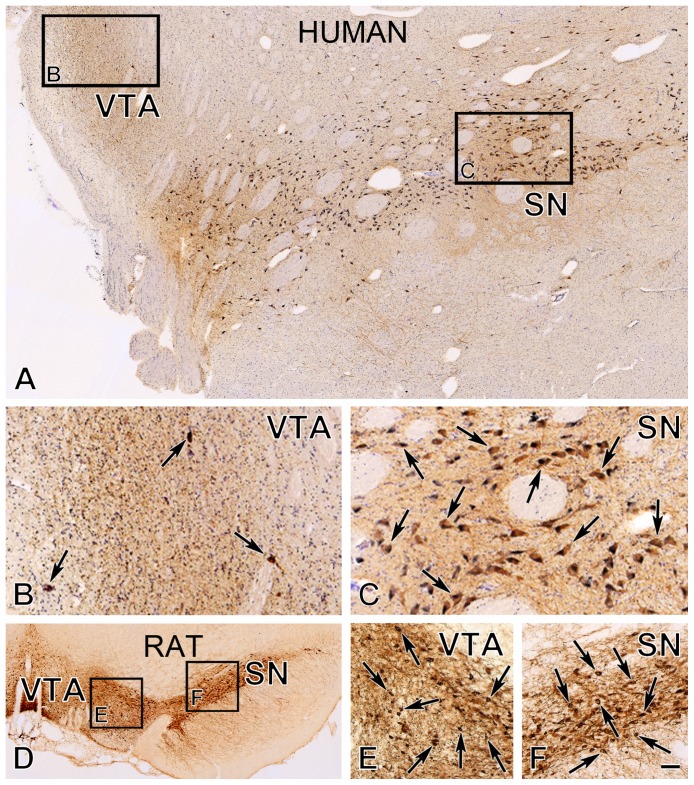
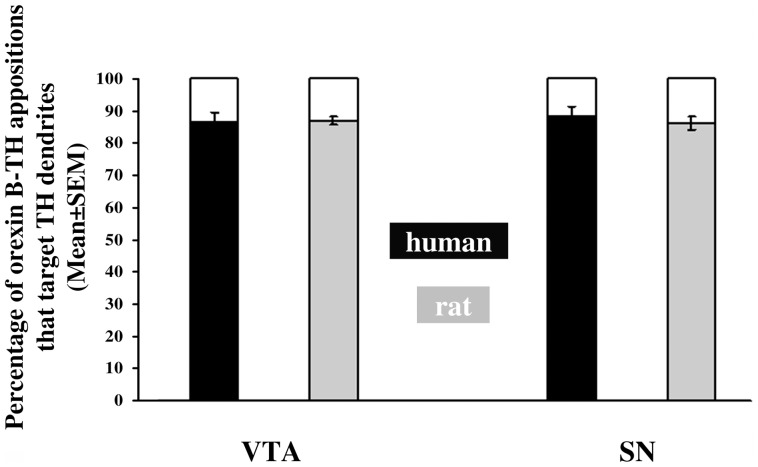
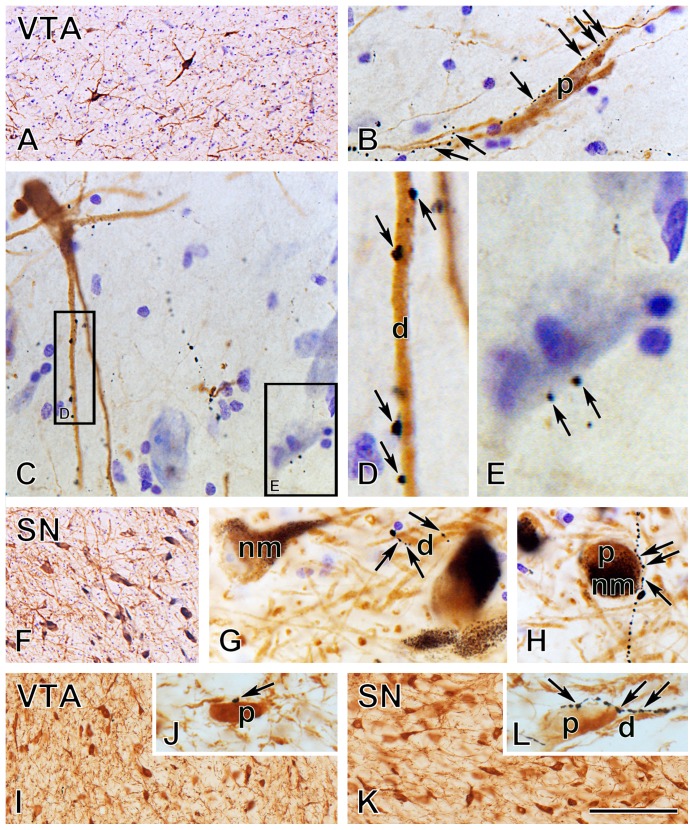
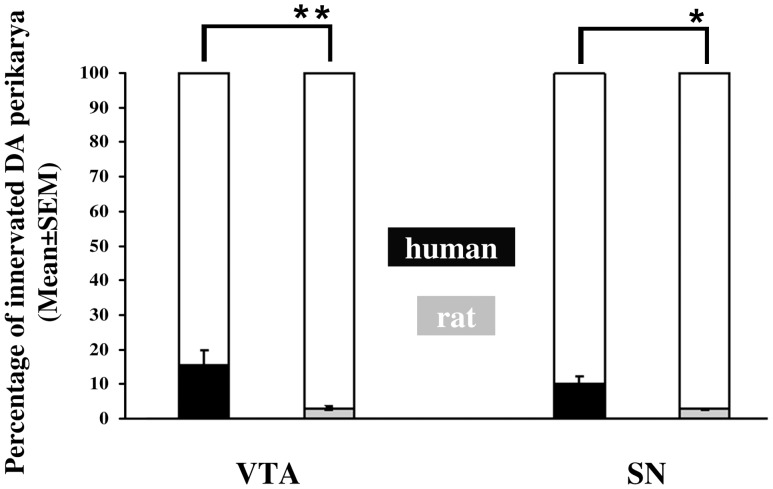
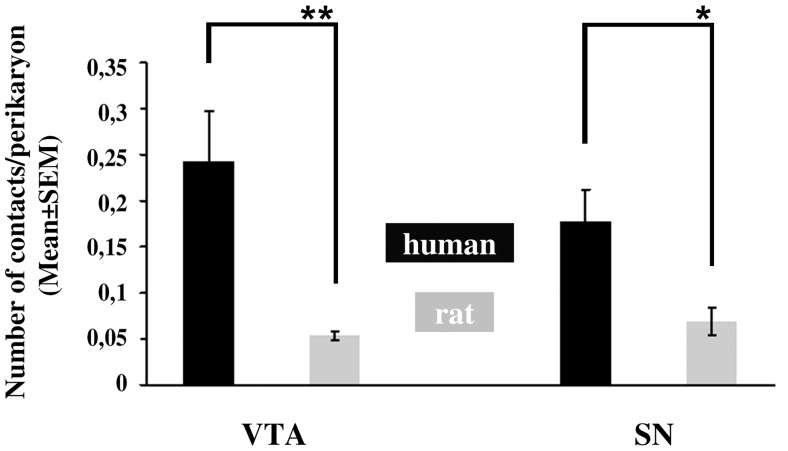
The mesolimbic reward pathway arising from dopaminergic (DA) neurons of the ventral tegmental area (VTA) has been strongly implicated in reward processing and drug abuse. In rodents, behaviors associated with this projection are profoundly influenced by an orexinergic input from the lateral hypothalamus to the VTA. Because the existence and significance of an analogous orexigenic regulatory mechanism acting in the human VTA have been elusive, here we addressed the possibility that orexinergic neurons provide direct input to DA neurons of the human VTA. Dual-label immunohistochemistry was used and orexinergic projections to the VTA and to DA neurons of the neighboring substantia nigra (SN) were analyzed comparatively in adult male humans and rats. Orexin B-immunoreactive (IR) axons apposed to tyrosine hydroxylase (TH)-IR DA and to non-DA neurons were scarce in the VTA and SN of both species. In the VTA, 15.0±2.8% of TH-IR perikarya in humans and 3.2±0.3% in rats received orexin B-IR afferent contacts. On average, 0.24±0.05 and 0.05±0.005 orexinergic appositions per TH-IR perikaryon were detected in humans and rats, respectively. The majority (86-88%) of randomly encountered orexinergic contacts targeted the dendritic compartment of DA neurons. Finally, DA neurons of the SN also received orexinergic innervation in both species. Based on the observation of five times heavier orexinergic input to TH-IR neurons of the human, compared with the rat, VTA, we propose that orexinergic mechanism acting in the VTA may play just as important roles in reward processing and drug abuse in humans, as already established well in rodents.
中脑边缘奖赏通路源于腹侧被盖区(VTA)的多巴胺(DA)神经元,强烈参与奖赏处理和药物滥用。在啮齿动物中,该投射相关的行为受到来自外侧下丘脑到 VTA 的食欲素能传入的强烈影响。由于类似的食欲素能调节机制在人类 VTA 中的存在和意义一直难以捉摸,因此我们在这里探讨了食欲素能神经元是否为人类 VTA 中的 DA 神经元提供直接输入的可能性。我们使用双重免疫组织化学方法,比较分析了成年雄性人类和大鼠中食欲素能投射到 VTA 和邻近的黑质(SN)中的 DA 神经元。在两种物种的 VTA 和 SN 中,食欲素 B-免疫反应(IR)轴突与酪氨酸羟化酶(TH)-IR DA 以及非-DA 神经元毗邻,但数量很少。在 VTA 中,人类中 15.0±2.8%的 TH-IR 神经元和大鼠中 3.2±0.3%的 TH-IR 神经元接受食欲素 B-IR 传入接触。平均而言,在人类和大鼠中分别检测到 0.24±0.05 和 0.05±0.005 个食欲素能接触点/TH-IR 神经元。随机遇到的食欲素能接触点的大多数(86-88%)靶向 DA 神经元的树突区。最后,在两种物种中,SN 的 DA 神经元也接受了食欲素能支配。基于观察到与大鼠相比,人类 VTA 中 TH-IR 神经元接受的食欲素能传入要重五倍,我们提出,在人类中,作用于 VTA 的食欲素能机制在奖赏处理和药物滥用中可能发挥与啮齿动物中同样重要的作用。