Energy and Environment Fusion Technology Center, Department of Energy and Biotechnology, Myongji University, Cheoin-gu, Yongin-si, Gyeonggi-do, Republic of Korea.
Division of Bioscience and Bioinformatics, Myongji University, Cheoin-gu, Yongin-si, Gyeonggi-do, Republic of Korea.
PLoS One. 2013 Dec 20;8(12):e83290. doi: 10.1371/journal.pone.0083290. eCollection 2013.
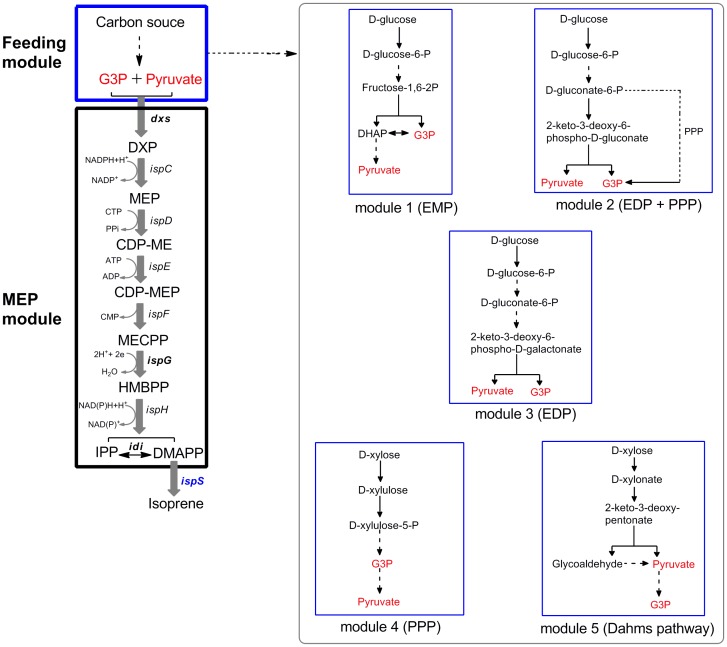
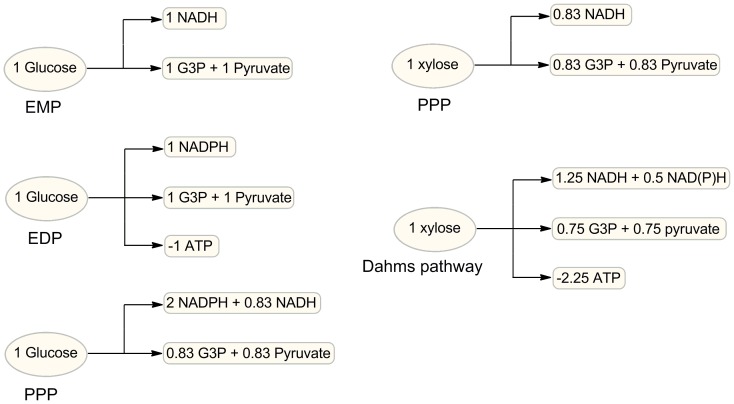
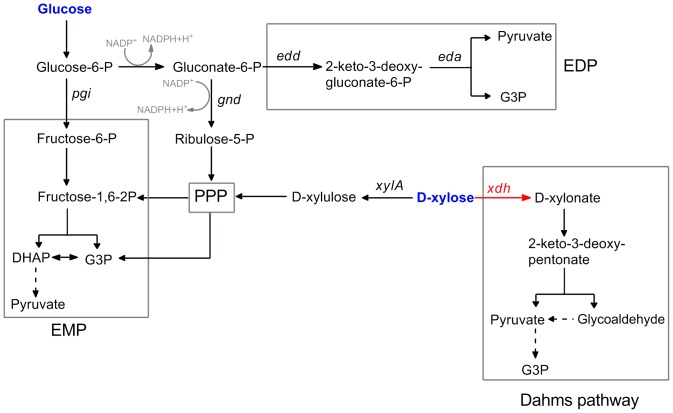
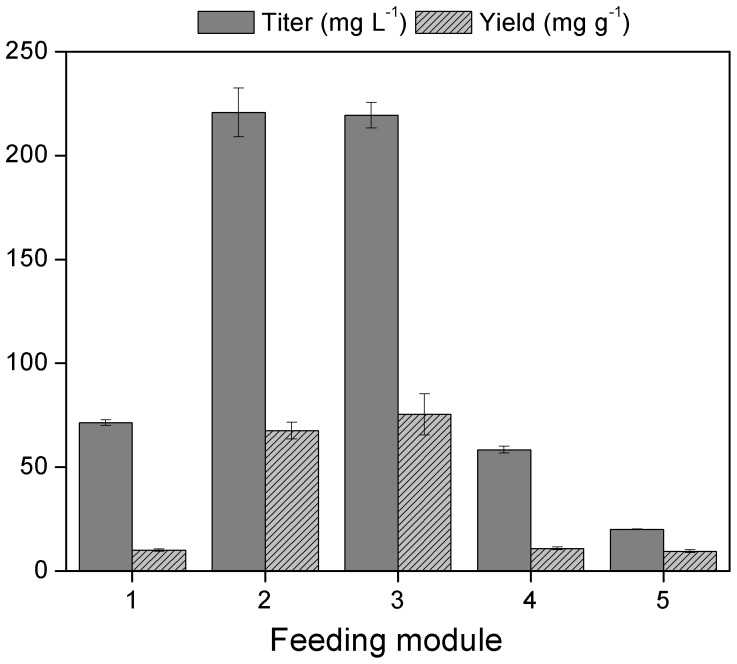
Embden-Meyerhof pathway (EMP) in tandem with 2-C-methyl-D-erythritol 4-phosphate pathway (MEP) is commonly used for isoprenoid biosynthesis in E. coli. However, this combination has limitations as EMP generates an imbalanced distribution of pyruvate and glyceraldehyde-3-phosphate (G3P). Herein, four glycolytic pathways-EMP, Entner-Doudoroff Pathway (EDP), Pentose Phosphate Pathway (PPP) and Dahms pathway were tested as MEP feeding modules for isoprene production. Results revealed the highest isoprene production from EDP containing modules, wherein pyruvate and G3P were generated simultaneously; isoprene titer and yield were more than three and six times higher than those of the EMP module, respectively. Additionally, the PPP module that generates G3P prior to pyruvate was significantly more effective than the Dahms pathway, in which pyruvate production precedes G3P. In terms of precursor generation and energy/reducing-equivalent supply, EDP+PPP was found to be the ideal feeding module for MEP. These findings may launch a new direction for the optimization of MEP-dependent isoprenoid biosynthesis pathways.
大肠杆菌中,通常采用 EMP 与 2-C-甲基-D-赤藓糖醇 4-磷酸途径(MEP)串联的方式进行异戊二烯生物合成。然而,这种组合存在局限性,因为 EMP 会导致丙酮酸和甘油醛-3-磷酸(G3P)分布不平衡。在此,我们测试了四种糖酵解途径(EMP、Entner-Doudoroff 途径(EDP)、磷酸戊糖途径(PPP)和 Dahms 途径)作为 MEP 供体途径用于异戊二烯生产。结果表明,含有 EDP 的途径模块可生成丙酮酸和 G3P,从而获得最高的异戊二烯产量;异戊二烯的产量和得率分别比 EMP 途径模块高出 3 倍和 6 倍以上。此外,先生成 G3P 再生成丙酮酸的 PPP 途径模块比 Dahms 途径模块更有效,后者中丙酮酸的生成先于 G3P。就前体生成和能量/还原当量供应而言,EDP+PPP 被发现是 MEP 的理想供体途径。这些发现可能为优化依赖 MEP 的异戊二烯生物合成途径开辟新的方向。