Zhou Jian, Mo Yifei, Li Hong, Ran Xingwu, Yang Wenying, Li Qiang, Peng Yongde, Li Yanbing, Gao Xin, Luan Xiaojun, Wang Weiqing, Xie Yun, Jia Weiping
Department of Endocrinology and Metabolism, Shanghai Jiao Tong University Affiliated Sixth People's Hospital, Shanghai Clinical Center for Diabetes, Shanghai Diabetes Institute, Shanghai Key Laboratory of Diabetes Mellitus, Shanghai Key Clinical Center for Metabolic Disease, Shanghai, China.
Department of Endocrinology and Metabolism, Sir Run Run Shaw Hospital, College of Medicine, Zhejiang University, Hangzhou, China.
PLoS One. 2013 Dec 23;8(12):e83827. doi: 10.1371/journal.pone.0083827. eCollection 2013.
Since there is a paucity of reference data in the literature to indicate the relationship between HbA1c, and 24 h mean blood glucose (MBG) from continuous glucose monitoring (CGM) in Chinese populations, we described the above relationship in adult Chinese subjects with different glucose tolerance status.
Seven-hundred-and-forty-two individuals without history of diabetes were included to the study at 11 hospitals in urban areas across China from 2007-2009 and data of 673 subjects were included into the final analysis. Oral glucose tolerance test (OGTT) classified the participants as nondiabetic subjects, including those with normal glucose regulation (NGR; n = 121) and impaired glucose regulation (IGR; n = 209), or newly diagnosed type 2 diabetes (n = 343). All participants completed testing for HbA1c levels and wore a CGM system for three consecutive days. The 24 h MBG levels were calculated. Spearman correlations and linear regression analyses were applied to quantify the relationship between glucose markers.
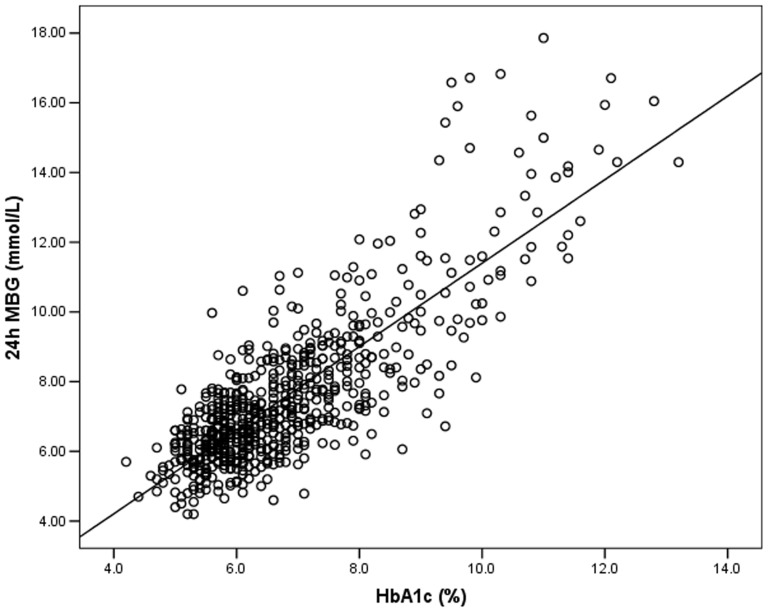
The levels of HbA1c and 24 h MBG significantly increased with presence of glucose intolerance (NGR<IGR<type 2 diabetes; both, P<0.001). Analysis of the total population indicated that HbA1c was strongly correlated with 24 h MBG (r = 0.735). The correlation was also found to be significant for the subgroup of participants with newly diagnosed type 2 diabetes (r = 0.694, P<0.001). Linear regression analysis of the total study population yielded the following equation: 24 h MBG(mmol/L )= 1.198×HbA1c-0.582 (24 h MBG(mg/dL )= 21.564×HbA1c-10.476) (R(2)= 0.670, P<0.001). The model fit was not improved by application of exponential or quadratic modeling. When HbA1c was 6.5%, the calculated 24 h MBG was 7.2 (6.4-8.1) mmol/L (130 (115-146) mg/dL); and when HbA1c was 7.0%, the 24 h MBG was 7.8 (6.9-8.7) mmol/L (140 (124-157) mg/dL).
Our study provided the reference data of the relationship between HbA1c and CGM in Chinese subjects.
由于文献中缺乏关于中国人群糖化血红蛋白(HbA1c)与连续血糖监测(CGM)所得24小时平均血糖(MBG)之间关系的参考数据,我们描述了不同糖耐量状态的成年中国受试者中上述关系。
2007年至2009年期间,来自中国城市地区11家医院的742名无糖尿病病史的个体纳入本研究,最终分析纳入673名受试者的数据。口服葡萄糖耐量试验(OGTT)将参与者分为非糖尿病受试者,包括血糖调节正常者(NGR;n = 121)和糖调节受损者(IGR;n = 209),或新诊断的2型糖尿病患者(n = 343)。所有参与者均完成了HbA1c水平检测,并连续三天佩戴CGM系统。计算24小时MBG水平。应用Spearman相关性分析和线性回归分析来量化血糖指标之间的关系。
随着糖耐量异常的出现,HbA1c和24小时MBG水平显著升高(NGR<IGR<2型糖尿病;均P<0.001)。对总体人群的分析表明,HbA1c与24小时MBG密切相关(r = 0.735)。在新诊断的2型糖尿病参与者亚组中也发现这种相关性显著(r = 0.694,P<0.001)。对整个研究人群进行线性回归分析得到以下方程:24小时MBG(mmol/L)= 1.198×HbA1c - 0.582(24小时MBG(mg/dL)= 21.564×HbA1c - 10.476)(R² = 0.670,P<0.001)。应用指数或二次模型并不能改善模型拟合度。当HbA1c为6.5%时,计算所得的24小时MBG为7.2(6.4 - 8.1)mmol/L(130(115 - 146)mg/dL);当HbA1c为7.0%时,24小时MBG为7.8(6.9 - 8.7)mmol/L(140(124 - 157)mg/dL)。
我们的研究提供了中国受试者中HbA1c与CGM之间关系的参考数据。