Dominoni Davide M, Quetting Michael, Partecke Jesko
Department of Migration and Immuno-ecology, Max Planck Institute for Ornithology, Radolfzell, Germany ; Department of Biology, University of Konstanz, Konstanz, Germany ; Institute of Biodiversity, Animal Health and Comparative Medicine, University of Glasgow, Glasgow, United Kingdom.
Department of Migration and Immuno-ecology, Max Planck Institute for Ornithology, Radolfzell, Germany.
PLoS One. 2013 Dec 20;8(12):e85069. doi: 10.1371/journal.pone.0085069. eCollection 2013.
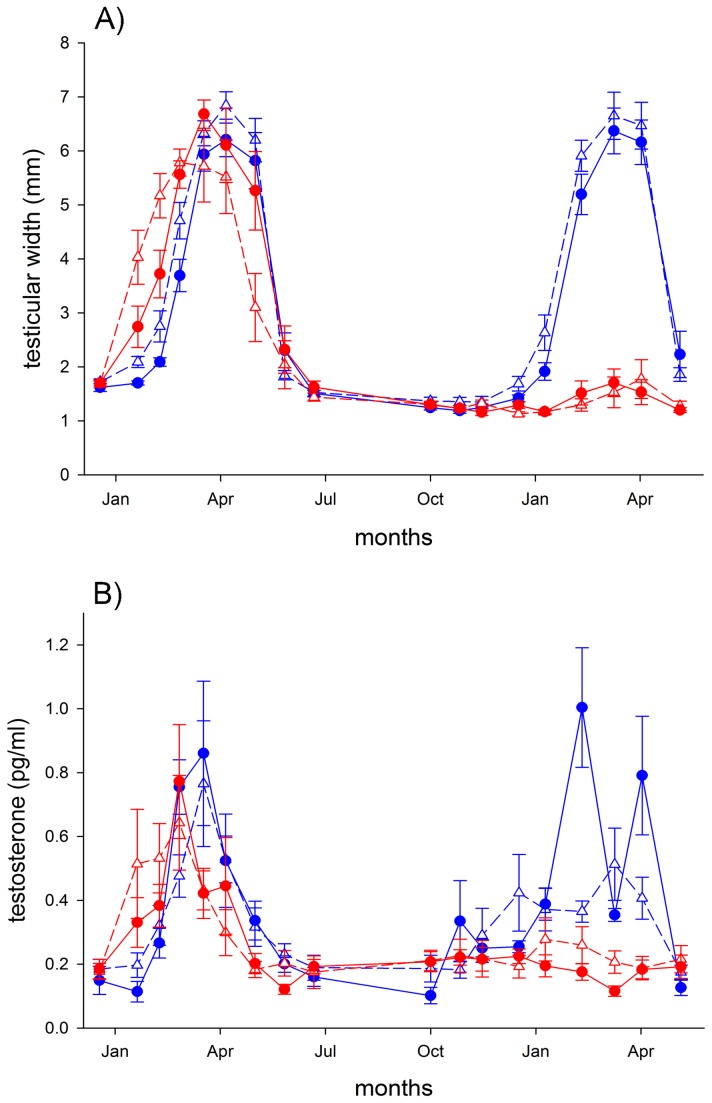
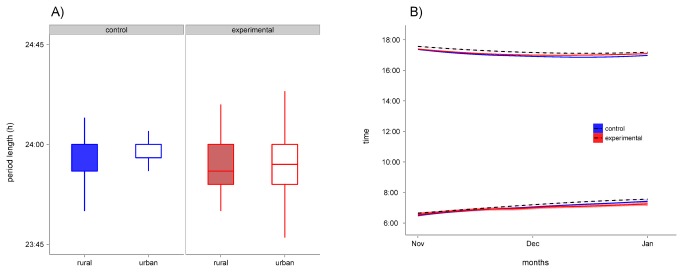
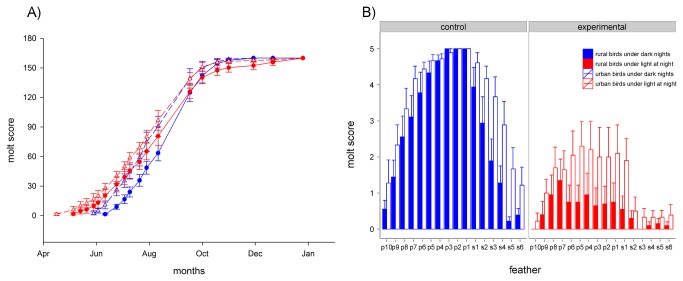
Light pollution is known to affect important biological functions of wild animals, including daily and annual cycles. However, knowledge about long-term effects of chronic exposure to artificial light at night is still very limited. Here we present data on reproductive physiology, molt and locomotor activity during two-year cycles of European blackbirds (Turdus merula) exposed to either dark nights or 0.3 lux at night. As expected, control birds kept under dark nights exhibited two regular testicular and testosterone cycles during the two-year experiment. Control urban birds developed testes faster than their control rural conspecifics. Conversely, while in the first year blackbirds exposed to light at night showed a normal but earlier gonadal cycle compared to control birds, during the second year the reproductive system did not develop at all: both testicular size and testosterone concentration were at baseline levels in all birds. In addition, molt sequence in light-treated birds was more irregular than in control birds in both years. Analysis of locomotor activity showed that birds were still synchronized to the underlying light-dark cycle. We suggest that the lack of reproductive activity and irregular molt progression were possibly the results of i) birds being stuck in a photorefractory state and/or ii) chronic stress. Our data show that chronic low intensities of light at night can dramatically affect the reproductive system. Future studies are needed in order to investigate if and how urban animals avoid such negative impact and to elucidate the physiological mechanisms behind these profound long-term effects of artificial light at night. Finally we call for collaboration between scientists and policy makers to limit the impact of light pollution on animals and ecosystems.
众所周知,光污染会影响野生动物的重要生理功能,包括日常和年度周期。然而,关于长期暴露于夜间人造光的影响的知识仍然非常有限。在此,我们呈现了关于欧洲乌鸫(Turdus merula)在两年周期内,处于暗夜或夜间0.3勒克斯光照环境下的生殖生理学、换羽和运动活动的数据。正如预期的那样,在两年的实验中,处于暗夜环境下的对照鸟呈现出两个规律的睾丸和睾酮周期。对照城市鸟的睾丸发育速度比对照农村同类鸟更快。相反,虽然在第一年,与对照鸟相比,夜间暴露于光照下的乌鸫性腺周期正常但提前,但在第二年,所有鸟的生殖系统根本没有发育:所有鸟的睾丸大小和睾酮浓度都处于基线水平。此外,在这两年中,接受光照处理的鸟的换羽顺序比对照鸟更不规则。运动活动分析表明,鸟仍然与潜在的明暗周期同步。我们认为,生殖活动缺乏和换羽进程不规则可能是由于:i)鸟陷入了光不应期状态和/或ii)慢性应激。我们的数据表明,夜间长期低强度光照会显著影响生殖系统。未来需要进行研究,以调查城市动物是否以及如何避免这种负面影响,并阐明夜间人造光这些深远长期影响背后的生理机制。最后,我们呼吁科学家和政策制定者合作,以限制光污染对动物和生态系统的影响。