Centre for the Advanced Study of Collective Behaviour, University of Konstanz, 78457 Konstanz, Germany.
Department of Collective Behaviour, Max Planck Institute of Animal Behavior, 78457 Konstanz, Germany.
Proc Biol Sci. 2022 May 11;289(1974):20212158. doi: 10.1098/rspb.2021.2158.
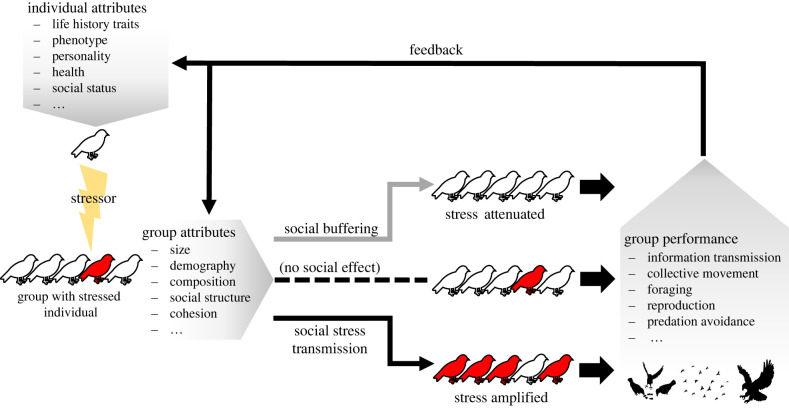
The stress systems are powerful mediators between the organism's systemic dynamic equilibrium and changes in its environment beyond the level of anticipated fluctuations. Over- or under-activation of the stress systems' responses can impact an animal's health, survival and reproductive success. While physiological stress responses and their influence on behaviour and performance are well understood at the individual level, it remains largely unknown whether-and how-stressed individuals can affect the stress systems of other group members, and consequently their collective behaviour. Stressed individuals could directly signal the presence of a stressor (e.g. via an alarm call or pheromones), or an acute or chronic activation of the stress systems could be perceived by others (as an indirect cue) and spread via social contagion. Such social transmission of stress responses could then amplify the effects of stressors by impacting social interactions, social dynamics and the collective performance of groups. As the neuroendocrine pathways of the stress response are highly conserved among vertebrates, transmission of physiological stress states could be more widespread among non-human animals than previously thought. We therefore suggest that identifying the extent to which stress transmission modulates animal collectives represents an important research avenue.
压力系统是生物体系统动态平衡与环境变化之间的强大中介,而后者超出了预期波动的水平。压力系统反应的过度或不足激活会影响动物的健康、生存和繁殖成功率。虽然个体层面的生理压力反应及其对行为和表现的影响已经得到充分理解,但人们在很大程度上仍不清楚压力个体是否以及如何能够影响其他群体成员的压力系统,从而影响其集体行为。有压力的个体可以直接发出压力源的存在信号(例如通过警报声或信息素),或者其他人可以感知到压力系统的急性或慢性激活(作为间接线索),并通过社会传染传播。这种压力反应的社会传递可以通过影响社交互动、社交动态和群体的集体表现来放大压力源的影响。由于压力反应的神经内分泌途径在脊椎动物中高度保守,因此生理压力状态的传递在非人类动物中的范围可能比以前认为的更为广泛。因此,我们建议确定压力传递调节动物群体的程度是一个重要的研究方向。