Karok Sophia, Witney Alice G
Department of Physiology, School of Medicine, Biomedical Sciences Institute, Trinity College Dublin, Dublin, Ireland.
PLoS One. 2013 Dec 23;8(12):e85693. doi: 10.1371/journal.pone.0085693. eCollection 2013.
Transcranial direct current stimulation (tDCS) of the primary motor cortex (M1) has beneficial effects on motor performance and motor learning in healthy subjects and is emerging as a promising tool for motor neurorehabilitation. Applying tDCS concurrently with a motor task has recently been found to be more effective than applying stimulation before the motor task. This study extends this finding to examine whether such task-concurrent stimulation further enhances motor learning on a dual M1 montage.
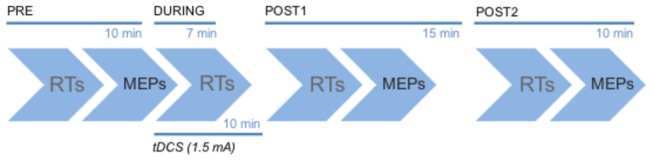
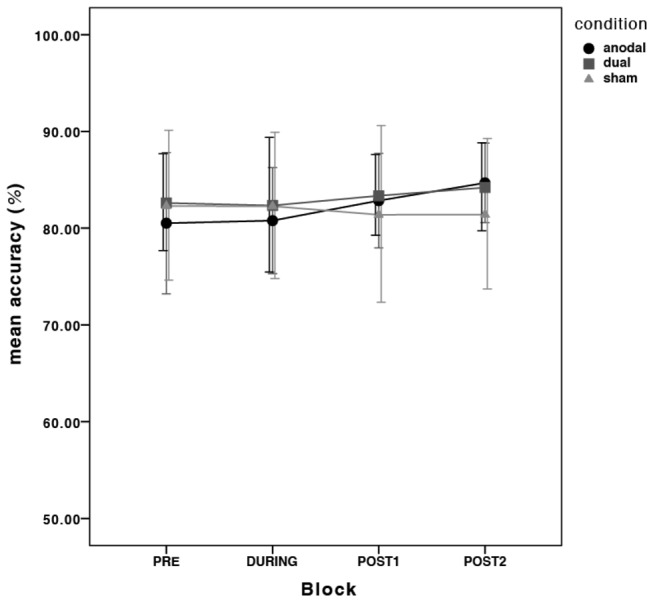
Twenty healthy, right-handed subjects received anodal tDCS to the right M1, dual tDCS (anodal current over right M1 and cathodal over left M1) and sham tDCS in a repeated-measures design. Stimulation was applied for 10 mins at 1.5 mA during an explicit motor learning task. Response times (RT) and accuracy were measured at baseline, during, directly after and 15 mins after stimulation. Motor cortical excitability was recorded from both hemispheres before and after stimulation using single-pulse transcranial magnetic stimulation.
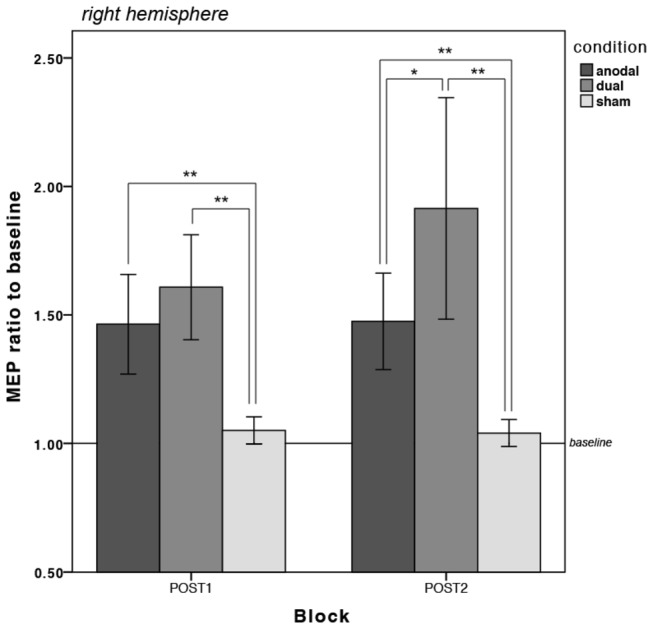
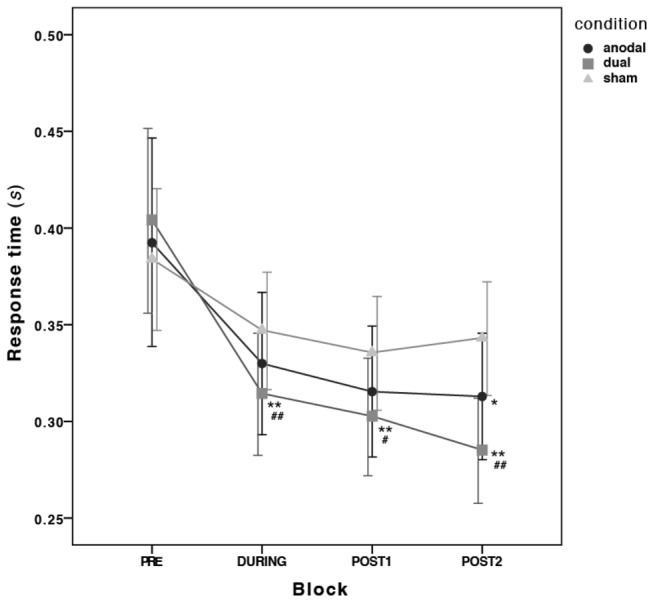
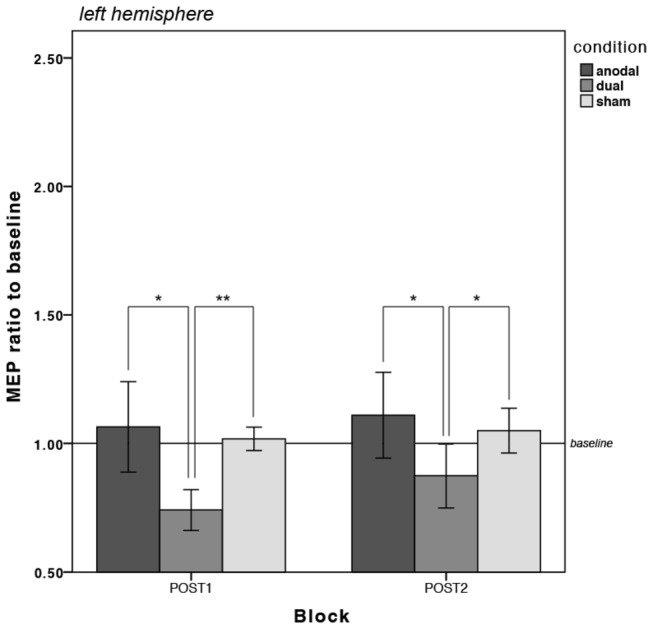
Task-concurrent stimulation with a dual M1 montage significantly reduced RTs by 23% as early as with the onset of stimulation (p<0.01) with this effect increasing to 30% at the final measurement. Polarity-specific changes in cortical excitability were observed with MEPs significantly reduced by 12% in the left M1 and increased by 69% in the right M1.
Performance improvement occurred earliest in the dual M1 condition with a stable and lasting effect. Unilateral anodal stimulation resulted only in trendwise improvement when compared to sham. Therefore, task-concurrent dual M1 stimulation is most suited for obtaining the desired neuromodulatory effects of tDCS in explicit motor learning.
经颅直流电刺激(tDCS)初级运动皮层(M1)对健康受试者的运动表现和运动学习具有有益影响,正成为运动神经康复的一种有前景的工具。最近发现,在进行运动任务的同时施加tDCS比在运动任务之前施加刺激更有效。本研究扩展了这一发现,以检验这种任务同步刺激是否能进一步增强双M1电极片上的运动学习。
20名健康的右利手受试者接受重复测量设计,分别接受右侧M1阳极tDCS、双tDCS(右侧M1阳极电流,左侧M1阴极电流)和假tDCS。在明确的运动学习任务期间,以1.5 mA的电流施加刺激10分钟。在基线、刺激期间、刺激刚结束后和刺激后15分钟测量反应时间(RT)和准确性。使用单脉冲经颅磁刺激在刺激前后记录双侧半球的运动皮层兴奋性。
双M1电极片的任务同步刺激最早在刺激开始时就使RT显著降低了23%(p<0.01),在最终测量时这种效果增加到30%。观察到皮层兴奋性的极性特异性变化,左侧M1的运动诱发电位(MEP)显著降低了12%,右侧M1的MEP增加了69%。
在双M1条件下性能改善出现得最早,且具有稳定和持久的效果。与假刺激相比,单侧阳极刺激仅导致趋势性改善。因此,任务同步双M1刺激最适合在明确的运动学习中获得tDCS所需的神经调节效果。