Weinstain Roy, Savariar Elamprakash N, Felsen Csilla N, Tsien Roger Y
Department of Pharmacology, ‡Department of Chemistry and Biochemistry, and §Howard Hughes Medical Institute, University of California San Diego , La Jolla, California 92093, United States.
J Am Chem Soc. 2014 Jan 22;136(3):874-7. doi: 10.1021/ja411547j. Epub 2014 Jan 8.
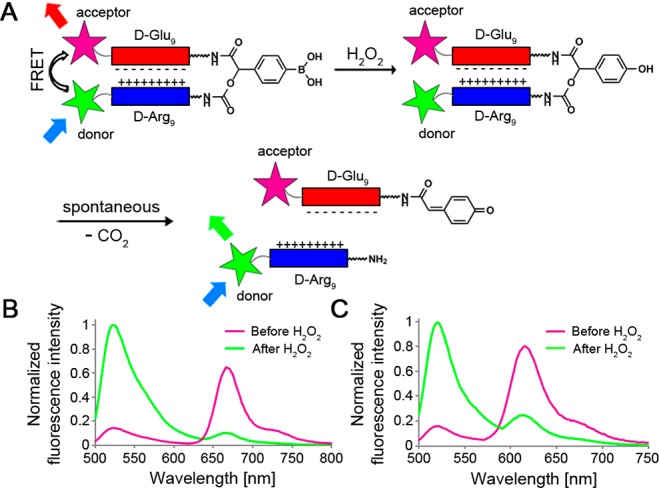
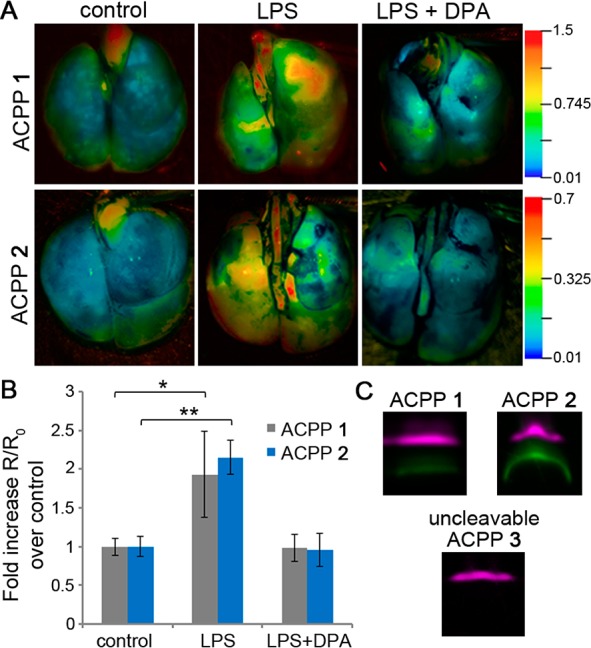
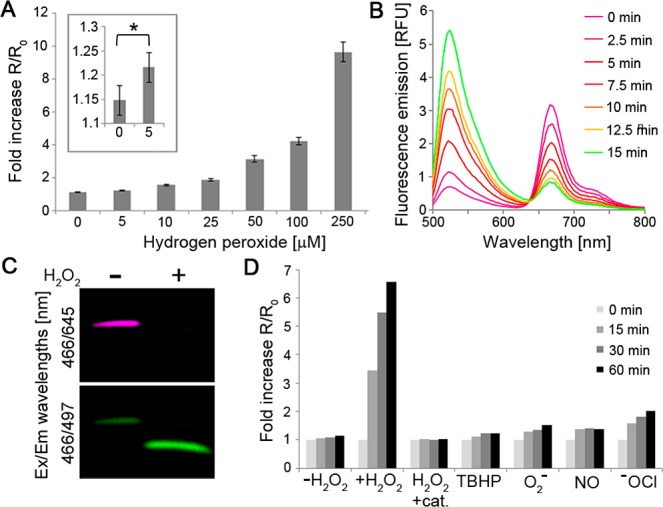
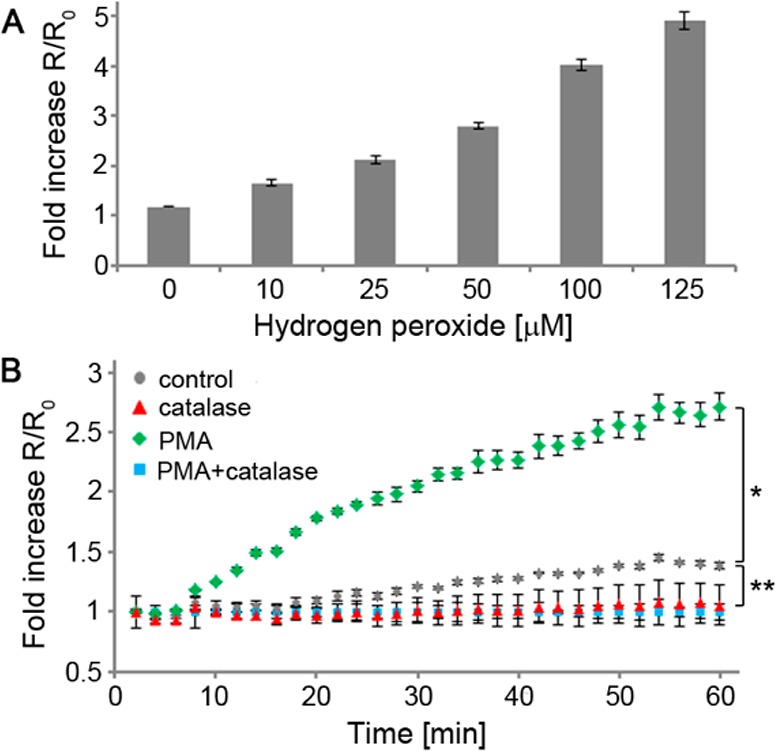
A hydrogen peroxide (H2O2)-activated cell-penetrating peptide was developed through incorporation of a boronic acid-containing cleavable linker between polycationic cell-penetrating peptide and polyanionic fragments. Fluorescence labeling of the two ends of the molecule enabled monitoring its reaction with H2O2 through release of the highly adhesive cell-penetrating peptide and disruption of fluorescence resonance energy transfer. The H2O2 sensor selectively reacts with endogenous H2O2 in cell culture to monitor the oxidative burst of promyelocytes and in vivo to image lung inflammation. Targeting H2O2 has potential applications in imaging and therapy of diseases related to oxidative stress.
通过在聚阳离子细胞穿透肽和聚阴离子片段之间引入含硼酸的可裂解连接子,开发了一种过氧化氢(H2O2)激活的细胞穿透肽。对该分子两端进行荧光标记,可通过释放高粘附性细胞穿透肽和破坏荧光共振能量转移来监测其与H2O2的反应。该H2O2传感器可在细胞培养中与内源性H2O2选择性反应,以监测早幼粒细胞的氧化爆发,并可在体内对肺部炎症进行成像。靶向H2O2在与氧化应激相关疾病的成像和治疗中具有潜在应用。