Korzeniowska Katarzyna, Jarosz-Chobot Przemyslawa, Szypowska Agnieszka, Ramotowska Anna, Fendler Wojciech, Kalina-Faska Barbara, Szadkowska Agnieszka, Mlynarski Wojciech, Mysliwiec Malgorzata
Medical University of Gdansk, Department of Pediatrics, Diabetology and Endocrinology, Gdansk, Poland. E-mail:
J Clin Res Pediatr Endocrinol. 2013;5(4):240-4. doi: 10.4274/Jcrpe.1136.
To investigate if L-thyroxine (T4) treatment may influence the clinical course of autoimmune thyroiditis (AIT) or prevent progression to subclinical or overt hypothyroidism in euthyroid nongoitrous pediatric patients with type 1 diabetes mellitus (T1DM) and AIT.
The study was performed in four Polish pediatric diabetes centers. Of 330 children with T1DM and AIT followed between 2008 and 2012, 101 received L-T4 and 160 underwent clinical observation for 24 months. Thyroid stimulating hormone (TSH), free T4 (fT4), anti thyroid peroxidase antibody (anti-TPO), anti thyroglobulin antibody (anti-TG), glycosylated hemoglobin (HbA1c) levels, and lipid profile were assessed in all patients. Ultrasonographic evaluation was also performed in all children at each examination.
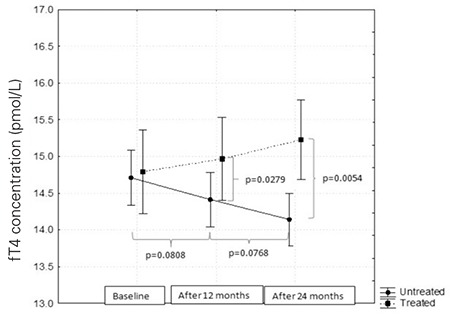
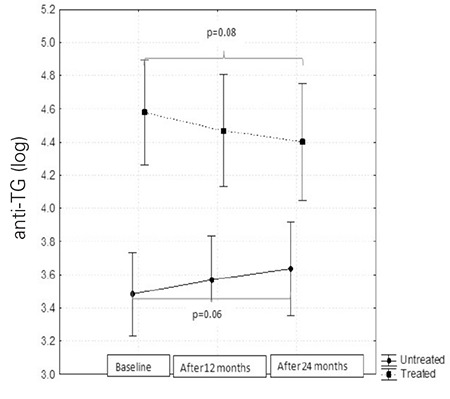
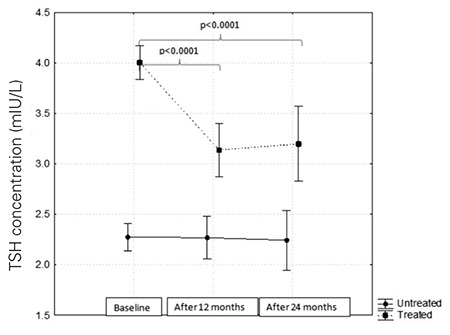
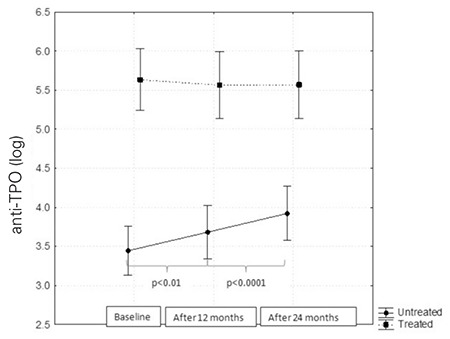
Patients treated with thyroid hormones had higher TSH levels (3.99; interquantile 3.5 to 4.52 vs. 2.09 mIU/L; interquantile 1.55 to 3.06; pp<0.0001). A fall in TSH level (0.87 mIU/L 95% CI 0.43-1.30; pp<0.0001) was documented after the first year of treatment. FT4 level did not differ between the groups at baseline (p=0.7434), but rose in the treatment group and fell in the control group [mean difference 0.78 95% CI-0.22-1.53 pmol/L (p=0.02) after 12 months and 0.98 95% CI 0.04-1.76 (p=0.005) after 24 months]. Higher levels of anti-TPO were initially found in the treated patients (pp<0.0001) and significantly decreased over the 24-month period (pp<0.0001). Children in the treatment group had higher anti-TG levels (pp<0.0001), which showed a borderline decrease (p=0.08) in time. In the control group, anti-TG levels rose marginally (p=0.06) during the study.
The data demonstrate that treatment with L-T4 in euthyroid pediatric patients with T1DM and AIT stabilizes autoimmune inflammation in the thyroid gland and is to be recommended as soon as the diagnosis is established.
探讨左甲状腺素(T4)治疗是否会影响自身免疫性甲状腺炎(AIT)的临床病程,或预防1型糖尿病(T1DM)合并AIT的甲状腺功能正常、无甲状腺肿的儿童患者进展为亚临床或显性甲状腺功能减退。
该研究在四个波兰儿科糖尿病中心进行。在2008年至2012年随访的330例T1DM合并AIT儿童中,101例接受L-T4治疗,160例接受24个月的临床观察。评估所有患者的促甲状腺激素(TSH)、游离T4(fT4)、抗甲状腺过氧化物酶抗体(抗-TPO)、抗甲状腺球蛋白抗体(抗-TG)、糖化血红蛋白(HbA1c)水平和血脂谱。每次检查时还对所有儿童进行超声评估。
接受甲状腺激素治疗的患者TSH水平较高(3.99;四分位数间距3.5至4.52 vs. 2.09 mIU/L;四分位数间距1.55至3.06;p<0.0001)。治疗第一年TSH水平下降(0.87 mIU/L,95%可信区间0.43 - 1.30;p<0.0001)。两组基线时FT4水平无差异(p = 0.7434),但治疗组上升,对照组下降[12个月后平均差异为0.78,95%可信区间 - 0.22至1.53 pmol/L(p = 0.02),24个月后为0.98,95%可信区间0.