Buhl Christof, Knechtle Beat, Rüst Christoph Alexander, Rosemann Thomas, Lepers Romuald
Institute of General Practice and for Health Services Research, University of Zurich, Zurich, Switzerland.
Institute of General Practice and for Health Services Research, University of Zurich, Zurich, Switzerland ; Gesundheitszentrum St Gallen, St Gallen, Switzerland.
Open Access J Sports Med. 2013 Mar 26;4:79-87. doi: 10.2147/OAJSM.S41171. eCollection 2013.
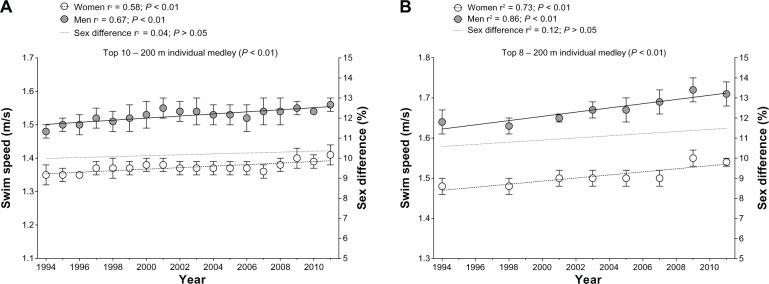
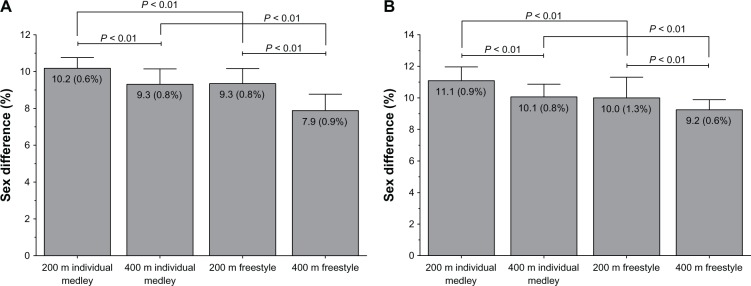
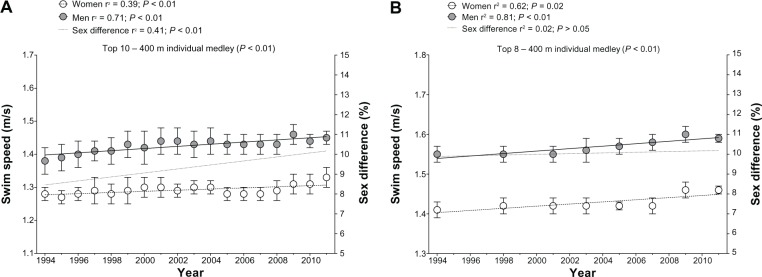
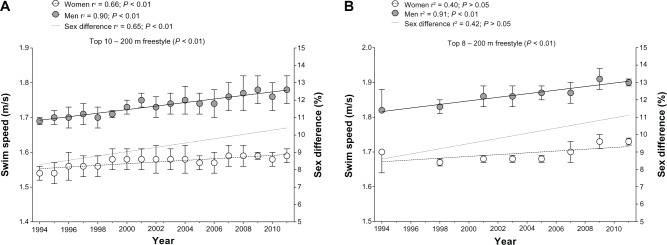
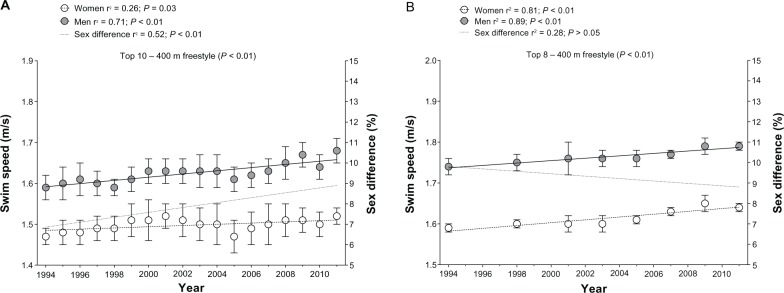
The change in swim performance over time has been investigated for freestyle, but not for other strokes, such as in the medley. The aim of the study was to examine changes in 200 m and 400 m swim performances in medley swimmers at national (Switzerland) and international level (world championship finals) from 1994 to 2011. The 200 m and 400 m freestyle performances were also analyzed for comparison. Swim performances were analyzed using linear regression and one-way analysis of variance. Male Swiss swimmers improved swim speed by 5.4% in the 200 m medley, 5.3% in the 200 m freestyle, 5.1% in the 400 m medley, and 5.7% in the 400 m freestyle (P < 0.01). Female Swiss swimmers improved swim speed by 4.4% in the 200 m medley, 3.3% in the 200 m freestyle, 3.9% in the 400 m medley, and 3.4% in the 400 m freestyle (P < 0.05). Male swimmers at international level improved swim speed by 4.5% in the 200 m medley, 4.6% in the 200 m freestyle, 2.6% in the 400 m medley, and 2.7% in the 400 m freestyle (P < 0.01). Female swimmers improved swim speed by 4.3% in the 200 m medley, 3.5% in the 400 m medley, and 3.1% in the 400 m freestyle (P ≤ 0.02), but 200 m freestyle performance remained unchanged (P > 0.05). The sex difference in national swim performance remained unchanged at 10.2% ± 0.6% for the 200 m medley (P > 0.05) and increased from 8.8% to 9.8% for the 400 m medley (P < 0.05). In freestyle, it increased from 8.8% to 10.7% in the 200 m, and from 7.8% to 9.4% in the 400 m (P < 0.01). The sex difference in international athletes remained unchanged at 11.1% ± 0.9% in the 200 m medley, 10.1% ± 0.8% in the 400 m medley, 10.0% ± 1.3% in the 200 m, and 9.2% ± 0.6% in the 400 m freestyle (P > 0.05). For the 400 m medley, the sex difference was lower compared to the 200 m medley for national (9.3% ± 0.8% vs 10.2% ± 0.6%, P = 0.01) and for international (10.1% ± 0.8% vs 11.1% ± 0.9%) athletes. For the 400 m freestyle, the sex difference was lower compared to the 200 m freestyle for national (7.9% ± 0.9% vs 9.3% ± 0.8%) and international (9.2% ± 0.6% vs 10.0% ± 1.3%) athletes (P < 0.01), and lower in the freestyle than the medley for the same distances (P < 0.01). Future studies should investigate the reasons for the greater sex difference in the medley than the freestyle.
人们已经对自由泳项目中游泳成绩随时间的变化进行了研究,但对于其他泳姿,如混合泳,尚未进行研究。本研究的目的是调查1994年至2011年期间,瑞士国内(瑞士)和国际水平(世界锦标赛决赛)的混合泳运动员在200米和400米游泳项目中的成绩变化。同时,还对200米和400米自由泳的成绩进行了分析,以便进行比较。使用线性回归和单因素方差分析对游泳成绩进行了分析。瑞士男性游泳运动员在200米混合泳中的游泳速度提高了5.4%,在200米自由泳中提高了5.3%,在400米混合泳中提高了5.1%,在400米自由泳中提高了5.7%(P<0.01)。瑞士女性游泳运动员在200米混合泳中的游泳速度提高了4.4%,在200米自由泳中提高了3.3%,在400米混合泳中提高了3.9%,在400米自由泳中提高了3.4%(P<0.05)。国际水平的男性游泳运动员在200米混合泳中的游泳速度提高了4.5%,在200米自由泳中提高了4.6%,在400米混合泳中提高了2.6%,在400米自由泳中提高了2.7%(P<0.01)。女性游泳运动员在200米混合泳中的游泳速度提高了4.3%,在400米混合泳中提高了3.5%,在400米自由泳中提高了3.1%(P≤0.02),但200米自由泳成绩保持不变(P>0.05)。国内游泳成绩的性别差异在200米混合泳中保持在10.2%±0.6%不变(P>0.05),在400米混合泳中从8.8%增加到9.8%(P<0.05)。在自由泳项目中,200米的性别差异从8.8%增加到10.7%,400米的性别差异从7.8%增加到9.4%(P<0.01)。国际运动员的性别差异在200米混合泳中保持在11.1%±0.9%不变,在400米混合泳中为10.1%±0.8%,在200米中为10.0%±1.3%,在400米自由泳中为9.2%±0.6%(P>0.05)。对于400米混合泳,国内(9.3%±0.8%对10.2%±0.6%,P = 0.01)和国际(10.1%±0.8%对11.1%±0.9%)运动员的性别差异低于200米混合泳。对于400米自由泳,国内(7.9%±0.9%对9.3%±0.8%)和国际(9.2%±0.6%对10.0%±1.3%)运动员的性别差异低于200米自由泳(P<0.01),并且在相同距离下,自由泳的性别差异低于混合泳(P<0.01)。未来的研究应该调查混合泳中性别差异大于自由泳的原因。