Jo Kyung Il, Im Young-Hyuck, Kong Doo Sik, Seol Ho Jun, Nam Do-Hyun, Lee Jung-Il
Department of Neurosurgery, Samsung Medical Center, Sungkyunkwan University School of Medicine, Seoul, Korea.
Division of Hematology-Oncology, Department of Medicine, Samsung Medical Center, Sungkyunkwan University School of Medicine, Seoul, Korea.
J Korean Neurosurg Soc. 2013 Nov;54(5):399-404. doi: 10.3340/jkns.2013.54.5.399. Epub 2013 Nov 30.
The authors conducted a retrospective cohort study to determine prognostic factors and treatment outcomes of brain metastases (BM) from breast cancer (BC) after Gamma Knife radiosurgery (GKS).
Pathologic and clinical features, and outcomes were analyzed in a cohort of 62 patients with BM from BC treated by GKS. The Kaplan-Meier method, the log-rank test, and Cox's proportional hazards model were used to assess prognostic factors.
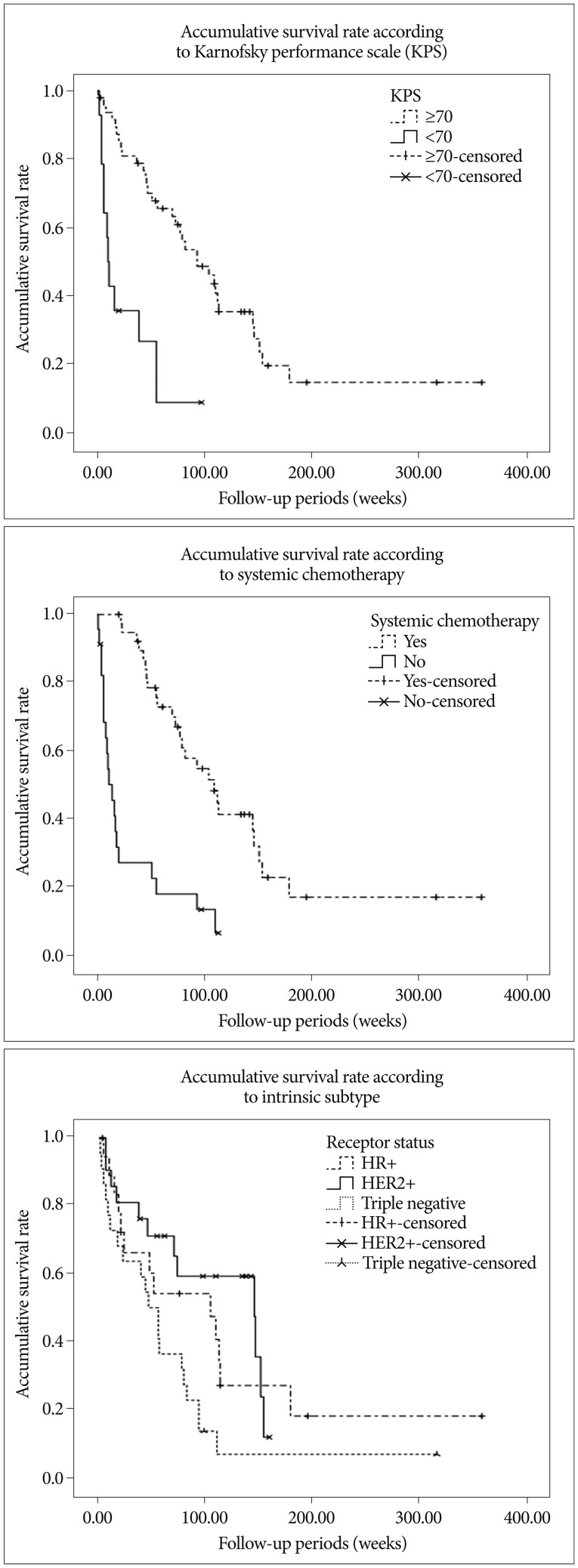
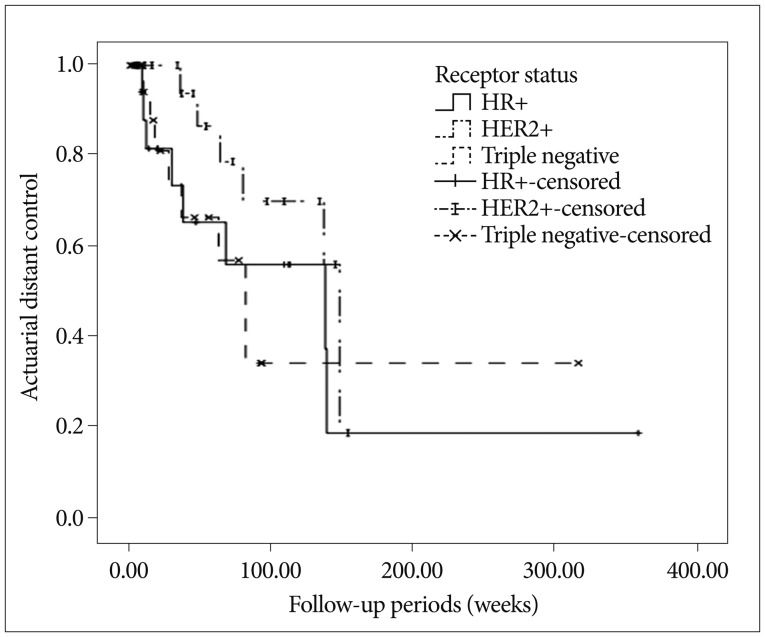
Median survival after GKS was 73.0 weeks (95% confidence interval, 46.0-100.1). HER2+ [hazard ratio (HR) 0.441; p=0.045], Karnofsky performance scale (KPS) ≥70 (RR 0.416; p=0.050) and systemic chemotherapy after GKS (RR 0.282; p=0.001) were found to be a favorable prognostic factor of overall survival. Actuarial local control (LC) rate were 89.5±4.5% and 70.5±6.9% at 6 and 12 months after GKS, respectively. No prognostic factors were found to affect LC rate. Uni- and multivariate analysis revealed that the distant control (DC) rate was higher in patients with; a small number (≤3) of metastasis (HR 0.300; p=0.045), no known extracranial metastasis (p=0.013, log-rank test), or the HER2+ subtype (HR 0.267; p=0.027). Additional whole brain radiation therapy and metastasis volume were not found to be significantly associated with LC, DC, or overall survival.
The treatment outcomes of patients with newly diagnosed BM from BC treated with GKS could be affected primarily by intrinsic subtype, KPS, and systemic chemotherapy. Therapeutic strategy and prognosis scoring system should be individualized based on considerations of intrinsic subtype in addition to traditionally known parameters related to stereotactic radiosurgery.
作者进行了一项回顾性队列研究,以确定伽玛刀放射外科手术(GKS)治疗乳腺癌(BC)脑转移瘤(BM)的预后因素和治疗结果。
分析了62例接受GKS治疗的BC脑转移患者的病理和临床特征及结果。采用Kaplan-Meier法、对数秩检验和Cox比例风险模型评估预后因素。
GKS术后中位生存期为73.0周(95%置信区间,46.0 - 100.1)。发现HER2阳性[风险比(HR)0.441;p = 0.045]、卡诺夫斯基功能状态评分(KPS)≥70(相对风险RR 0.416;p = 0.050)以及GKS术后全身化疗(RR 0.282;p = 0.001)是总生存期的有利预后因素。GKS术后6个月和12个月的精算局部控制(LC)率分别为89.5±4.5%和70.5±6.9%。未发现影响LC率的预后因素。单因素和多因素分析显示,转移灶数量少(≤3个)(HR 0.300;p = 0.045)、无已知颅外转移(p = 0.013,对数秩检验)或HER2阳性亚型(HR 0.267;p = 0.027)的患者远处控制(DC)率较高。未发现额外的全脑放疗和转移灶体积与LC、DC或总生存期有显著相关性。
新诊断的BC脑转移患者接受GKS治疗的结果可能主要受内在亚型、KPS和全身化疗的影响。除了传统上已知的与立体定向放射外科相关的参数外,治疗策略和预后评分系统应基于内在亚型的考虑进行个体化。