Jeong Won Joo, Park Jae Hong, Lee Eun Jung, Kim Jeong Hoon, Kim Chang Jin, Cho Young Hyun
Department of Neurosurgery, Asan Medical Center, University of Ulsan College of Medicine, Seoul, Korea.
Radiosurgery Center, Asan Medical Center, University of Ulsan College of Medicine, Seoul, Korea.
J Korean Neurosurg Soc. 2015 Sep;58(3):217-24. doi: 10.3340/jkns.2015.58.3.217. Epub 2015 Sep 30.
To investigate the efficacy and safety of fractionated stereotactic radiosurgery for large brain metastases (BMs).
Between June 2011 and December 2013, a total of 38 large BMs >3.0 cm in 37 patients were treated with fractionated Cyberknife radiosurgery. These patients comprised 16 men (43.2%) and 21 women, with a median age of 60 years (range, 38-75 years). BMs originated from the lung (n=19, 51.4%), the gastrointestinal tract (n=10, 27.0%), the breast (n=5, 13.5%), and other tissues (n=3, 8.1%). The median tumor volume was 17.6 cc (range, 9.4-49.6 cc). For Cyberknife treatment, a median peripheral dose of 35 Gy (range, 30-41 Gy) was delivered in 3 to 5 fractions.
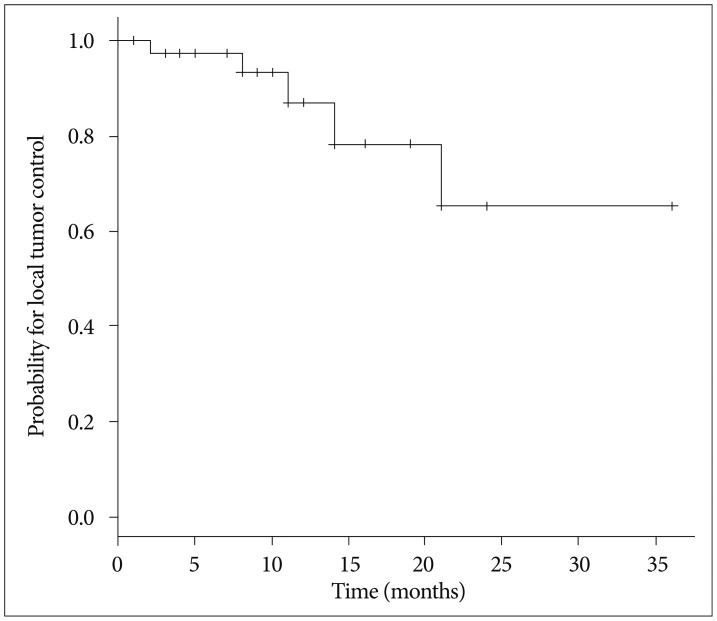
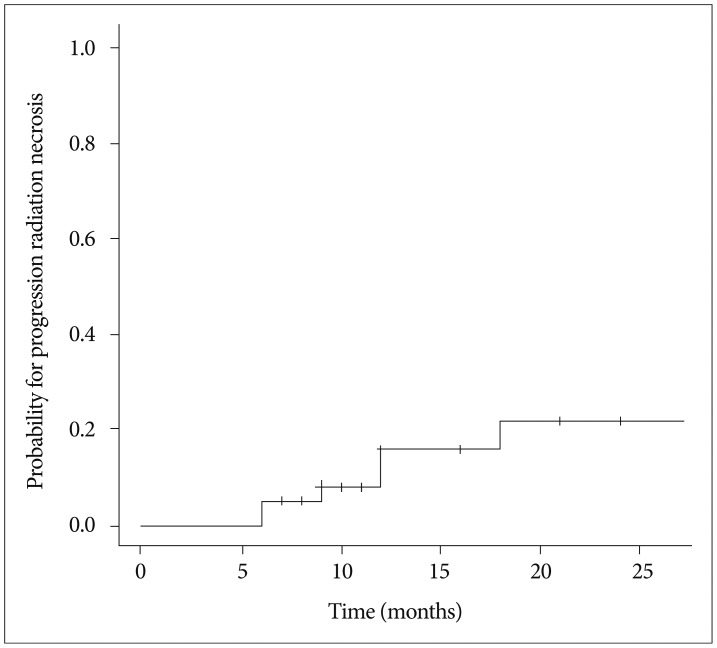
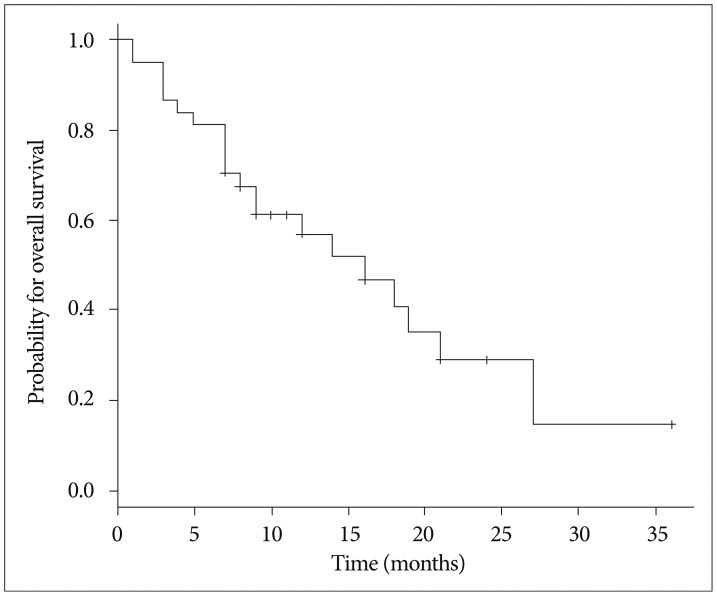
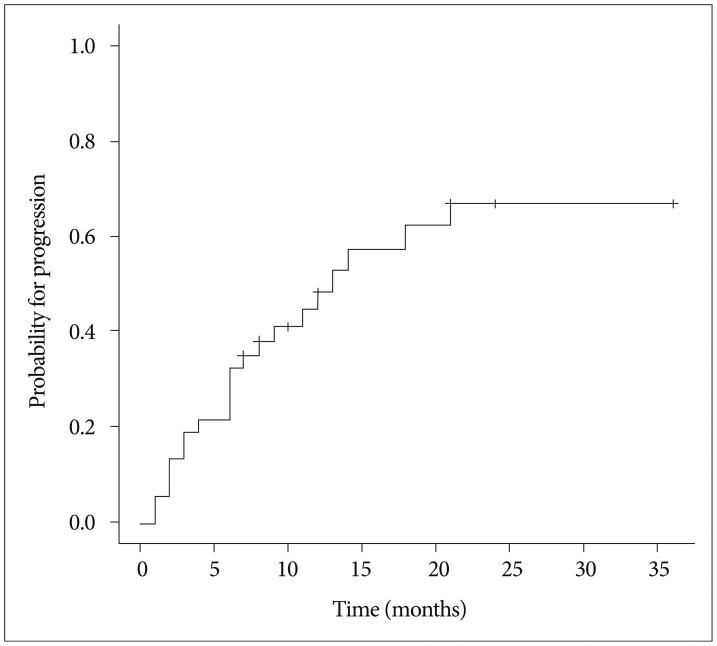
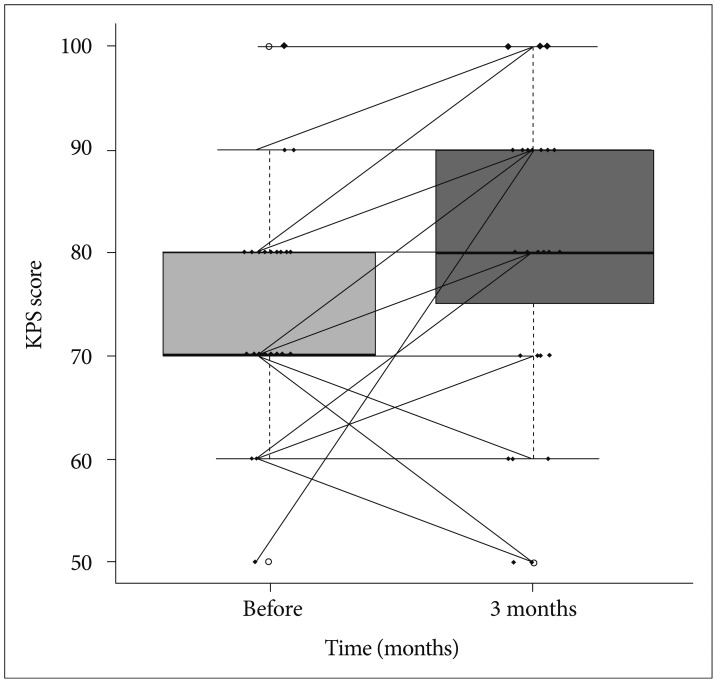
With a median follow-up of 10 months (range, 1-37 months), the crude local tumor control (LTC) rate was 86.8% and the estimated LTC rates at 12 and 24 months were 87.0% and 65.2%, respectively. The median overall survival (OS) and progression-free survival (PFS) rates were 16 and 11 months, respectively. The estimated OS and PFS rates at 6, 12, and 18 months were 81.1% and 65.5%, 56.8% and 44.9%, and 40.7% and 25.7%, respectively. Patient performance status and preoperative focal neurologic deficits improved in 20 of 35 (57.1%) and 12 of 17 patients (70.6%), respectively. Radiation necrosis with a toxicity grade of 2 or 3 occurred in 6 lesions (15.8%).
These results suggest a promising role of fractionated stereotactic radiosurgery in treating large BMs in terms of both efficacy and safety.
探讨分次立体定向放射外科治疗大脑大转移瘤(BMs)的疗效和安全性。
2011年6月至2013年12月,共37例患者的38个直径>3.0 cm的大脑大转移瘤接受了分次射波刀放射外科治疗。这些患者包括16名男性(43.2%)和21名女性,中位年龄为60岁(范围38 - 75岁)。转移瘤起源于肺(n = 19,51.4%)、胃肠道(n = 10,27.0%)、乳腺(n = 5,13.5%)和其他组织(n = 3,8.1%)。中位肿瘤体积为17.6 cc(范围9.4 - 49.6 cc)。对于射波刀治疗,中位周边剂量为35 Gy(范围30 - 41 Gy),分3至5次给予。
中位随访10个月(范围1 - 37个月),粗局部肿瘤控制(LTC)率为86.8%,12个月和24个月时的估计LTC率分别为87.0%和65.2%。中位总生存期(OS)和无进展生存期(PFS)分别为16个月和11个月。6个月、12个月和18个月时的估计OS和PFS率分别为81.1%和65.5%、56.8%和44.9%、40.7%和25.7%。35例患者中的20例(57.1%)患者的表现状态和17例患者中的12例(70.6%)术前局灶性神经功能缺损得到改善。6个病灶(15.8%)发生了毒性分级为2或3级的放射性坏死。
这些结果表明,分次立体定向放射外科在治疗大脑大转移瘤的疗效和安全性方面具有广阔前景。